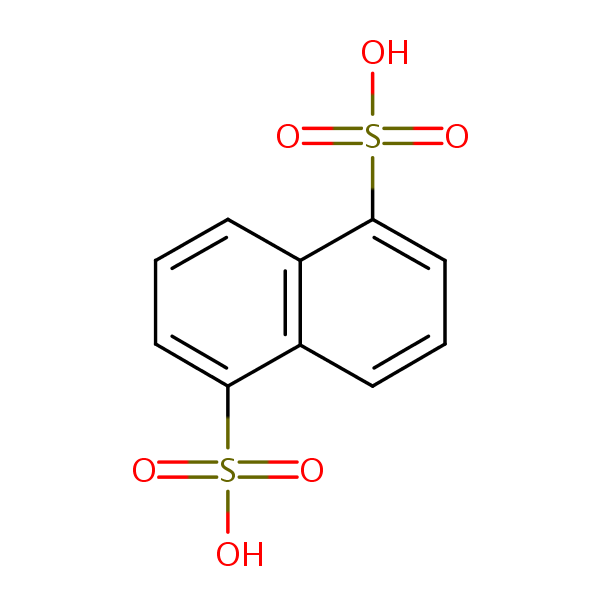
| CAS Number | 81-04-9 |
|---|---|
| Molecular Formula | C10H8O6S2 |
| Molecular Weight | 288.291 |
| InChI Key | XTEGVFVZDVNBPF-UHFFFAOYSA-N |
| LogP | -0.262 |
| Synonyms |
|
Applications:
HPLC Method for Separation of Naphthalene and Sulfonated Naphthalene Compounds on Chromni Column
June 2, 2026
HPLC Method for 1,5-Naphthalenedisulfonic Acid, 2-Naphthalenesulfonic Acid, Naphthalene on Chromni by SIELC Technologies
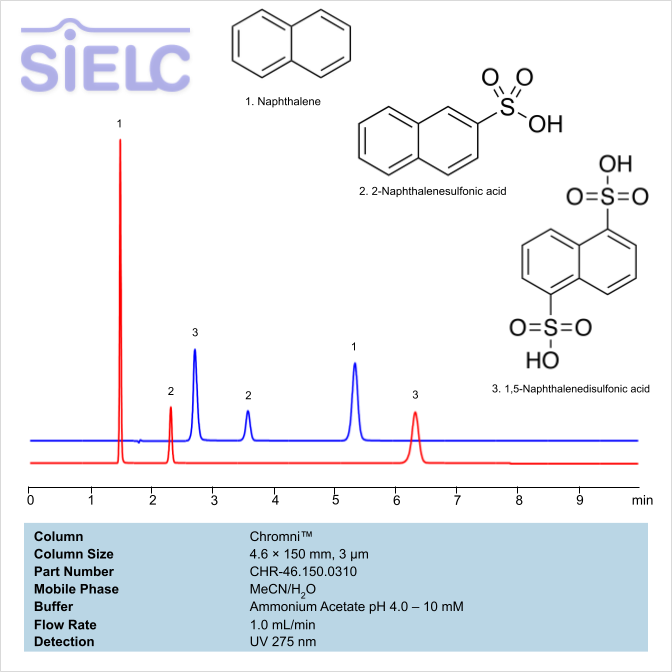
High Performance Liquid Chromatography (HPLC) Method for Analysis of 1,5-Naphthalenedisulfonic Acid, 2-Naphthalenesulfonic Acid, Naphthalene.
Naphthalene is an aromatic hydrocarbon with the chemical formula C10H8. It is primarily used as a precursor to derivative chemicals. The largest use of it is in the industrial production of phthalic anhydride. You can find detailed UV spectra of 1,5-Naphthalenedisulfonic Acid, 2-Naphthalenesulfonic Acid, Naphthalene and information about its various lambda maxima by visiting the following link.
2-Naphthalenesulfonic Acid is an organic compound with the formula C10H7SO3H. It is used primarily in the production of dyes, but has also historically been industrially used for a it’s various chemical reactions.
Armstrong’s acid, also known as is naphthalene-1,5-disulfonic acid, is an acid with the chemical formula C10H6(SO3H)2. It is occasionally used as a divalent counterion for forming salts as an alternative to mesylate and tosylate salts. You can find detailed UV spectra of 1,5-Naphthalenedisulfonic Acid, 2-Naphthalenesulfonic Acid, Naphthalene and information about its various lambda maxima by visiting the following link.
1,5-Naphthalenedisulfonic Acid, 2-Naphthalenesulfonic Acid, Naphthalene can be retained and analyzed using the Chromni stationary phase column. The analysis utilizes an isocratic method with a simple mobile phase consisting of water and acetonitrile (MeCN) with a [buffer] buffer. Detection is performed using UV.
| Column | Chromni, 4.6 x 150 mm, 3 µm, 100 A, dual ended |
| Mobile Phase | MeCN/H2O |
| Buffer | Ammonium Acetate pH 4.0 – 10 mM |
| Flow Rate | 1.0 mL/min |
| Detection | UV 275 nm |
| Class of Compounds | Naphthalene |
| Analyzing Compounds | 1,5-Naphthalenedisulfonic Acid, 2-Naphthalenesulfonic Acid, Naphthalene |
Application Column
Chromni
Column Diameter: 4.6 mm
Column Length: 150 mm
Particle Size: 3 µm
Pore Size: 100 A
Column options: dual ended
2-Naphthalenesulfonic Acid
Naphthalene

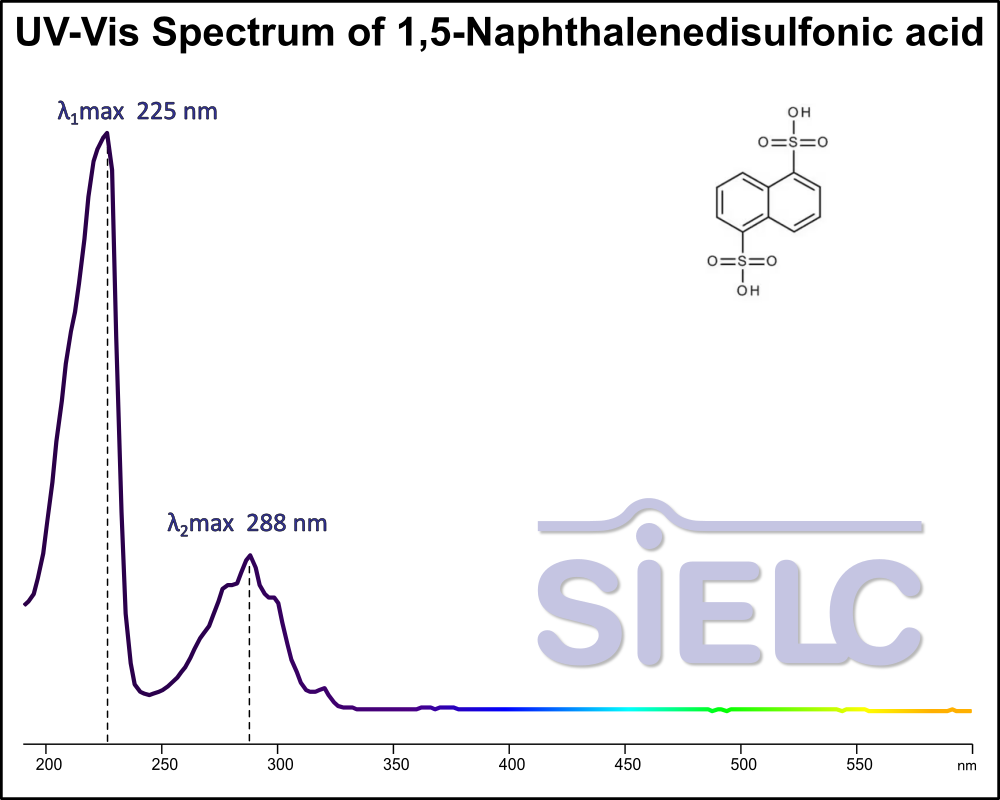
UV-Vis Spectrum of 1,5-Naphthalenedisulfonic Acid
December 19, 2025
If you are looking for optimized HPLC method to analyze 1,5-Naphthalenedisulfonic Acid check our HPLC Applications library
For optimal results in HPLC analysis, it is recommended to measure absorbance at a wavelength that matches the absorption maximum of the compound(s) being analyzed. The UV spectrum shown can assist in selecting an appropriate wavelength for your analysis. Please note that certain mobile phases and buffers may block wavelengths below 230 nm, rendering absorbance measurement at these wavelengths ineffective. If detection below 230 nm is required, it is recommended to use acetonitrile and water as low UV-transparent mobile phases, with phosphoric acid and its salts, sulfuric acid, and TFA as buffers.
For some compounds, the UV-Vis Spectrum is affected by the pH of the mobile phase. The spectra presented here are measured with an acidic mobile phase that has a pH of 3 or lower.
HPLC Method for Analysis of 2 – Naphthalenesulfonic acid and 1,5 -Naphthalenedisulfonic acid on BIST A Column
December 1, 2022
HPLC Method for Analysis of 2-Naphthalenesulfonic Acid, 1,5-Naphthalenedisulfonic Acid on BIST A Column by SIELC Technologies
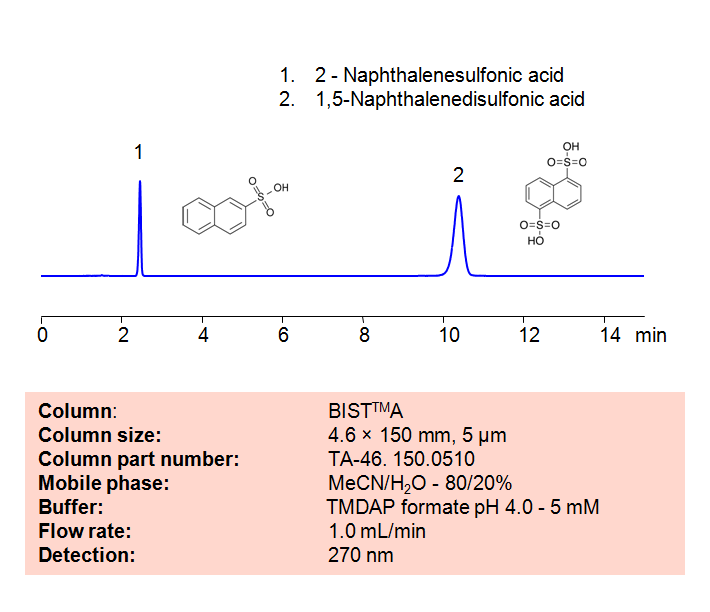
2-Naphthalenesulfonic acid and 1,5-Naphthalenedisulfonic acid, also known as Armstrong’s acid, are two similarly-structured compounds. 2-Naphthalenesulfonic acid is commonly used in dye production and 1,5-Naphthalenedisulfonic acid is used in synthesizing the salts of basic drugs and in electrokinetic chromatography.
2-Naphthalenesulfonic Acid is an organic compound with the formula C10H7SO3H. It is used primarily in the production of dyes, but has also historically been industrially used for a it’s various chemical reactions.
1,5-Naphthalenedisulfonic acid is a strong organic acid with a double charge. It has the chemical formula C10H8S2O6.
Using SIELC’s newly introduced BIST™ method, these two acids can be retained on a negatively-charged, cation-exchange BIST A. There are two keys to this retention method: 1) a multi-charged, positive buffer, such as N,N,N’,N’-Tetramethyl-1,3-propanediamine (TMDAP), which acts as a bridge, linking the negatively-charged tartrazine analytes to the negatively-charged column surface and 2) a mobile phase consisting mostly of organic solvent to minimize the formation of a solvation layer around the charged analytes. Using this new and unique analysis method, 2-Naphthalenesulfonic acid and 1,5-Naphthalenedisulfonic acid can be retained and UV detected at 270 nm.
Condition
| Column | BIST A, 4.6 x 150 mm, 5 µm, 100 A, dual ended |
| Mobile Phase | MeCN – 80/20% |
| Buffer | TMDAP formate pH 4.0 – 5,0 mM |
| Flow Rate | 1.0 ml/min |
| Detection | 270 nm |
Description
| Class of Compounds | Acid, Sulfonic acid |
| Analyzing Compounds | 2-Naphthalenesulfonic Acid, 1,5-Naphthalenedisulfonic Acid |
Application Column
BIST A
Column Diameter: 4.6 mm
Column Length: 150 mm
Particle Size: 5 µm
Pore Size: 100 A
Column options: dual ended
2-Naphthalenesulfonic Acid
HPLC Determination of 1,5-Naphthalenedisulfonic Acid on Newcrom B Column
March 2, 2021
HPLC Method for 1,5-Naphthalenedisulfonic Acid on Newcrom B by SIELC Technologies
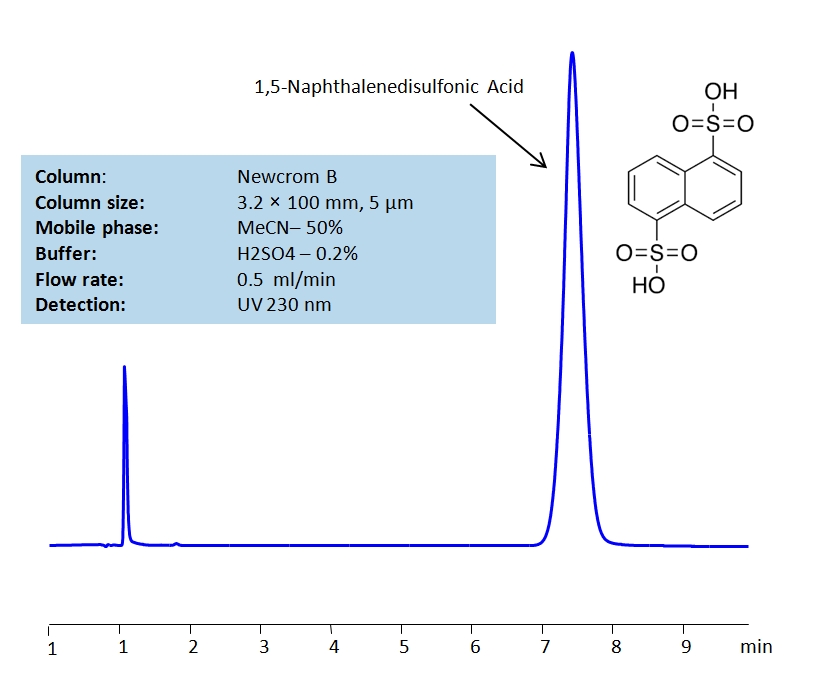
| Column | Newcrom B, 3.2 x 100 mm, 5 µm, 100 A, dual ended |
| Mobile Phase | MeCN/H2O – 50/50% |
| Buffer | H2SO4 – 0.2% |
| Flow Rate | 0.5 ml/min |
| Detection | UV 230nm |
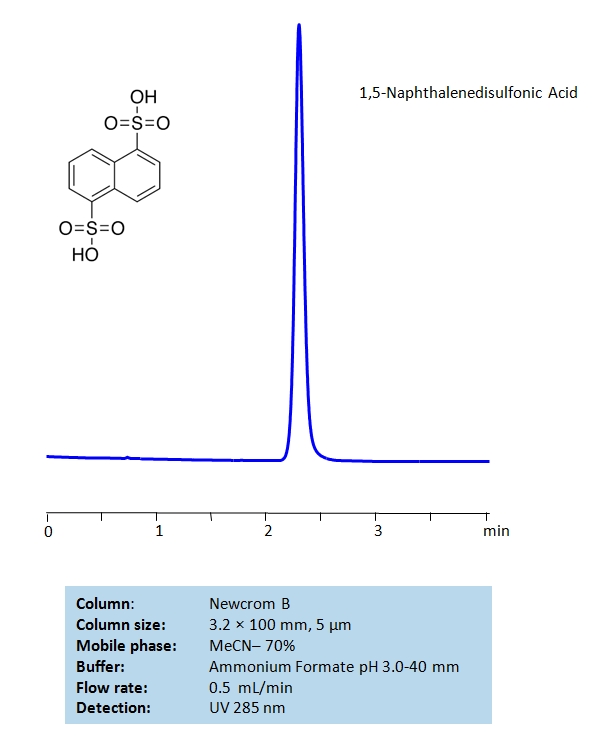
High Performance Liquid Chromatography (HPLC) Method for Analysis of 1,5-Naphthalenedisulfonic Acid.
1,5-Naphthalenedisulfonic acid, also known as Armstrong’s acid, is a strong organic acid with a double charge. It has the chemical formula C10H8S2O6.
Multi-charged molecules generally have a tendency to exhibit poor peak shape in HPLC on reverse-phase columns showing significant tailing. 1,5-Naphthalenedisulfonic Acid can be retained with great peak shape on a Newcrom B mixed-mode column. The Newcrom line of columns was designed specifically for improved peak shape of multi-charged molecules. The method uses a mobile phase consisting of acetonitrile (ACN), water and ammonium formate buffer, making the method MS-compatible. UV detection at 260nm can also be used.
| Column | Newcrom B, 3.2 x 100 mm, 5 µm, 100 A, dual ended |
| Mobile Phase | MeCN/H2O – 70/30% |
| Buffer | Ammonium Formate pH 3.0 – 40 mM |
| Flow Rate | 0.5 ml/min |
| Detection | UV 285 nm |
| Class of Compounds | Acid |
| Analyzing Compounds | 1,5-Naphthalenedisulfonic Acid |
Application Column
Newcrom B
Column Diameter: 3.2 mm
Column Length: 100 mm
Particle Size: 5 µm
Pore Size: 100 A
Column options: dual ended
HPLC Determination of 1,5-Naphthalenedisulfonic Acid on Newcrom BH Column
June 25, 2020
HPLC Method for 1,5-Naphthalenedisulfonic Acid on Newcrom BH by SIELC Technologies
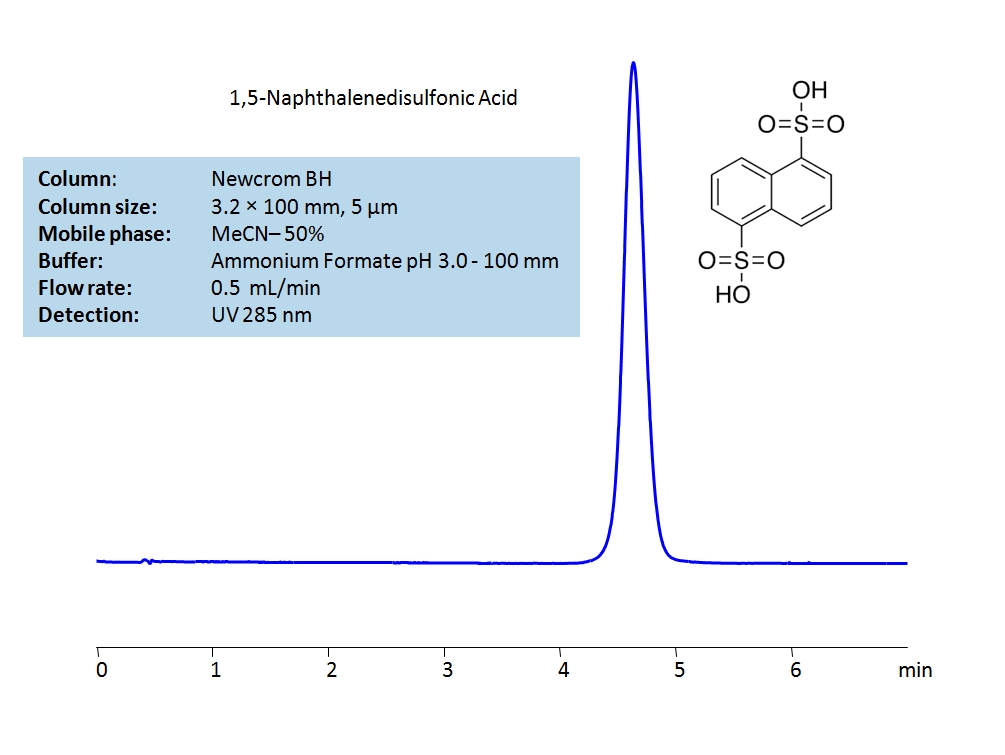
High Performance Liquid Chromatography (HPLC) Method for Analysis of 1,5-Naphthalenedisulfonic Acid.
1,5-Naphthalenedisulfonic acid is a strong organic acid with a double charge. Multi-charged molecules generally have a tendency to exhibit poor peak shape in HPLC on reverse-phase columns showing significant tailing. The acid can be retained with great peak shape on a Newcrom BH mixed-mode column. The Newcrom line of columns was designed specifically for improved peak shape of multi-charged molecules. The method uses a mobile phase consisting of acetonitrile (ACN), water and ammonium formate buffer, making the method MS-compatible. UV detection at 260nm can also be used.
| Column | Newcrom BH, 3.2 x 100 mm, 5 µm, 100 A, dual ended |
| Mobile Phase | MeCN/H2O – 50/50% |
| Buffer | Ammonium Formate – 100 mM, pH 3.0 |
| Flow Rate | 0.5 ml/min |
| Detection | UV 285 nm |
| Class of Compounds | Acid |
| Analyzing Compounds | 1,5-Naphthalenedisulfonic Acid |
Application Column
Newcrom BH
Column Diameter: 3.2 mm
Column Length: 100 mm
Particle Size: 5 µm
Pore Size: 100 A
Column options: dual ended
HPLC Separation of Organic Acids in HILIC and Anion-Exclusion Mode on Primesep S2 Column
July 14, 2011
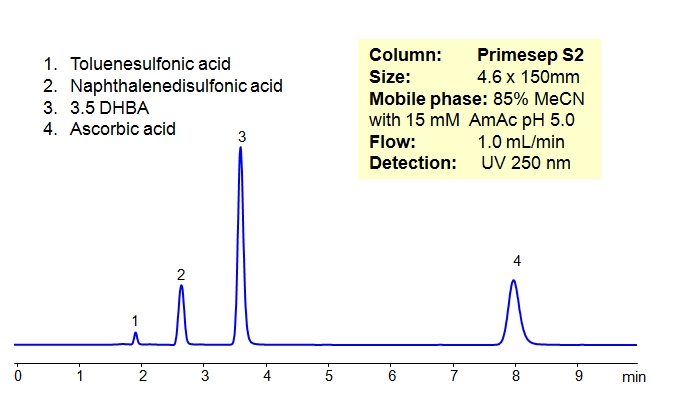
Organic acids were separated on a HILIC/cation-exchange column in HILIC/anion-exclusion mode. This column can be used for analysis of polar compounds in HILIC mode. If compounds are ionizable, additional mode of interaction can be added (cation-exchange or anion-exclusion).
| Column | Primesep S2, 4.6×150 mm, 5 µm, 100A |
| Mobile Phase | MeCN/H2O – 85/15% |
| Buffer | AmAc pH 5.0 15 mM |
| Flow Rate | 1.0 ml/min |
| Detection | ELSD, 50C UV 250 nm |
| Class of Compounds |
Nucleosides, Hydrophilic, Ionizable |
| Analyzing Compounds | Toluenesulfonic acid, Naphthalenedisulfonic acid, 3.5 DHBA, Ascorbic acid, |
Application Column
Primesep S2
The Primesep family of mixed-mode columns offers a wide variety of stationary phases, boasting unprecedented selectivity in the separation of a broad array of chemical compounds across multiple applications. Corresponding Primesep guard columns, available with all stationary phases, do not require holders. SIELC provides a method development service available to all customers. Inquire about our specially-tailored custom LC-phases for specific separations.
Select options3,5-Dihydroxybenzoic Acid
Ascorbic Acid
Organic Acids
p-Toluenesulfonic Acid (PTSA)
HILIC Retention of 1,5-Naphthalenedisulfonic Acid on Obelisc N Mixed-Mode HILIC Columns
July 16, 2009
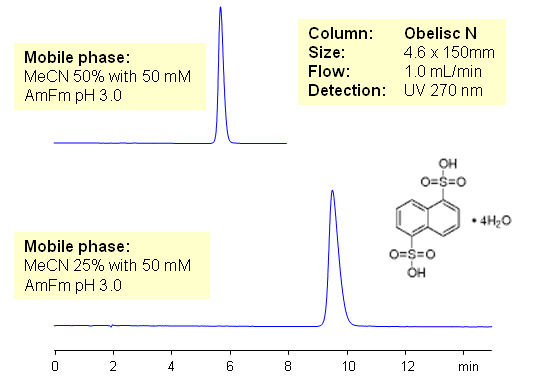
Naphthalenedisulfonic acid is retained by anion-exchange mechanism on Obelisc N mixed-mode HILIC column. Retention time is controlled by amount of ion in the mobile phase. Method demonstrates very good peak shape and controllable retention. This mixed-mode approach can be used for quantitation of various sulfonic acid in different matrices. UV, ELSD or LC/MS can be used for quantitation.
| Column | Obelisc N , 4.6×150 mm, 5 µm, 100A |
| Mobile Phase | MeCN/H2O |
| Buffer | AmFm pH 3.0 |
| Flow Rate | 1.0 ml/min |
| Detection | UV, 270 nm |
| Class of Compounds |
Acid |
| Analyzing Compounds | 1,5-Naphthalenedisulfonic Acid |
Application Column
Obelisc N
SIELC has developed the Obelisc™ columns, which are mixed-mode and utilize Liquid Separation Cell technology (LiSC™). These cost-effective columns are the first of their kind to be commercially available and can replace multiple HPLC columns, including reversed-phase (RP), AQ-type reversed-phase, polar-embedded group RP columns, normal-phase, cation-exchange, anion-exchange, ion-exclusion, and HILIC (Hydrophilic Interaction Liquid Chromatography) columns. By controlling just three orthogonal method parameters - buffer concentration, buffer pH, and organic modifier concentration - users can adjust the column properties with pinpoint precision to separate complex mixtures.
Select optionsSulfonic Acid
UV Detection
