
| CAS Number | 107-43-7 |
|---|---|
| Molecular Formula | C5H11NO2 |
| Molecular Weight | 117.148 |
| InChI Key | KWIUHFFTVRNATP-UHFFFAOYSA-N |
| LogP | -2.72 |
| Synonyms |
|
Applications:
HPLC Method for Separation of Glycine, Methylglycine, Dimethylglycine and Trimethylglycine on Primesep 100 Column
December 10, 2025
HPLC Method for Dimethylglycine, Methylglycine (Sarcosine), Trimethylglycine (Betaine), Glycine on Primesep 100 by SIELC Technologies
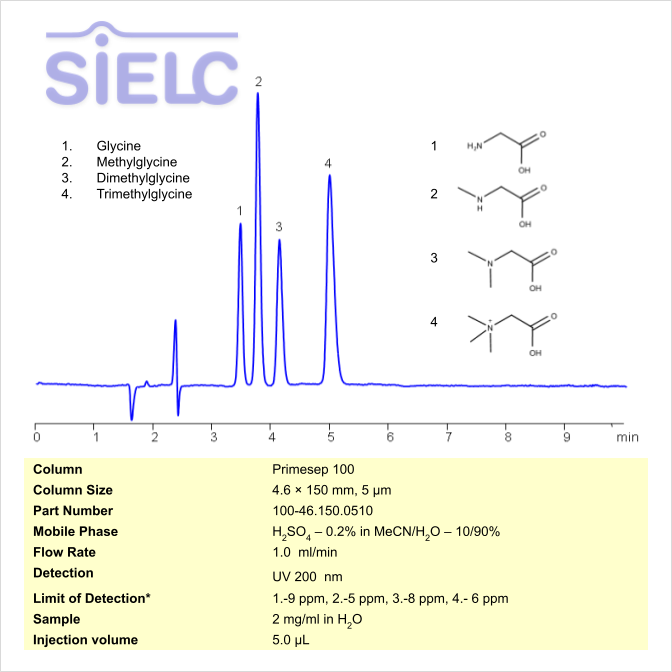
High Performance Liquid Chromatography (HPLC) Method for Analysis of Dimethylglycine, Methylglycine (Sarcosine), Trimethylglycine (Betaine), Glycine.
Glycine, also written as Gly or G, is an important amino acid compounds widely used in pharmaceutical, biochemical, and peptide research. It has the chemical formula C₂H₅NO₂. It is water-soluble and plays a critical role in protein synthesis, peptide modification, and metabolic studies. It can be found in meat., eggs. and bones. You can find detailed UV spectra of Glycine and information about its various lambda maxima by visiting the following link.
Methylglycine, also known as Sarcosine, is an amino acid with the chemical formula C3H7NO2. It is primarily known as a potential disease marker, as it does not typically occur in urine, but it is an intermediate and byproduct of glycine synthesis and degradation. You can find detailed UV spectra of Methylglydine and information about its various lambda maxima by visiting the following link.
Dimethylglycine is a derivative of glycine with the chemical formula C4H9NO2. While it is found primarily in beans and liver, it is said to have a sweet taste. There has been research done into using Dimethylglycine as treatment for autism, epilepsy, and mitochondrial disease, though no evidence to suggest it’s effectiveness as a treatment was found. You can find detailed UV spectra of Dimethylglycine and information about its various lambda maxima by visiting the following link.
Trimethylglycine, also known as betaine, is a compound derived from the amino acid glycine with the chemical formula C5H11NO2. It is found in various foods, including beets, spinach, whole grains, and seafood. Trimethylglycine has been studied for its potential health benefits, and it is commonly used as a dietary supplement. It plays a role in a process called methylation, which is important for various biochemical reactions in the body. Some studies suggest that trimethylglycine may have potential benefits for heart health as it is believed to help lower levels of homocysteine, an amino acid linked to an increased risk of heart disease when present in high concentrations. You can find detailed UV spectra of Trimethylglycine and information about its various lambda maxima by visiting the following link.
Multi-charged molecules, such as oxaloacetate and oxalate, generally have a tendency to exhibit poor peak shape on reverse-phase HPLC columns, where they show significant tailing. Dimethylglycine, Methylglycine (Sarcosine), Trimethylglycine (Betaine), Glycine can be retained with great peak shape on a Newcrom BH mixed-mode column. Oxalic acid can be measured at low UV. Using a Newcrom BH mixed-mode column and a mobile phase consisting of acetonitrile (ACN) and water with sulfuric acid (H2SO4) buffer, oxaloacetic acid and oxalic acid can be retained, separated, and UV detected at 200 nm with precise resolution.
| Column | Primesep 100, 4.6 x 150 mm, 5 µm, 100 A, dual ended |
| Mobile Phase | MeCN/H2O |
| Buffer | H2SO4- 2% |
| Flow Rate | 1.0 ml/min |
| Detection | UV, 200 nm |
| Class of Compounds | Amino Acids |
| Analyzing Compounds | Dimethylglycine, Methylglycine (Sarcosine), Trimethylglycine (Betaine), Glycine |
Application Column
Primesep 100
Column Diameter: 4.6 mm
Column Length: 150 mm
Particle Size: 5 µm
Pore Size: 100 A
Column options: dual ended
Glycine
Methylglycine (Sarcosine)
Trimethylglycine (Betaine)

UV-Vis Spectrum of Betaine
July 30, 2025
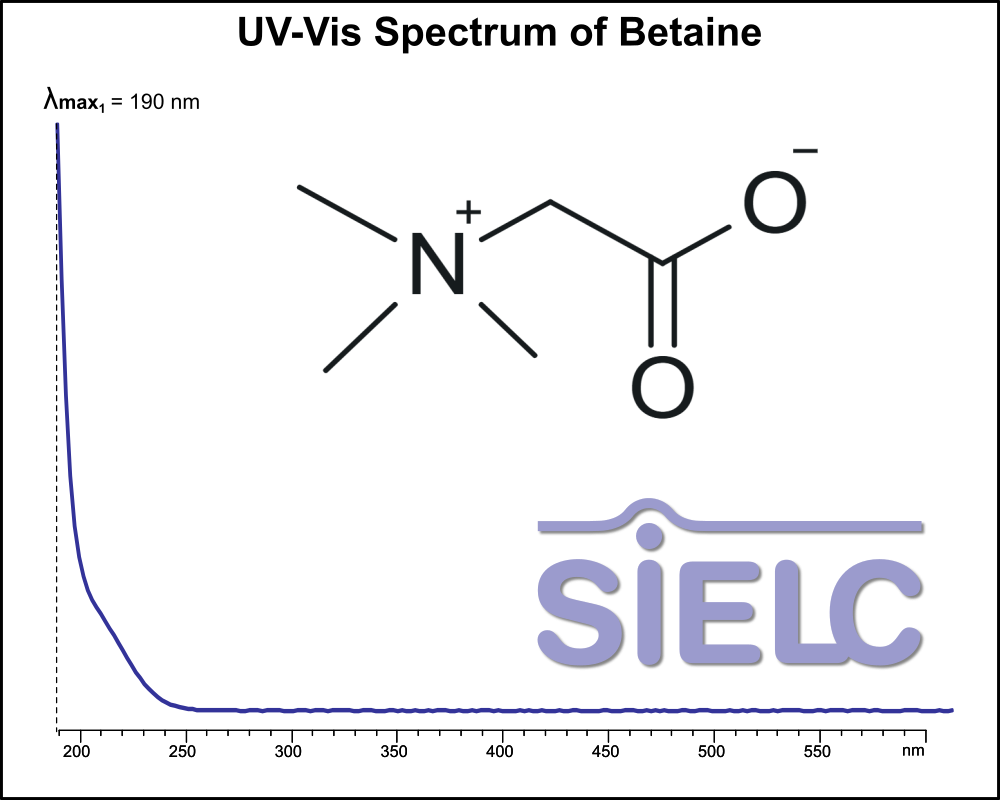
If you are looking for optimized HPLC method to analyze Trimethylglycine (Betaine) check our HPLC Applications library
For optimal results in HPLC analysis, it is recommended to measure absorbance at a wavelength that matches the absorption maximum of the compound(s) being analyzed. The UV spectrum shown can assist in selecting an appropriate wavelength for your analysis. Please note that certain mobile phases and buffers may block wavelengths below 230 nm, rendering absorbance measurement at these wavelengths ineffective. If detection below 230 nm is required, it is recommended to use acetonitrile and water as low UV-transparent mobile phases, with phosphoric acid and its salts, sulfuric acid, and TFA as buffers.
For some compounds, the UV-Vis Spectrum is affected by the pH of the mobile phase. The spectra presented here are measured with an acidic mobile phase that has a pH of 3 or lower.
HPLC MS Method for Analysis of Trimethylglycine (Betaine) on Primesep 100 Column
January 18, 2024
HPLC Method for Analysis of Trimethylglycine (Betaine) on Primesep 100 by SIELC Technologies
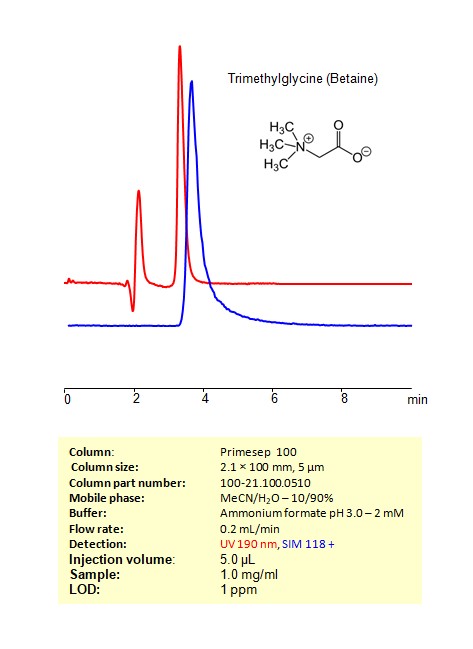
High Performance Liquid Chromatography (HPLC) Method for Analysis of Trimethylglycine (Betaine)
Trimethylglycine, also known as betaine, is a compound derived from the amino acid glycine. It is found in various foods, including beets, spinach, whole grains, and seafood. Trimethylglycine has been studied for its potential health benefits, and it is commonly used as a dietary supplement.
Methylation Support: Trimethylglycine plays a role in a process called methylation, which is important for various biochemical reactions in the body. Methylation is involved in the synthesis of neurotransmitters, DNA, and proteins.Heart Health: Some studies suggest that trimethylglycine may have potential benefits for heart health. It is believed to help lower levels of homocysteine, an amino acid linked to an increased risk of heart disease when present in high concentrations.
Exercise Performance: There is some evidence suggesting that trimethylglycine supplementation may enhance exercise performance. It is thought to improve oxygen utilization and reduce fatigue during physical activity.
Liver Health: Trimethylglycine has been investigated for its potential to support liver health. It may help protect the liver from certain forms of damage.
Anti-Inflammatory Properties: Some studies propose that trimethylglycine may have anti-inflammatory effects, which could be beneficial in various health conditions.
Trimethylglycine can be retained and analyzed using a Primesep 100 mixed-mode stationary phase column. The analysis employs an isocratic method with a simple mobile phase consisting of water, acetonitrile (MeCN), and ammonium formate as a buffer. Detection is achieved using UV at 190 nm and SIM 118+
| Column | Primesep 100, 2.1 x 100 mm, 5 µm, 100 A, dual ended |
| Mobile Phase | MeCN/H2O – 10/90% |
| Buffer | Ammonium formate pH 3.0 – 2 mM |
| Flow Rate | 0.2 ml/min |
| Detection | UV 190 nm, SIM 188+ |
| Samples | 1 mg/mL |
| Injection volume | 1 µl |
| LOD* | 1 ppm |
| Class of Compounds | Quaternary ammonium |
| Analyzing Compounds | Trimethylglycine (Betaine) |
Application Column
Primesep 100
Column Diameter: 2.1 mm
Column Length: 100 mm
Particle Size: 5 µm
Pore Size: 100 A
Column options: dual ended
HPLC Method for Analysis of Trimethylglycine (Betaine) on Primesep 100 Column
January 17, 2024
HPLC Method for Analysis of Trimethylglycine (Betaine) on Primesep 100 by SIELC Technologies
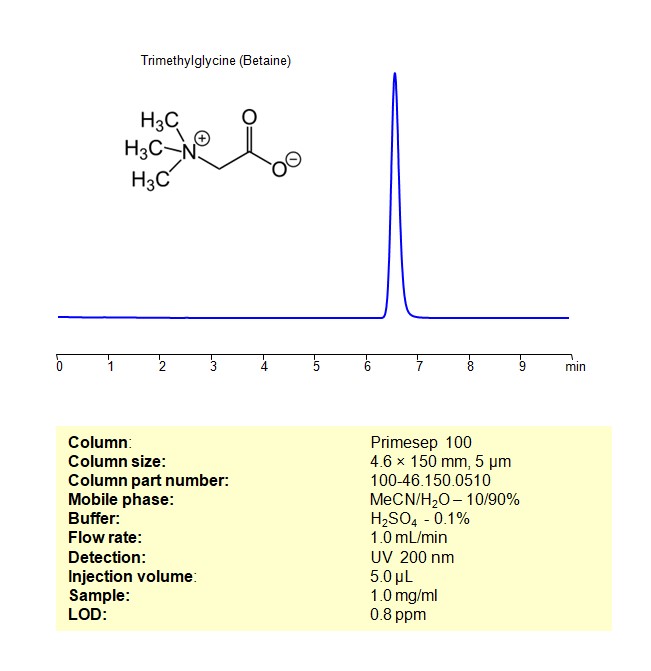
High Performance Liquid Chromatography (HPLC) Method for Analysis of Trimethylglycine (Betaine)
Trimethylglycine, also known as betaine, is a compound derived from the amino acid glycine. It is found in various foods, including beets, spinach, whole grains, and seafood. Trimethylglycine has been studied for its potential health benefits, and it is commonly used as a dietary supplement.
Methylation Support: Trimethylglycine plays a role in a process called methylation, which is important for various biochemical reactions in the body. Methylation is involved in the synthesis of neurotransmitters, DNA, and proteins.Heart Health: Some studies suggest that trimethylglycine may have potential benefits for heart health. It is believed to help lower levels of homocysteine, an amino acid linked to an increased risk of heart disease when present in high concentrations.
Exercise Performance: There is some evidence suggesting that trimethylglycine supplementation may enhance exercise performance. It is thought to improve oxygen utilization and reduce fatigue during physical activity.
Liver Health: Trimethylglycine has been investigated for its potential to support liver health. It may help protect the liver from certain forms of damage.
Anti-Inflammatory Properties: Some studies propose that trimethylglycine may have anti-inflammatory effects, which could be beneficial in various health conditions.
Trimethylglycine be retained and analyzed using a Primesep 100 mixed-mode stationary phase column. The analysis employs an isocratic method with a simple mobile phase comprising water, acetonitrile (MeCN), and sulfuric acid as a buffer. This method allows for detection using UV at 200 nm
| Column | Primesep 100, 4.6 x 150 mm, 5 µm, 100 A, dual ended |
| Mobile Phase | MeCN/H2O – 10/90% |
| Buffer | H2SO4 -0.2% |
| Flow Rate | 1.0 ml/min |
| Detection | UV 200 nm |
| Samples | 1 mg/mL |
| Injection volume | 5 µl |
| LOD* | 0.8 ppm |
| Class of Compounds | Aromatic amines, Ureas |
| Analyzing Compounds | Trimethylglycine (Betaine) |
Application Column
Primesep 100
Column Diameter: 4.6 mm
Column Length: 150 mm
Particle Size: 5 µm
Pore Size: 100 A
Column options: dual ended
HILIC Separation of Carboxymethylcysteine and Betaine
August 22, 2008
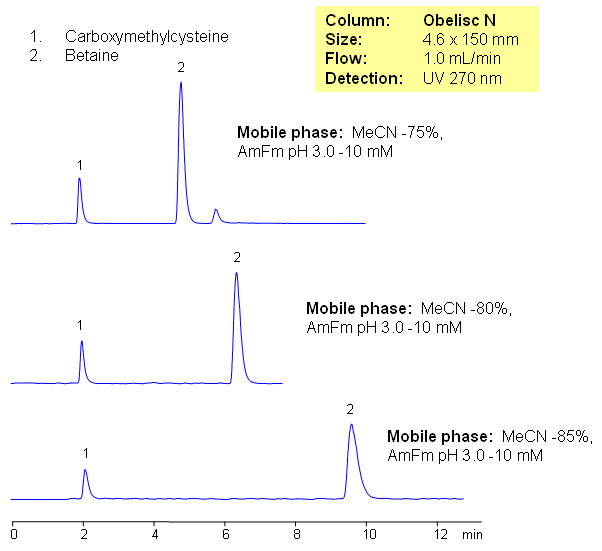
In this HPLC method, betaine and carboxymethylcysteine are separated by HILIC mixed-mode mechanism. Betaine and carboxymethylcysteine are very hydrophilic compounds which are not retained on reverse phase columns. Compounds are separated by combination of HILIC and ion-exchange mechanisms. In HIILIC mode, Obelisc N columns allow operating at lower organic concentration for improved solubility of analytes. Method can be used for quantitative or qualitative analysis of betaine and carboxymethylcysteine using ESLD or LC/MS detection. Betaine in chemistry is any neutral chemical compound with a positively charged cationic functional group such as ammonium ion or phosphonium ion (generally: onium ions) which bears no hydrogen atom and with a negatively charged functional group such as a carboxylate group which may not be adjacent to the cationic site. Historically the term was reserved for tetramethylglycine only.
Application Column
Obelisc N
SIELC has developed the Obelisc™ columns, which are mixed-mode and utilize Liquid Separation Cell technology (LiSC™). These cost-effective columns are the first of their kind to be commercially available and can replace multiple HPLC columns, including reversed-phase (RP), AQ-type reversed-phase, polar-embedded group RP columns, normal-phase, cation-exchange, anion-exchange, ion-exclusion, and HILIC (Hydrophilic Interaction Liquid Chromatography) columns. By controlling just three orthogonal method parameters - buffer concentration, buffer pH, and organic modifier concentration - users can adjust the column properties with pinpoint precision to separate complex mixtures.
Select optionsTrimethylglycine (Betaine)
UV Detection
Retention Characteristics of Betaine in Mixed-Mode HPLC
May 5, 2005

The retention of the zwitterion betaine on Primesep 200 demonstrates the tunability of Primesep columns. Retention of betaine is altered by acid type, amount of acid in the mobile phase, and the amount of organic solvent. Typical reversed-phase columns do not show this tunability with simple mass spec compatible mobile phases of water, acetonitrile (MeCN, ACN) and trifluoracetic acid (TFA) with evaporative light scattering detection (ELSD).
Application Column
Primesep 200
The Primesep family of mixed-mode columns offers a wide variety of stationary phases, boasting unprecedented selectivity in the separation of a broad array of chemical compounds across multiple applications. Corresponding Primesep guard columns, available with all stationary phases, do not require holders. SIELC provides a method development service available to all customers. Inquire about our specially-tailored custom LC-phases for specific separations.
Select optionsTrimethylglycine (Betaine)
Zwitterion
