| CAS Number | 16887-00-6 |
|---|---|
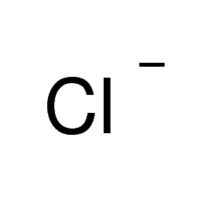
| Molecular Formula | Cl |
| Molecular Weight | 35.450 |
| InChI Key | VEXZGXHMUGYJMC-UHFFFAOYSA-M |
| LogP | 0.0 |
| Synonyms |
|
Applications:
HPLC Method for Analysis of Inorganic anions on BIST™A+ Column
July 7, 2022
| Separation type: Bridge Ion Separation Technology, or BIST™ | ||||||||||||||
|
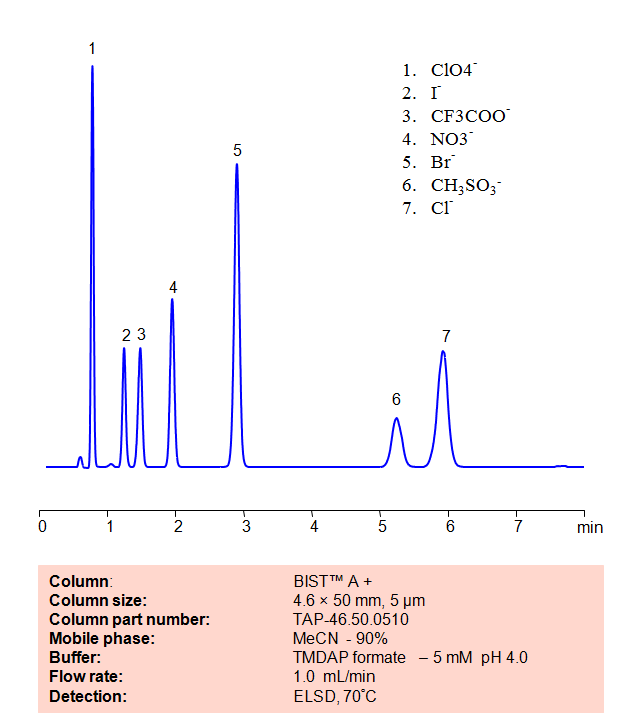 | ||||||||||||||
| High Performance Liquid Chromatography (HPLC) Method for Analysis of Inorganic anions, Chloride, Bromide, Nitrate, Iodide, Perchlorate
Using SIELC’s newly introduced BIST™ method, a mixture of many different inorganic anions can be separated on a negatively-charged, cation-exchange BIST™ A column, contrary to conventional chromatographic wisdom. There are two keys to this retention method: 1) a multi-charged, positive buffer, such as N,N,N’,N’-Tetramethyl-1,3-propanediamine (TMDAP), which acts as a bridge, linking the negatively-charged anion analytes to the negatively-charged column surface and 2) a mobile phase consisting mostly of organic solvent (such as MeCN) to minimize the formation of a solvation layer around the charged analytes. Other positively-charged buffers that can generate BIST™ include Calcium acetate and Magnesium acetate. Using this new and unique analysis method, these anions can be separated, retained, and detected through ELSD. This method is also compatible with Mass Spectrometry. | ||||||||||||||
|
Application Column
BIST A+
Column Diameter: 4.6 mm
Column Length: 50 mm
Particle Size: 10 µm
Pore Size: 100 A
Column options: dual ended
Chloride
Iodide
Methanesulfonic Acid
Nitrate
Perchlorate
TFA (Trifluoroacetic Acid)

HPLC Determination of Chloride, Chlorate and Perchlorate on Newcrom B Column
December 10, 2019
HPLC Method for Chlorate, Perchlorate, Sodium Chlorate, Chloride on Newcrom B by SIELC Technologies
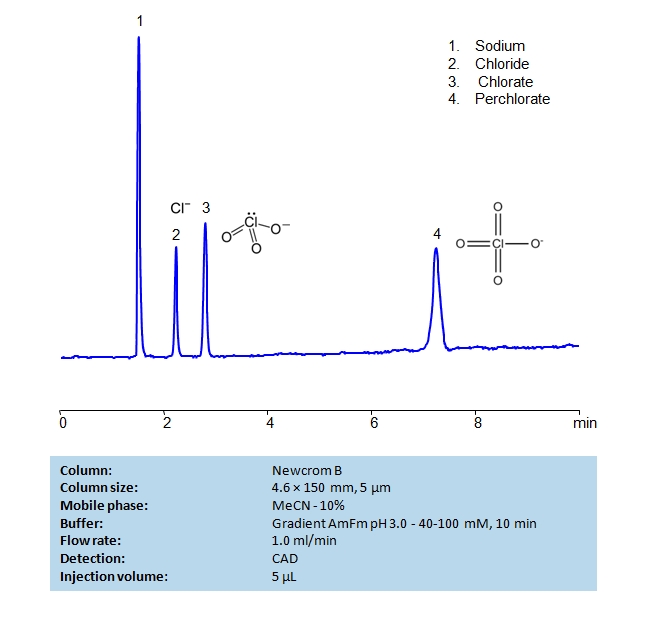
High Performance Liquid Chromatography (HPLC) Method for Analysis of Chlorate, Perchlorate, Sodium Chlorate, Chloride
Main source of contamination of environment by perchlorates are rocket fuels, car airbags, and fireworks.
EPA developed regulation of the perchlorate level in drinking water which already adapted by several states.HPLC analysis of [compound] with Newcrom B. Includes separation method, chromatogram, and mobile phase.
The most convenient, universal and very sensitive way to measure perchlorate is chromatography.
SIELC developed a simple, rugged, and selective HPLC method which allows to measure perchlorate in different matrices including drinking water.
This method allows to measure simultaneously other chloro containing ions such as chloride, and chlorate.
The method shows high selectivity and specificity.
The mobile phase is a simple mixture of water acetonitrile and ammonium formate.
The column used in the analysis has advanced surface chemistry with long chain holding a terminal positively changed functional group.
| Column | Newcrom B, 4.6 x 150 mm, 5 µm, 100 A, dual ended |
| Mobile Phase | MeCN/H2O – 10/90% |
| Buffer | Gradient AmFm pH 3.0 – 40-100 mM , 10 min |
| Flow Rate | 1.0 ml/min |
| Detection | CAD |
| Class of Compounds | Ions, Hydrophilic, Ionizable |
| Analyzing Compounds | Chlorate, Perchlorate, Sodium Chlorate, Chloride |
Application Column
Newcrom B
Column Diameter: 4.6 mm
Column Length: 150 mm
Particle Size: 5 µm
Pore Size: 100 A
Column options: dual ended
Chloride
Perchlorate
Sodium Chlorate
HPLC Separation of Inorganic Anions on Newcrom BH Column
October 23, 2019
HPLC Method for Sodium, Phosphate, Chloride, Bromide, Nitrate, Sulfate, Iodine, Perchlorate, Iodide on Newcrom BH by SIELC Technologies
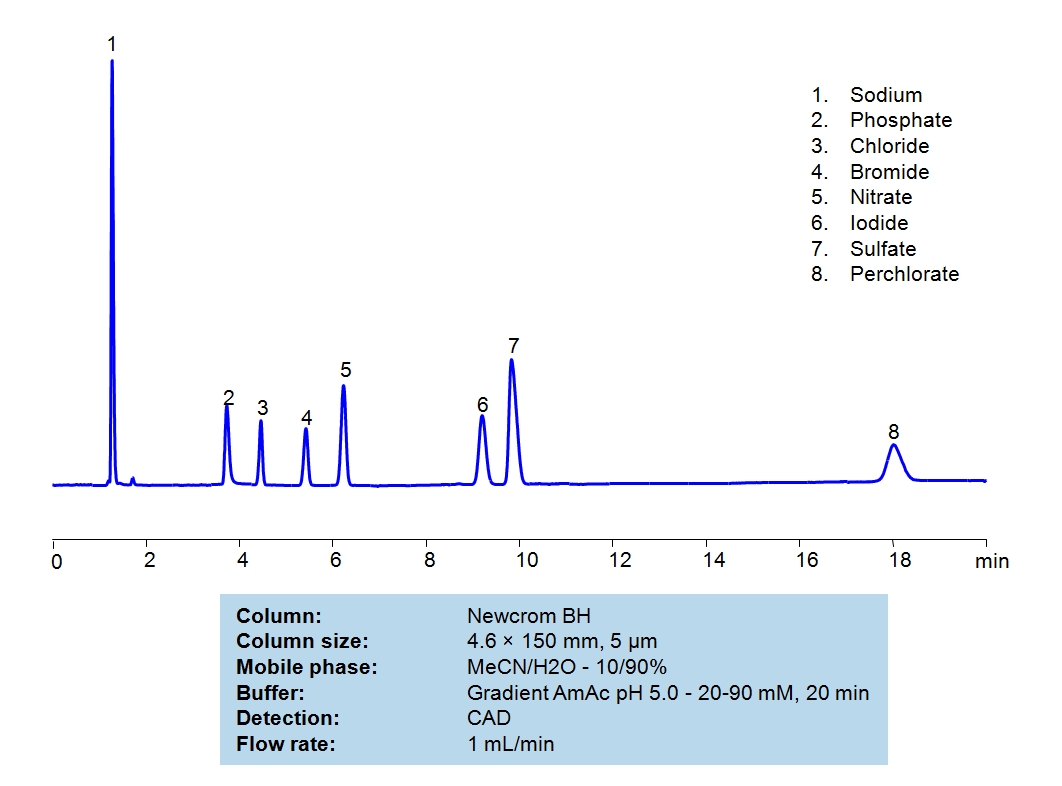
High Performance Liquid Chromatography (HPLC) Method for Analysis of Sodium, Phosphate, Chloride, Bromide, Nitrate, Sulfate, Iodine, Perchlorate, Iodide
Sodium, which has a chemical symbol of Na, is a soft alkali metal that is highly reactive. It is found in abundance in everyday materials like table salt, sea water, and even the Earth’s crust. It is crucial for the body’s function and fluid balance.
Phosphate, PO43-, is a compound that plays an important part in biological energy transfer. It contains phosphorus, which is also a key component in bones and teeth. It is also a buffer, which helps maintain pH levels in a body.
Chloride is typically used to refer to a compound or molecule that contains a chlorine anion: Cl–. It is an electrolyte that is essential for bodily functions including blood pH, fluid balance, cellular functions, and more. Imbalance of chloride can indicate underlying health problems.
Bromide is typically used to refer to a compound or molecule that contains a bromide anion: Br–. It is often found in anticonvulsants, flame-retardant materials, and cell stains.
Nitrate, NO3–, is a compound of nitrogen and oxygen. It is essential as a nutrient in plants; therefore, it is often used in fertilizers. It is easily found in leafy greens. While it is important for cardiovascular health, too high of exposure to it can be dangerous.
Iodide, the Ionic form of Iodine, I– is essential for thyroid hormone production. Lack of it can lead to iodine deficiency disorders. It is typically found in Iodized salt and occasionally as an antiseptic.
Sulfate is an ionic chemical with the formula SO42-. In nature, it is usually found in geodes like gypsum. It is also created in atmosphere from sulfur dioxide. It is used for a variety of applications, but most notably, coloring wood and creating light-reflecting paints.
Perchlorate is an inorganic compound with the formula ClO4–. It is most typically used for explosives. For example, fireworks and rocket propellants. Due to it’s water solubility, it can easily contaminate it. When ingested, it can pose a health risk and cause developmental harm.
Sodium, Phosphate, Chloride, Bromide, Nitrate, Sulfate, Iodine, Perchlorate, Iodide can be retained and analyzed using the Newcrom BH stationary phase column. The analysis utilizes an isocratic method with a simple mobile phase consisting of water and acetonitrile (MeCN) with a Ammonium Acetate buffer. Detection is performed using CAD.
| Column | Newcrom BH, 4.6 x 150 mm, 5 µm, 100 A, dual ended |
| Mobile Phase | MeCN/H2O – 10/90% |
| Buffer | Gradient AmAc pH 5.0 – 20-90 mM , 20 min |
| Flow Rate | 1.0 ml/min |
| Detection | CAD (Corona) (MS-compatible mobile phase) |
Application Column
Newcrom BH
Column Diameter: 4.6 mm
Column Length: 150 mm
Particle Size: 5 µm
Pore Size: 100 A
Column options: dual ended
Chloride
Iodide
Iodine
Nitrate
Perchlorate
Phosphate
Sodium
Sulfate
Separation of Paraquat, Diguat, and Glyphosate on Obelisc R Column
July 3, 2013
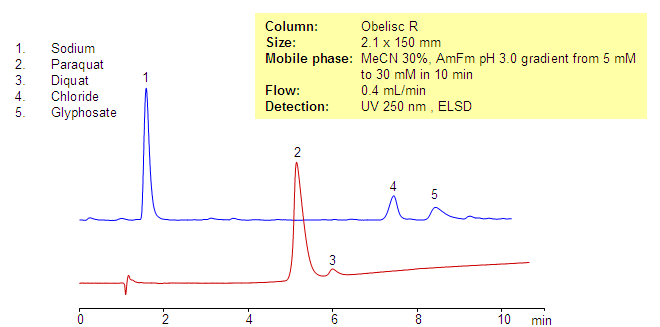
Paraquat, diquat and glyphosate are three of most widely used herbicides in the world. Paraquat and diquat are very polar and very basic quaternary amines. Glyphosate is an aminophosphonic analog of glycine. It is very polar and acidic at most of the pH of the mobile phase. Since glyphosate and the quats have opposite charges no ion-pairing method can be developed for the mixture of basic and acidic herbicides. All three herbicides were separated on the Obelisc R tri-modal column. Paraquat and diquat are retained by a cation-exchange mechanism, and glyphosate is retained by weak reversed-phase and strong anion-exchange mechanisms. This method can be used for analysis of common herbicides in fruits, vegetables, ground water, drinking water and other matrices. Method is LC/MS compatible and can be used to determine trace levels of herbicides.
| Column | Obelisc R, 2.1×150 mm, 5 µm, 100A |
| Mobile Phase | MeCN – 30% |
| Buffer | Gradient AmFm pH 3.0 – 5-30 mM, 10 min |
| Flow Rate | 0.4 ml/min |
| Detection | UV, 250 nm, ELSD |
| Class of Compounds |
Insecticide, Herbicide, Fungicide, Hydrophobic, Ionizable |
| Analyzing Compounds | Paraquat, Diquat, Glyphosate |
Application Column
Obelisc R
SIELC has developed the Obelisc™ columns, which are mixed-mode and utilize Liquid Separation Cell technology (LiSC™). These cost-effective columns are the first of their kind to be commercially available and can replace multiple HPLC columns, including reversed-phase (RP), AQ-type reversed-phase, polar-embedded group RP columns, normal-phase, cation-exchange, anion-exchange, ion-exclusion, and HILIC (Hydrophilic Interaction Liquid Chromatography) columns. By controlling just three orthogonal method parameters - buffer concentration, buffer pH, and organic modifier concentration - users can adjust the column properties with pinpoint precision to separate complex mixtures.
Select optionsDiquat
Glyphosate
Paraquat
Sodium
UV Detection
HPLC Separation of Mepiquat on Obelisc R Column
July 8, 2011
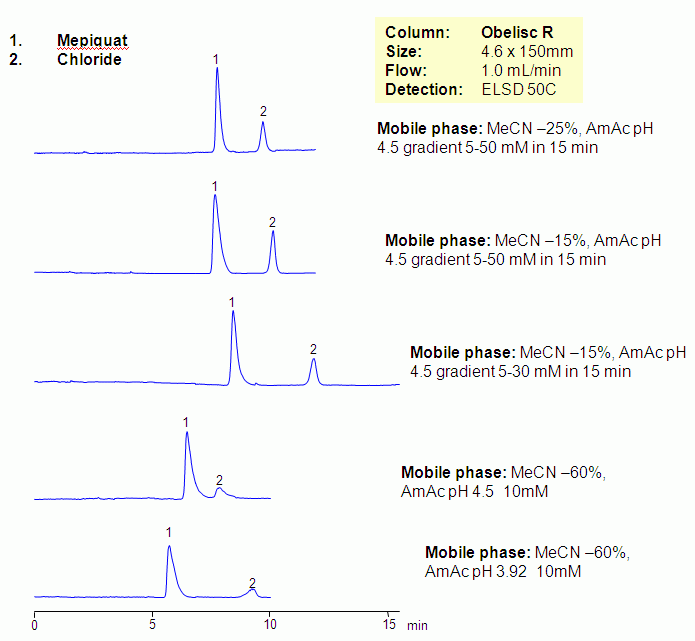
Mepiquat is a plant growth regulator that is monitored by EPA in water. It is a quaternary amine that is very polar in nature. Mepiquat and other hydrophilic amines are not retained on reversed-phase columns, and produce poor peak shape due to residual silanol interactions. Ion-pairing reagent is required to retain mepiquat. Ion-pairing reagents are not compatible with LC/MS detection and most environmental application require high sensitivity methods to determine very low level of contaminants. Obelisc R mixed-mode column can be used for EPA methods for determination of common pesticides, herbicides and insecticides where analysis of very polar ionic compounds is required.
| Column | Obelisc R, 4.6×50 mm, 5 µm, 100A |
| Mobile Phase | MeCN/H2O |
| Buffer | AmAc |
| Flow Rate | 1.0 ml/min |
| Detection | ELSD 50C |
| Class of Compounds |
Grow regulator, Hydrophilic, Ionizable |
| Analyzing Compounds | Mepiquat, Chloride |
Application Column
Obelisc R
SIELC has developed the Obelisc™ columns, which are mixed-mode and utilize Liquid Separation Cell technology (LiSC™). These cost-effective columns are the first of their kind to be commercially available and can replace multiple HPLC columns, including reversed-phase (RP), AQ-type reversed-phase, polar-embedded group RP columns, normal-phase, cation-exchange, anion-exchange, ion-exclusion, and HILIC (Hydrophilic Interaction Liquid Chromatography) columns. By controlling just three orthogonal method parameters - buffer concentration, buffer pH, and organic modifier concentration - users can adjust the column properties with pinpoint precision to separate complex mixtures.
Select optionsMepiquat
HPLC Separation of Sodium, Chloride, Bromide, and Iodine
November 21, 2010
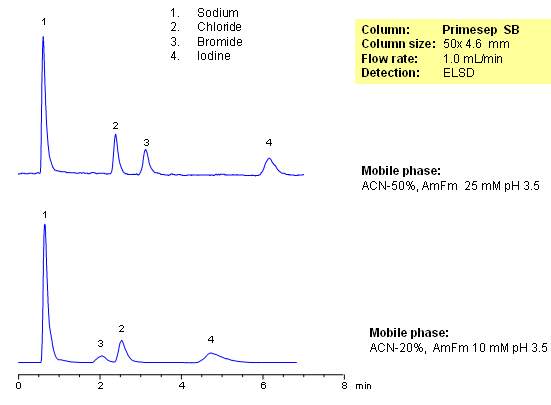
Halide ions are usually analyzed by ion-chromatography with a conductivity detector. Mixed-mode chromatography in combination with ELSD is offering a valuable alternative to ion-chromatography with conductivity detection. Chloride, bromide and iodide were separated on a Primesep SB mixed-mode anion-exchange column. Mobile phase is compatible with ELSD and LC/MS.
| Column | Primesep SB, 4.6×50 mm, 5 µm, 100A |
| Mobile Phase | MeCN/H2O |
| Buffer | AmFm |
| Flow Rate | 1.0 ml/min |
| Detection | ELSD |
| Class of Compounds |
Hydrophilic, Ions |
| Analyzing Compounds | Chloride, Sodium, Bromide, Iodine |
Application Column
Primesep SB
The Primesep family of mixed-mode columns offers a wide variety of stationary phases, boasting unprecedented selectivity in the separation of a broad array of chemical compounds across multiple applications. Corresponding Primesep guard columns, available with all stationary phases, do not require holders. SIELC provides a method development service available to all customers. Inquire about our specially-tailored custom LC-phases for specific separations.
Select optionsChloride
Iodine
Sodium
HPLC Separation of Potassium, Perchlorate, Methanesulfonic, Chloride, Bromide, and Nitrate Ions on Obelisc N
March 3, 2010
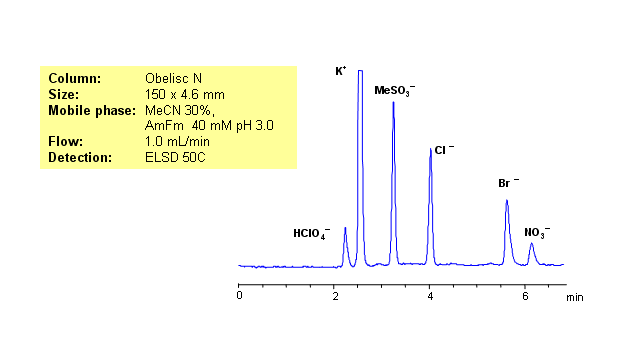
Ion chromatography is usually used for analysis of hydrophilic organic and inorganic ions. Same separation can be achieved on HILIC/mixed-mode Obelisc N HPLC columns. Obelisc N HPLC columns have very polar groups on their surface: one of the groups is basic and the other acidic. In case of low organic concentration, two groups are connected by hydrophilic linker. Obelisc N column can be used as cation-exchange and anion-exchange column. This allows to separate positively and negatively charged molecules in one run. Five anions (chloride, bromide, methanesulfonate, nitrate and perchlorate) along with one cation (sodium) were separated in one run. Method is compatible with ELSD, CAD and LC/MS and can be used for analysis of various hydrophilic and hydrophobic cations and anions in one HPLC run.
| Column | Obelisc N, 4.6×150 mm, 5 µm, 100A |
| Mobile Phase | MeCN/H2O |
| Buffer | AmFm |
| Flow Rate | 1.0 ml/min |
| Detection | ELSD |
| Class of Compounds |
Hydrophilic, Ions |
| Analyzing Compounds | Chloride, Nitrate, Chlorate, Bromide, Potassium |
Application Column
Obelisc N
SIELC has developed the Obelisc™ columns, which are mixed-mode and utilize Liquid Separation Cell technology (LiSC™). These cost-effective columns are the first of their kind to be commercially available and can replace multiple HPLC columns, including reversed-phase (RP), AQ-type reversed-phase, polar-embedded group RP columns, normal-phase, cation-exchange, anion-exchange, ion-exclusion, and HILIC (Hydrophilic Interaction Liquid Chromatography) columns. By controlling just three orthogonal method parameters - buffer concentration, buffer pH, and organic modifier concentration - users can adjust the column properties with pinpoint precision to separate complex mixtures.
Select optionsChloride
Methanesulfonic Acid
Nitrate
Nitric Acid
Potassium
HPLC Analysis of Basic Drugs and Acidic Counter-Ions by Mixed-Mode Chromatography
July 16, 2009
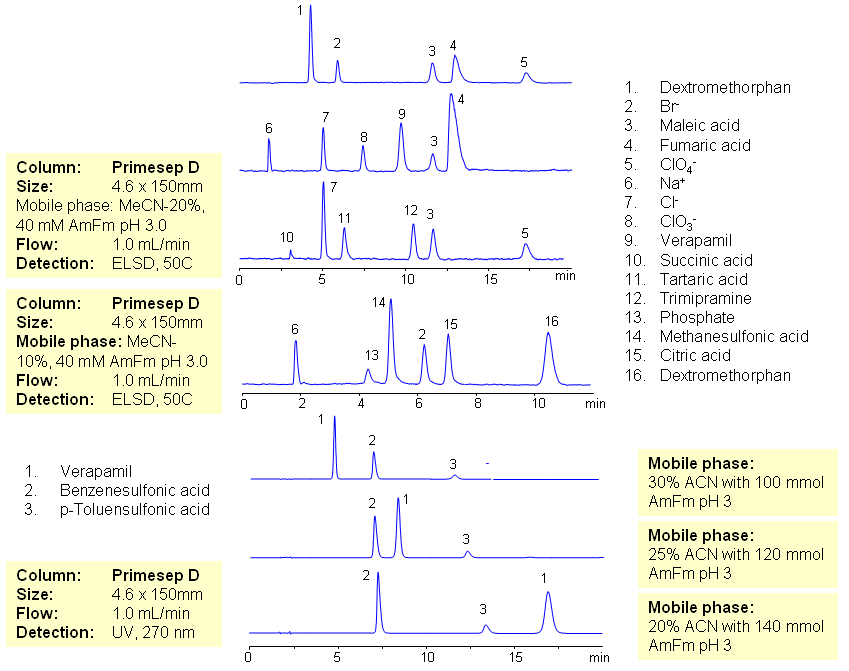
The majority of drugs in the pharmaceutical industry are administered in salt form. The presence of two counter-ions very often necessitates the use of two methods. The nature of these counterparts in drugs can be an inorganic cation and organic acid, inorganic anion and organic base, and organic cation and organic anion. Furthermore, the properties of the molecules will result in a differing stoichiometry. The task of simultaneous quantitation of counter-ions can be achieved by using mixed-mode columns. The general approach for analysis is based on properties of corresponding counter-ions. Hydrophobic basic drugs, like dextromethorphan, verapamil, trimipramine, and corresponding acidic counter-ions (chloride, chlorate, bromide, bromate, perchlorate, maleate, fumarate,tartrate, succinate, phosphate, citrate, benzosulfonate, toleuensulfonate) can be separated and quantitated in the same run on reversed-phase anion-exchange column. Basic hydrophobic drugs are retained by the reversed-phase mechanism, and counter-ions are retained by the reversed-phase and anion-exchange mechanism. Some polar counter-ions are retained only by the anion-exchange mechanism. Retention time and selectivity of HPLC separation of drugs and counter-ions can be achieved by changing the amount of acetonitrile and the amount of ions in the mobile phase. The detection technique depends on the properties of the counter-ions. In case of low or no UV activity, ELSD can be employed if the counter-ion forms a non-volatile salt with the mobile phase additive (ammonium formate). This HPLC method can be used for simultaneous quantitation of other basic drugs and counter-ions. The presence of two mechanisms of retention allows control over retention times of drug and counter-ion independently, and even allows a change of order of elution when necessary.
| Column | Primesep D , 4.6×150 mm, 5 µm, 100A |
| Mobile Phase | MeCN/H2O |
| Buffer | AmFm pH 3.0 |
| Flow Rate | 1.0 ml/min |
| Detection | ELSD, UV 270 |
| Class of Compounds | Ions, Hydrophilic, Hydrophobic, Base, Acids, Ionizable |
| Analyzing Compounds | Sodium Chloride, Sodium chloride, Sodium Chlorate, Sodium bromide, Sodium bromate, Perchloric Acid, Maleic Acid, Fumaric Acid, Tartaric Acid, Succinic Acid, Phosphoric Acid, Citric acid, Benzosulfonic acid, Dextromethorphan, Verapamil, Trimipramine |
Application Column
Primesep D
The Primesep family of mixed-mode columns offers a wide variety of stationary phases, boasting unprecedented selectivity in the separation of a broad array of chemical compounds across multiple applications. Corresponding Primesep guard columns, available with all stationary phases, do not require holders. SIELC provides a method development service available to all customers. Inquire about our specially-tailored custom LC-phases for specific separations.
Select optionsBromide
Chlorate
Chloride
Citric Acid
Dextromethorphan
Fumaric Acid
Maleic Acid
Organic Acids
Perchlorate
Phosphoric Acid
Pyrilamine
Succinic Acid
Tartaric Acid
Verapamil
p-Toluenesulfonic Acid (PTSA)
UV Detection
Effect of Concentration of Organic Modifier on Retention of Cation and Anions
November 20, 2005
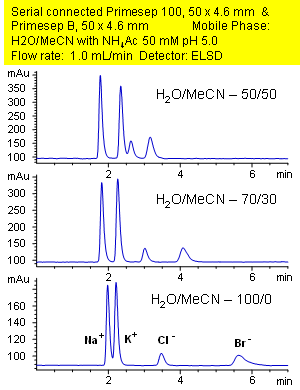
Primesep 100 and Primesep B columns connected in series allow the quantitation of sodium chloride and potassium bromide ions in one injection. The Primesep B column retains the chloride and bromide anions by anion exchange, and the Primesep 100 retains the sodium and potassium cations by cation exchange. The retention can be adjusted by changing the water/acetonitrile ratio in the mobile phase. The separation uses a mobile phase mixture of water, acetonitrile (MeCN, ACN) and ammonium acetate with evaporative light scattering detection (ELSD).
| Column | Primesep 100, Primesep B , 4.6×50 mm, 5 µm, 100A |
| Mobile Phase | MeCN/H2O |
| Buffer | AmAc pH 5.0 |
| Flow Rate | 1.0 ml/min |
| Detection | ELSD |
| Class of Compounds |
Ions, Hydrophilic, Ionizable, Vitamin, Supplements |
| Analyzing Compounds | Sodium, Potassium, Bromide, Chloride |
Application Column
Primesep 100
The Primesep family of mixed-mode columns offers a wide variety of stationary phases, boasting unprecedented selectivity in the separation of a broad array of chemical compounds across multiple applications. Corresponding Primesep guard columns, available with all stationary phases, do not require holders. SIELC provides a method development service available to all customers. Inquire about our specially-tailored custom LC-phases for specific separations.
Select options
Primesep B
The Primesep family of mixed-mode columns offers a wide variety of stationary phases, boasting unprecedented selectivity in the separation of a broad array of chemical compounds across multiple applications. Corresponding Primesep guard columns, available with all stationary phases, do not require holders. SIELC provides a method development service available to all customers. Inquire about our specially-tailored custom LC-phases for specific separations.
Select optionsChloride
Potassium
Sodium
Simultaneous Separation of Cations and Anions
November 15, 2005
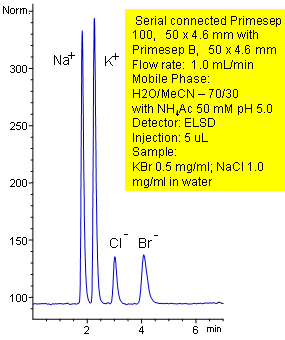
Primesep 100 and Primesep B columns connected in series allow the quantitation of sodium chloride and potassium bromide ions in one injection. The Primesep B column retains the chloride and bromide anions by anion exchange, and the Primesep 100 retains the sodium and potassium captions by cation exchange. The separation uses a mobile phase mixture of water, acetonitrile (MeCN, ACN) and trifluoroacetic acid (TFA) with evaporative light scattering detection (ELSD).
| Column | Primesep 100, Primesep B , 4.6×50 mm, 5 µm, 100A |
| Mobile Phase | MeCN/H2O |
| Buffer | AmAc pH 5.0 |
| Flow Rate | 1.0 ml/min |
| Detection | ELSD 50C |
| Class of Compounds |
Ions, Hydrophilic, Ionizable, Vitamin, Supplements |
| Analyzing Compounds | Sodium, Potassium, Bromide, Chloride |
Application Column
Primesep 100
The Primesep family of mixed-mode columns offers a wide variety of stationary phases, boasting unprecedented selectivity in the separation of a broad array of chemical compounds across multiple applications. Corresponding Primesep guard columns, available with all stationary phases, do not require holders. SIELC provides a method development service available to all customers. Inquire about our specially-tailored custom LC-phases for specific separations.
Select options
Primesep B
The Primesep family of mixed-mode columns offers a wide variety of stationary phases, boasting unprecedented selectivity in the separation of a broad array of chemical compounds across multiple applications. Corresponding Primesep guard columns, available with all stationary phases, do not require holders. SIELC provides a method development service available to all customers. Inquire about our specially-tailored custom LC-phases for specific separations.
Select optionsChloride
Potassium
Sodium
Separation of Zn and Mn on Primesep 100 Column
October 15, 2005
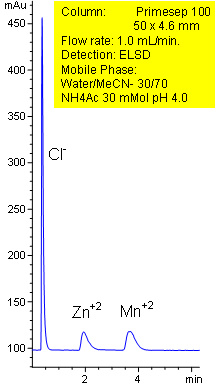
Primesep 100 separates the divalent cations, zinc and manganese, from their counter ion, chloride. The cations are retained by cation exchange and the chloride anion is eluted by ion exclusion. The mobile phase mixture of water, acetonitrile (MeCN, ACN) and ammonium acetate is evaporative light scattering detection (ELSD) compatible.
| Column | Primesep 100, 4.6×50 mm, 5 µm, 100A |
| Mobile Phase | MeCN/H2O |
| Buffer | AmAc pH 4.0 |
| Flow Rate | 1.0 ml/min |
| Detection | ELSD |
| Class of Compounds |
Ions, Hydrophilic, Ionizable, Vitamin, Supplements |
| Analyzing Compounds | Chloride, Magnesium, Zinc |
Application Column
Primesep 100
The Primesep family of mixed-mode columns offers a wide variety of stationary phases, boasting unprecedented selectivity in the separation of a broad array of chemical compounds across multiple applications. Corresponding Primesep guard columns, available with all stationary phases, do not require holders. SIELC provides a method development service available to all customers. Inquire about our specially-tailored custom LC-phases for specific separations.
Select optionsManganese
Zinc
Zn and Na Quantitation in Drug Substances
October 11, 2005
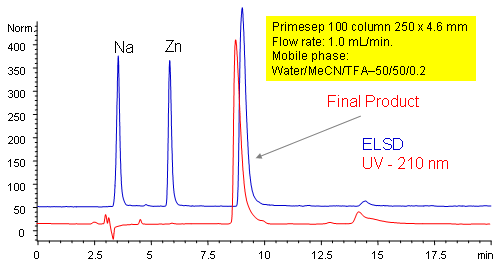
Primesep 100 allows the quantitation of sodium and zinc cations in a drug product sample. The cations are retained by cation exchange and the drug product is retained by hydrophobic, reversed-phase mechanisms. The separation uses a mobile phase mixture of water, acetonitrile (MeCN, ACN) and trifluoroacetic acid (TFA) with evaporative light scattering detection (ELSD) and UV detection.
| Column | Primesep 100, 4.6×250 mm, 5 µm, 100A |
| Mobile Phase | MeCN/H2O |
| Buffer | TFA |
| Flow Rate | 1.0 ml/min |
| Detection | ELSD 50C |
| Class of Compounds |
Ions, Hydrophilic, Ionizable, Vitamin, Supplements |
| Analyzing Compounds | Sodium, Zinc |
Application Column
Primesep 100
The Primesep family of mixed-mode columns offers a wide variety of stationary phases, boasting unprecedented selectivity in the separation of a broad array of chemical compounds across multiple applications. Corresponding Primesep guard columns, available with all stationary phases, do not require holders. SIELC provides a method development service available to all customers. Inquire about our specially-tailored custom LC-phases for specific separations.
Select optionsSodium
Zinc
UV Detection
HPLC Separation of Chloride and Nitrate Ions
January 13, 2005
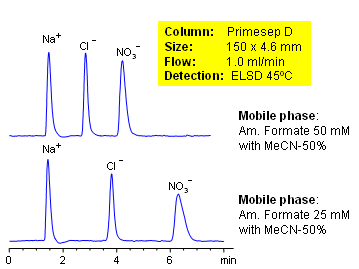
High nitrate concentrations in water and soil can be toxic to humans, fish and domestic animals. Chloride can be used for analysis of water contamination. Primesep D column can be used to separate and quantify both ions. The baseline separation between chloride and nitrate can be increased by decreasing the ammonium formate concentration in the mobile phase. Evaporative Light Scattering Detection (ELSD) used.
| Column | Primesep D, 4.6×150 mm, 5 µm, 100A |
| Mobile Phase | MeCN/H2O |
| Buffer | AmFm |
| Flow Rate | 1.0 ml/min |
| Detection | ELSD |
| Class of Compounds |
Hydrophilic, Ion |
| Analyzing Compounds | Chloride, Nitrate |
Application Column
Primesep D
The Primesep family of mixed-mode columns offers a wide variety of stationary phases, boasting unprecedented selectivity in the separation of a broad array of chemical compounds across multiple applications. Corresponding Primesep guard columns, available with all stationary phases, do not require holders. SIELC provides a method development service available to all customers. Inquire about our specially-tailored custom LC-phases for specific separations.
Select optionsNitrate
Nitric Acid
Sodium
