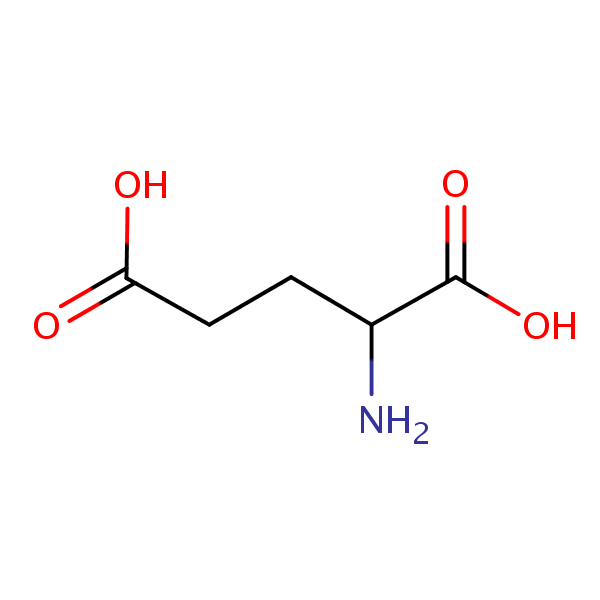
| CAS Number | 617-65-2 |
|---|---|
| Molecular Formula | C5H9NO4 |
| Molecular Weight | 147.131 |
| InChI Key | WHUUTDBJXJRKMK-UHFFFAOYSA-N |
| LogP | -2.77 |
| Synonyms |
|
Applications:
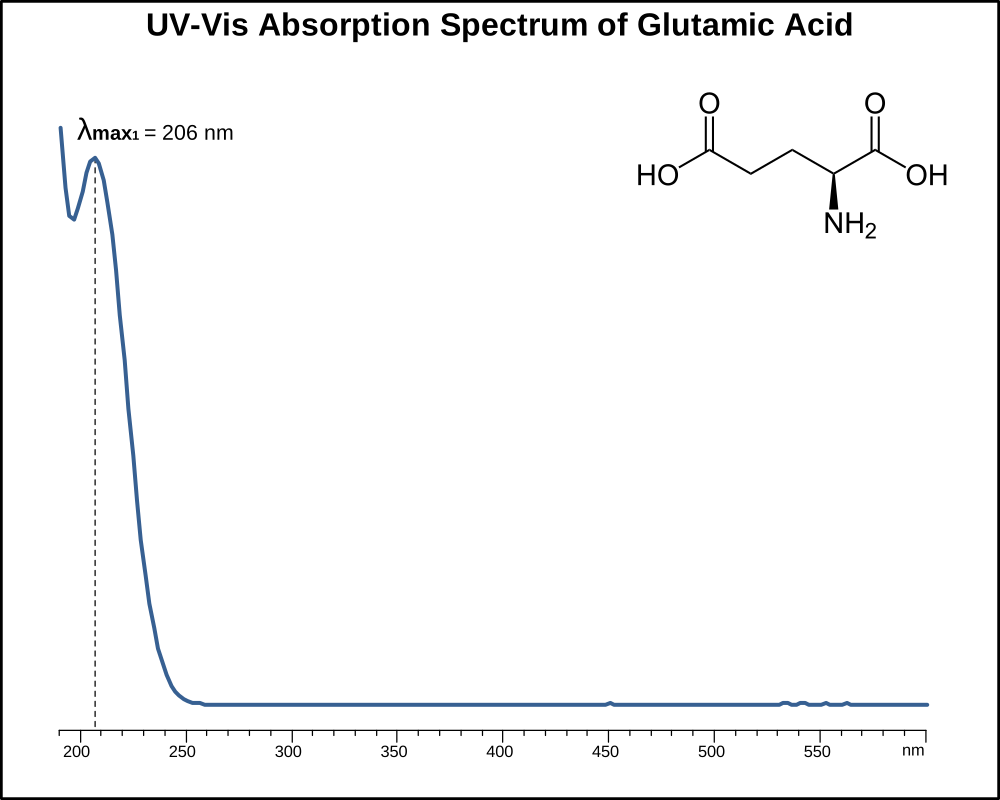
UV-Vis Spectrum of Glutamic Acid
July 9, 2024
Access the UV-Vis Spectrum SIELC Library
If you are looking for optimized HPLC method to analyze Glutamic Acid check our HPLC Applications library
For optimal results in HPLC analysis, it is recommended to measure absorbance at a wavelength that matches the absorption maximum of the compound(s) being analyzed. The UV spectrum shown can assist in selecting an appropriate wavelength for your analysis. Please note that certain mobile phases and buffers may block wavelengths below 230 nm, rendering absorbance measurement at these wavelengths ineffective. If detection below 230 nm is required, it is recommended to use acetonitrile and water as low UV-transparent mobile phases, with phosphoric acid and its salts, sulfuric acid, and TFA as buffers.

HPLC Method for Separation of Ibotenic Acid and Glutamic Acid on Primesep A Column
February 28, 2023
HPLC Method for Separation of Ibotenic Acid and Glutamic Acid on Primesep A by SIELC Technologies
Separation type: Liquid Chromatography Mixed-mode
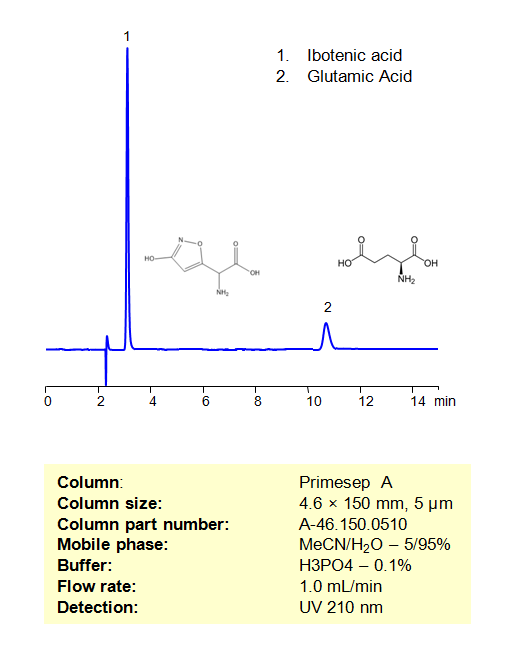
Ibotenic acid is a physchoactive NDMA and metabotropic glutamate receptor agonist with neurotoxic properties. These structurally similar psychoactive drugs can be retained, separated, and analyzed on a mixed-mode Primesep A column with a mobile phase consisting of water, Acetonitrile (MeCN), and Phosphoric acid (H3PO4). This analytical method can be UV detected at 210 nm with high resolution and peak symmetry.
High Performance Liquid Chromatography (HPLC) Method for Analysis of Ibotenic Acid and Glutamic Acid
Condition
| Column | Primesep A, 4.6 x 150 mm, 5 µm, 100 A, dual ended |
| Mobile Phase | MeCN/H2O – 5/95% |
| Buffer | H3PO4 – 0.1% |
| Flow Rate | 1.0 ml/min |
| Detection | UV 210 nm |
| Peak Retention Time | 3.22 min, 10.52 min |
Description
| Class of Compounds | Acid |
| Analyzing Compounds | Ibotenic Acid, Glutamic Acid |
Application Column
Primesep A
Column Diameter: 4.6 mm
Column Length: 150 mm
Particle Size: 5 µm
Pore Size: 100 A
Column options: dual ended
GLU (L-Glutamic acid)
Glutamic Acid
Ibotenic acid
L-Glutamic acid hydrochloride
HPLC Separation of Amino Acids on Newcrom AH Column
October 1, 2020
HPLC Method for Aspartic Acid, L-Glutamine, Glutamic Acid, Glycine on Newcrom AH by SIELC Technologies
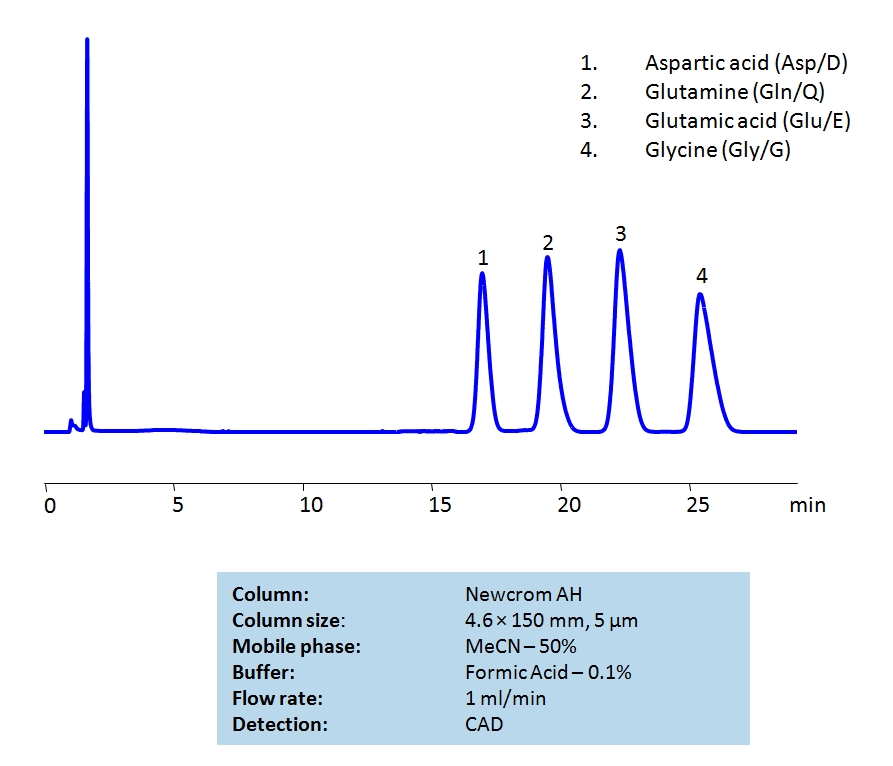
Amino acids are the building blocks of proteins. Based on their dietary requirement, they are classified into essential and non-essential amino acids. Essential amino acids cannot be synthesized by the human body in sufficient quantities and must be obtained from the diet. Non-essential amino acids, on the other hand, can be synthesized by the body and are not dependent on dietary intake.
It’s worth noting that while these amino acids are considered “non-essential” for adults under normal circumstances because the body can synthesize them, there are situations where some may become “conditionally essential.” This means that under certain conditions like illness, stress, or trauma, the body might not produce them in sufficient quantities, and dietary intake becomes necessary. Arginine, for instance, is considered conditionally essential, especially during periods of rapid growth, illness, or trauma.
You can find detailed UV spectra of Aspartic Acid and information about its various lambda maxima by visiting the following link.
You can find detailed UV spectra of Glutamine and information about its various lambda maxima by visiting the following link.
You can find detailed UV spectra of Glutamine and information about its various lambda maxima by visiting the following link.
You can find detailed UV spectra of Glutamine and information about its various lambda maxima by visiting the following link.
Aspartic Acid, L-Glutamine, Glutamic Acid, Glycine can be retained and analyzed using the Newcrom AH stationary phase column. The analysis utilizes an isocratic method with a simple mobile phase consisting of water and acetonitrile (MeCN) with a Formic Acid buffer. Detection is performed using CAD.
| Column | Newcrom AH, 4.6 x 150 mm, 5 µm, 100 A, dual ended |
| Mobile Phase | MeCN – 50% |
| Buffer | Formic Acid – 0.1% |
| Flow Rate | 1.0 ml/min |
| Detection | CAD |
| Class of Compounds |
Drug, Acid, Hydrophilic, Ionizable, Vitamin, Supplements, Amino acid |
| Analyzing Compounds | Aspartic Acid, L-Glutamine, Glutamic Acid, Glycine |
Application Column
Newcrom AH
Column Diameter: 4.6 mm
Column Length: 150 mm
Particle Size: 5 µm
Pore Size: 100 A
Column options: dual ended
Glutamic Acid
Glycine
L-Glutamine
HPLC Separation of a Mixture of Non-Essential Amino Acids, such as L-Aspartic Acid, L-Serine, L-Glutamic Acid, and L-Alanine on Primesep 100 Column
March 11, 2019
High Performance Liquid Chromatography (HPLC) Method for Analysis of Non-Essential Amino Acids on Primesep 100 by SIELC Technologies
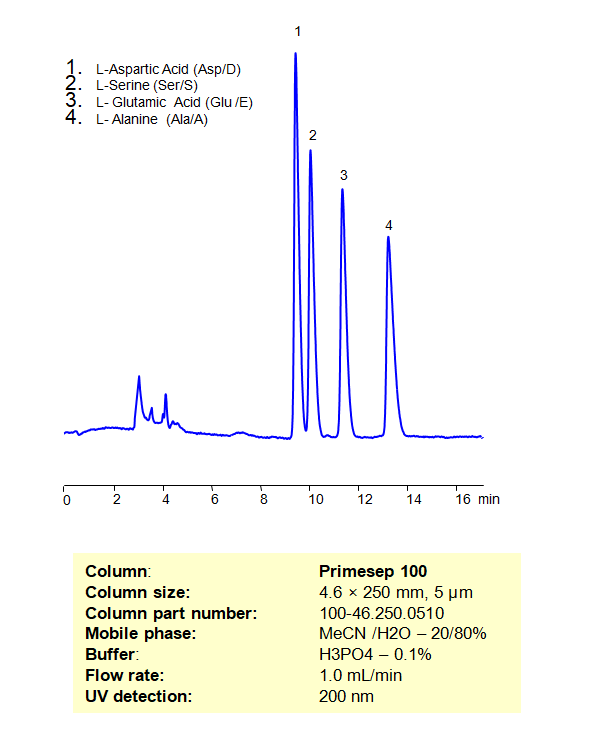
High Performance Liquid Chromatography (HPLC) Method for Analyses of Non-Essential Amino Acids
| Column | Primesep 100, 4.6 x 250 mm, 5 µm, 100 A, dual ended |
| Mobile Phase | MeCN/H2O – 20/80% |
| Buffer | H3PO4 – 0.1% |
| Flow Rate | 1.0 ml/min |
| Detection | UV, 200 nm |
| Class of Compounds | Drug, Acid, Hydrophilic, Ionizable, Vitamin, Supplements, Amino acid |
| Analyzing Compounds | Aspartic Acid, Serine, GLU (L-Glutamic acid), Glutamic Acid, D-Alanine, DL-Alanine, Amino Acids, Alanine |
Amino acids are the building blocks of proteins. Based on their dietary requirement, they are classified into essential and non-essential amino acids. Essential amino acids cannot be synthesized by the human body in sufficient quantities and must be obtained from the diet. Non-essential amino acids, on the other hand, can be synthesized by the body and are not dependent on dietary intake.
It’s worth noting that while these amino acids are considered “non-essential” for adults under normal circumstances because the body can synthesize them, there are situations where some may become “conditionally essential.” This means that under certain conditions like illness, stress, or trauma, the body might not produce them in sufficient quantities, and dietary intake becomes necessary. Arginine, for instance, is considered conditionally essential, especially during periods of rapid growth, illness, or trauma.
Amino acids can be retained, separeted and analyzed on a Primesep 100 mixed-mode stationary phase column using an isocratic analytical method with a simple mobile phase of water, Acetonitrile (MeCN), and a phosphoric acid (H3PO4) as a buffer. This analysis method can be detected in the UV regime at 200 nm.
Application Column
Primesep 100
Column Diameter: 4.6 mm
Column Length: 250 mm
Particle Size: 5 µm
Pore Size: 100 A
Column options: dual ended
Amino Acids
Aspartic Acid
D-Alanine
DL-Alanine
GLU (L-Glutamic acid)
Glutamic Acid
Serine
HPLC Separation of Lysine and Arginine from Other Amino Acids
July 10, 2012
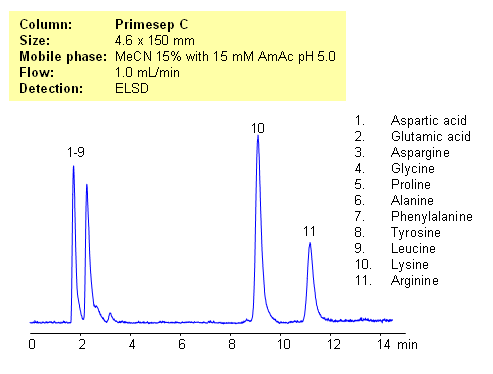
Application Notes: Amino acids are polar ionic compounds which are not retained on reversed-phase column without ion-pairing reagent. In our application, lysine and arginine can be separated from other amino acids. Amino acids with a pH between 3 and 5 and with one basic and one acidic group become very polar. Therefore these amino acids don’t have strong ion-exchange interaction with Primesep C stationary phase. Amino acids with two amino groups still carry positive net charge and can interact with stationary phase by cations-exchange mechanism. pH variation of the mobile phase can be an effective tool to adjust selectivity of separation for zwitter-ionic, basic and acidic compounds. This method can be used for separation of mono-charged compounds from compounds having an extra charge.
Application Columns: Primesep C
Application compounds: Aspartic acid, Glutamic acid, Aspargine, Glycine, Proline, Alanine, Phenylalanine, Tyrosine, Leucine, Lysine, Arginine
Detection technique: UV, LC/MS, ELSD/CAD
| Column | Primesep C, 4.6×150 mm, 5 µm, 100A |
| Mobile Phase | MeCN – 15% |
| Buffer | AmAc pH 5.0- 15 mM |
| Flow Rate | 1.0 ml/min |
| Detection | ELSD |
| Class of Compounds |
Drug, Acid, Hydrophilic, Ionizable, Vitamin, Supplements |
| Analyzing Compounds | Aspartic acid, Glutamic acid, Aspargine, Glycine, Proline, Alanine, Phenylalanine, Tyrosine, Leucine, Lysine, Arginine |
Application Column
Primesep C
The Primesep family of mixed-mode columns offers a wide variety of stationary phases, boasting unprecedented selectivity in the separation of a broad array of chemical compounds across multiple applications. Corresponding Primesep guard columns, available with all stationary phases, do not require holders. SIELC provides a method development service available to all customers. Inquire about our specially-tailored custom LC-phases for specific separations.
Select optionsArginine
Asparagine
Aspartic Acid
Glutamic Acid
Glycine
Leucine
Lysine
Phenylalanine
Proline
Tyrosine
UV Detection
HPLC Separation of Glutamic Acid and GABA
July 8, 2011
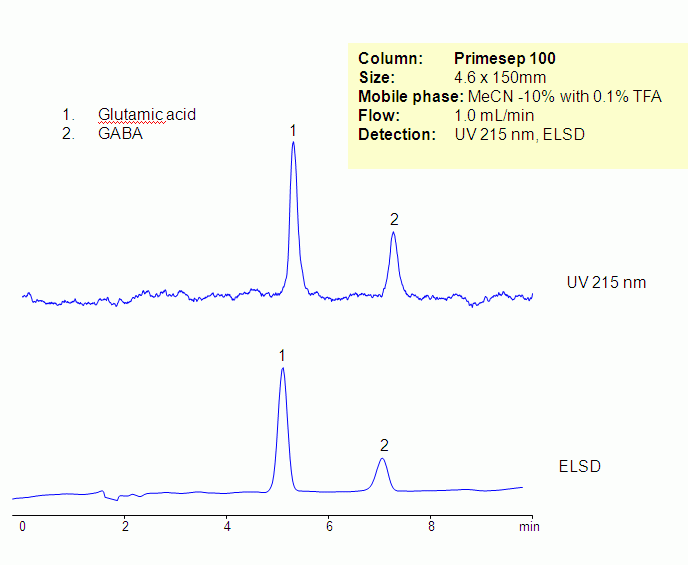
Glutamic acid and GABA are neurotransmitters. Glutamic acid and GABA are non-essential amino acids. They are hydrophilic and zwitter-ionic in nature . At lower pH, carboxylic acid groups of amino acids are not ionized, making them more hydrophobic and basic. Underivatized glutamic acid and GABA were retained and separated on a Primesep 100 column using ACN/water/TFA mobile phase. Amino acids can be monitored by low UV or ELSD/CAD. Retention is provided by reversed-phase and cation-exchange mechanism. Method can be used for analysis of underivatized amino acids in various matrices including supplements, vitamin and other complex mixtures. various mobile phase can be used with corresponding detection techniques.
| Column | Primesep 100, 4.6×150 mm, 5 µm, 100A |
| Mobile Phase | MeCN/H2O – 10/90% |
| Buffer | TFA – 0.1% |
| Flow Rate | 1.0 ml/min |
| Detection | UV, 215 nm, ELSD |
| Class of Compounds |
Drug, Acid, Hydrophilic, Ionizable, Vitamin, Supplements |
| Analyzing Compounds | Glutamic acid, GABA |
Application Column
Primesep 100
The Primesep family of mixed-mode columns offers a wide variety of stationary phases, boasting unprecedented selectivity in the separation of a broad array of chemical compounds across multiple applications. Corresponding Primesep guard columns, available with all stationary phases, do not require holders. SIELC provides a method development service available to all customers. Inquire about our specially-tailored custom LC-phases for specific separations.
Select optionsZwitterion
gamma-Aminobutyric Acid (GABA)
UV Detection
HPLC Analysis of Active Drug and Amino Acids in a Formulation
October 14, 2010
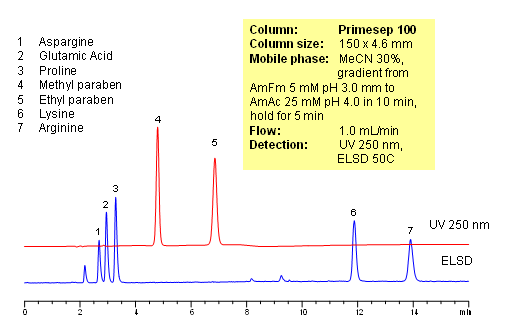
Polar amino acids are very often used as components of vitamin and supplement composition. Analysis of such complex composition is a challenging task. In this application, 5 amino acids (asparagine, glutamic acid, proline and arginine) and two preservatives (methyl paraben and propyl paraben) are separated on a Primesep 100 reversed-phase cation-exchange column with LC/MS compatible mobile phase. Method does not require ion-pairing reagent in the mobile phase. Compounds are monitored by ELSD and UV. Method is validated for quantitation of underivatized amino acids in complex mixtures. The method is simple and robust and can be used for analysis of various vitamin formulations.
| Column | Primesep 100, 4.6×150 mm, 5 µm, 100A |
| Mobile Phase | MeCN/H2O |
| Buffer | AmFm |
| Flow Rate | 1.0 ml/min |
| Detection | ELSD 50C, UV 250 nm |
| Class of Compounds |
Drug, Acid, Hydrophilic, Ionizable, Vitamin, Supplements |
| Analyzing Compounds | Glutamic acid, Aspargine, Proline, Lysine, Arginine, Methyl paraben, Propyl paraben |
Application Column
Primesep 100
The Primesep family of mixed-mode columns offers a wide variety of stationary phases, boasting unprecedented selectivity in the separation of a broad array of chemical compounds across multiple applications. Corresponding Primesep guard columns, available with all stationary phases, do not require holders. SIELC provides a method development service available to all customers. Inquire about our specially-tailored custom LC-phases for specific separations.
Select optionsAsparagine
Ethylparaben
Glutamic Acid
Lysine
Methylparaben
Proline
UV Detection
HPLC Separation of Polar Compounds
January 13, 2010
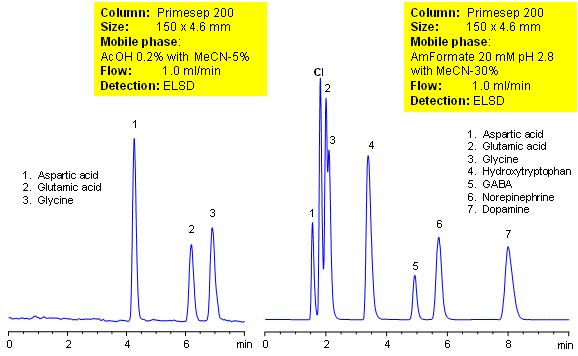
The separation of amino acids, the building blocks of proteins, can be challenging to separate on a reverse-phase column due to their high polarity. Using a mixed-mode HPLC column, allows the separation of amino acids by cation-exchange and ion-exclusion mechanisms as well as hydrophobicity. Fine tuning of separation can be achieved with changes in organic concentration of the mobile phase as well as choice of buffer and pH.
| Column | Primesep 200, 4.6×150 mm, 5 µm, 100A |
| Mobile Phase | MeCN/H2O |
| Buffer | AcOH, AmFm |
| Flow Rate | 1.0 ml/min |
| Detection | ELSD |
| Class of Compounds |
Drug, Acid, Hydrophilic, Ionizable, Hormone |
| Analyzing Compounds | Aspartic acid, Glutaric acid, Glycine, Hydroxytriptophan, GABA, Norepinephrine, Dopamine |
Application Column
Primesep 200
The Primesep family of mixed-mode columns offers a wide variety of stationary phases, boasting unprecedented selectivity in the separation of a broad array of chemical compounds across multiple applications. Corresponding Primesep guard columns, available with all stationary phases, do not require holders. SIELC provides a method development service available to all customers. Inquire about our specially-tailored custom LC-phases for specific separations.
Select optionsAspartic Acid
Dopamine
Glutamic Acid
Norepinephrine
gamma-Aminobutyric Acid (GABA)
HPLC-ELSD Method for Analysis of Amino Acids on Primesep 100 Column
September 18, 2006
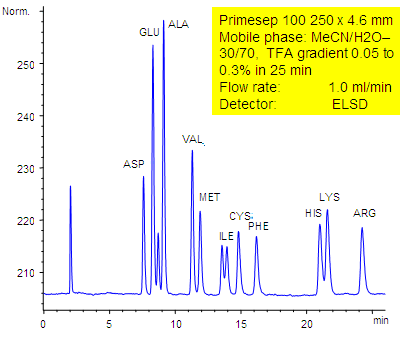
11 underivatized amino acids (aspartic acid, glutamic acid, alanine, valine, methionine, isoleucine, cysteine, phenylalanine, histidine, lysine, and arginine) are separated by a Primesep 100 HPLC column by reversed-phase and ion-exchange mechanisms with LC/MS compatible conditions without the use of ion-pair reagents. The HPLC separation uses a TFA (trifluoroacetic acid) gradient in a mobile phase of water acetonitrile (MeCN, ACN with evaporative light scattering detection (ELSD).
| Column | Primesep 100, 4.6×250 mm, 5 µm, 100A |
| Mobile Phase | MeCN/H2O – 30/70% |
| Buffer | TFA , gradient 0.05-0.3 % , 25 min |
| Flow Rate | 1.0 ml/min |
| Detection | ELSD |
| Class of Compounds |
Drug, Acid, Hydrophilic, Ionizable, Vitamin, Supplements |
| Analyzing Compounds | Aspartic acid, Glutamic acid, Alanine, Valine, Methionine, Isoleucine, Cysteine, Phenylalanine, Histidine, Lysine, Arginine |
Application Column
Primesep 100
The Primesep family of mixed-mode columns offers a wide variety of stationary phases, boasting unprecedented selectivity in the separation of a broad array of chemical compounds across multiple applications. Corresponding Primesep guard columns, available with all stationary phases, do not require holders. SIELC provides a method development service available to all customers. Inquire about our specially-tailored custom LC-phases for specific separations.
Select optionsAmino Acids
Arginine
Aspartic Acid
Cysteine
Glutamic Acid
Histidine
Isoleucine
Lysine
Methionine
Phenylalanine
Valine
HPLC Analysis of Cheese Extract using Mixed-Mode Chromatography
May 6, 2005
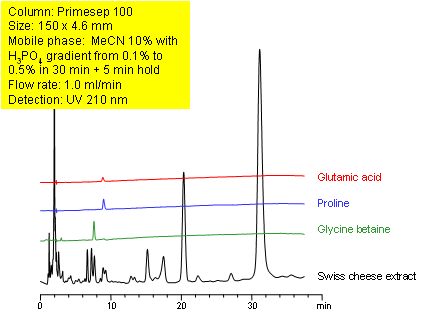
Primesep 100 separates the components of a Swiss cheese extract by HPLC using cation exchange and reversed phase as retention mechanisms. The amino acids, glutamic acid and proline, as well as glycine betaine were resolved in less than 10 minutes. A mobile phase gradient of water, acetonitrile (MeCN, ACN,) and phosphoric acid (H3PO4) and ultraviolet (UV) detection was used.
| Column | Primesep 100, 4.6×150 mm, 5 µm, 100A |
| Mobile Phase | MeCN/H2O |
| Buffer | H3PO4 |
| Flow Rate | 1.0 ml/min |
| Detection | UV 210 nm |
| Class of Compounds |
Drug, Acid, Hydrophilic, Ionizable, Vitamin, Supplements |
| Analyzing Compounds | Glutamic acid, Proline, Glycine betaine |
Application Column
Primesep 100
The Primesep family of mixed-mode columns offers a wide variety of stationary phases, boasting unprecedented selectivity in the separation of a broad array of chemical compounds across multiple applications. Corresponding Primesep guard columns, available with all stationary phases, do not require holders. SIELC provides a method development service available to all customers. Inquire about our specially-tailored custom LC-phases for specific separations.
Select optionsGlutamic Acid
Glycine Betaine
Proline
