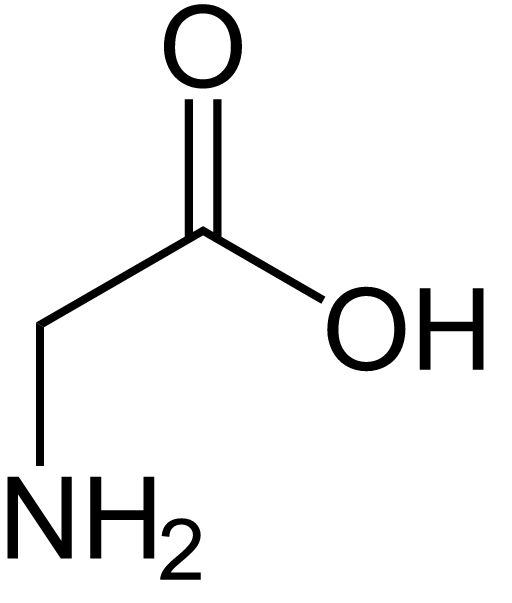
| CAS Number | 56-40-6 |
|---|---|
| Molecular Formula | C2H5NO2 |
| Molecular Weight | 75.067 |
| InChI Key | DHMQDGOQFOQNFH-UHFFFAOYSA-N |
| LogP | -3.21 |
| Synonyms |
|
Applications:
HPLC Method for Separation of Glycine, Methylglycine, Dimethylglycine and Trimethylglycine on Primesep 100 Column
December 10, 2025
HPLC Method for Dimethylglycine, Methylglycine (Sarcosine), Trimethylglycine (Betaine), Glycine on Primesep 100 by SIELC Technologies
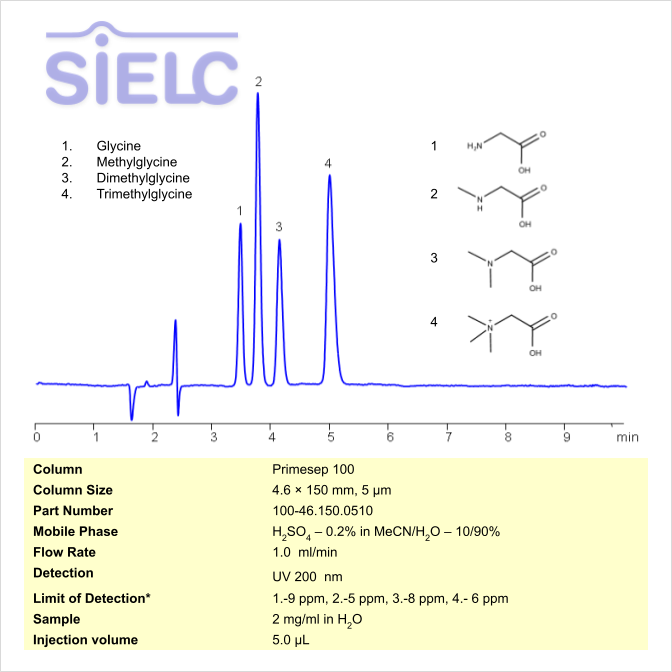
High Performance Liquid Chromatography (HPLC) Method for Analysis of Dimethylglycine, Methylglycine (Sarcosine), Trimethylglycine (Betaine), Glycine.
Glycine, also written as Gly or G, is an important amino acid compounds widely used in pharmaceutical, biochemical, and peptide research. It has the chemical formula C₂H₅NO₂. It is water-soluble and plays a critical role in protein synthesis, peptide modification, and metabolic studies. It can be found in meat., eggs. and bones. You can find detailed UV spectra of Glycine and information about its various lambda maxima by visiting the following link.
Methylglycine, also known as Sarcosine, is an amino acid with the chemical formula C3H7NO2. It is primarily known as a potential disease marker, as it does not typically occur in urine, but it is an intermediate and byproduct of glycine synthesis and degradation. You can find detailed UV spectra of Methylglydine and information about its various lambda maxima by visiting the following link.
Dimethylglycine is a derivative of glycine with the chemical formula C4H9NO2. While it is found primarily in beans and liver, it is said to have a sweet taste. There has been research done into using Dimethylglycine as treatment for autism, epilepsy, and mitochondrial disease, though no evidence to suggest it’s effectiveness as a treatment was found. You can find detailed UV spectra of Dimethylglycine and information about its various lambda maxima by visiting the following link.
Trimethylglycine, also known as betaine, is a compound derived from the amino acid glycine with the chemical formula C5H11NO2. It is found in various foods, including beets, spinach, whole grains, and seafood. Trimethylglycine has been studied for its potential health benefits, and it is commonly used as a dietary supplement. It plays a role in a process called methylation, which is important for various biochemical reactions in the body. Some studies suggest that trimethylglycine may have potential benefits for heart health as it is believed to help lower levels of homocysteine, an amino acid linked to an increased risk of heart disease when present in high concentrations. You can find detailed UV spectra of Trimethylglycine and information about its various lambda maxima by visiting the following link.
Multi-charged molecules, such as oxaloacetate and oxalate, generally have a tendency to exhibit poor peak shape on reverse-phase HPLC columns, where they show significant tailing. Dimethylglycine, Methylglycine (Sarcosine), Trimethylglycine (Betaine), Glycine can be retained with great peak shape on a Newcrom BH mixed-mode column. Oxalic acid can be measured at low UV. Using a Newcrom BH mixed-mode column and a mobile phase consisting of acetonitrile (ACN) and water with sulfuric acid (H2SO4) buffer, oxaloacetic acid and oxalic acid can be retained, separated, and UV detected at 200 nm with precise resolution.
| Column | Primesep 100, 4.6 x 150 mm, 5 µm, 100 A, dual ended |
| Mobile Phase | MeCN/H2O |
| Buffer | H2SO4- 2% |
| Flow Rate | 1.0 ml/min |
| Detection | UV, 200 nm |
| Class of Compounds | Amino Acids |
| Analyzing Compounds | Dimethylglycine, Methylglycine (Sarcosine), Trimethylglycine (Betaine), Glycine |
Application Column
Primesep 100
Column Diameter: 4.6 mm
Column Length: 150 mm
Particle Size: 5 µm
Pore Size: 100 A
Column options: dual ended
Glycine
Methylglycine (Sarcosine)
Trimethylglycine (Betaine)

HPLC Method for Analysis of Glycine on Primesep 100 Column
December 5, 2025
HPLC Method for Glycine on Primesep 100 by SIELC Technologies
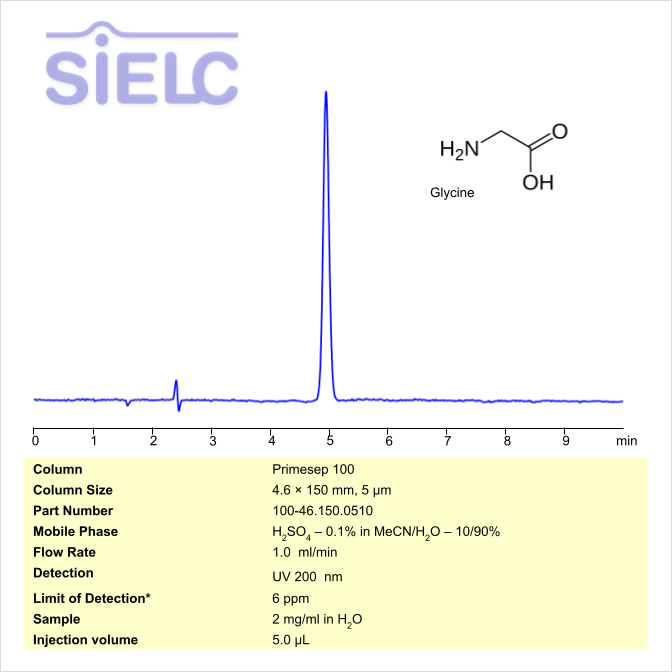
High Performance Liquid Chromatography (HPLC) Method for Analysis of Glycine.
Glycine, also written as Gly or G, is an important amino acid compounds widely used in pharmaceutical, biochemical, and peptide research. It has the chemical formula C₂H₅NO₂. It is water-soluble and plays a critical role in protein synthesis, peptide modification, and metabolic studies. It can be found in meat., eggs. and bones. You can find detailed UV spectra of Glycine and information about its various lambda maxima by visiting the following link.
Glycine can be retained and analyzed using the Primesep 100 stationary phase column. The analysis utilizes an isocratic method with a simple mobile phase consisting of water and acetonitrile (MeCN) with sulfuric acid as a buffer. Detection is performed using UV.
| Column | Primesep 100, 4.6 x 150 mm, 5 µm, 100 A, dual ended |
| Mobile Phase | MeCN – 10% |
| Buffer | Sulfuric Acid – 0.1% |
| Flow Rate | 1.0 mL/min |
| Detection | UV 200 nm |
| LOD* | 6 ppm |
*LOD was determined for this combination of instrument, method, and analyte, and it can vary from one laboratory to another even when the same general type of analysis is being performed.
| Class of Compounds | Amino Acids |
| Analyzing Compounds | Glycine |
Application Column
Primesep 100
Column Diameter: 4.6 mm
Column Length: 150 mm
Particle Size: 5 µm
Pore Size: 100 A
Column options: dual ended
UV-Vis Spectrum of Glycine
July 8, 2024
Access the UV-Vis Spectrum SIELC Library
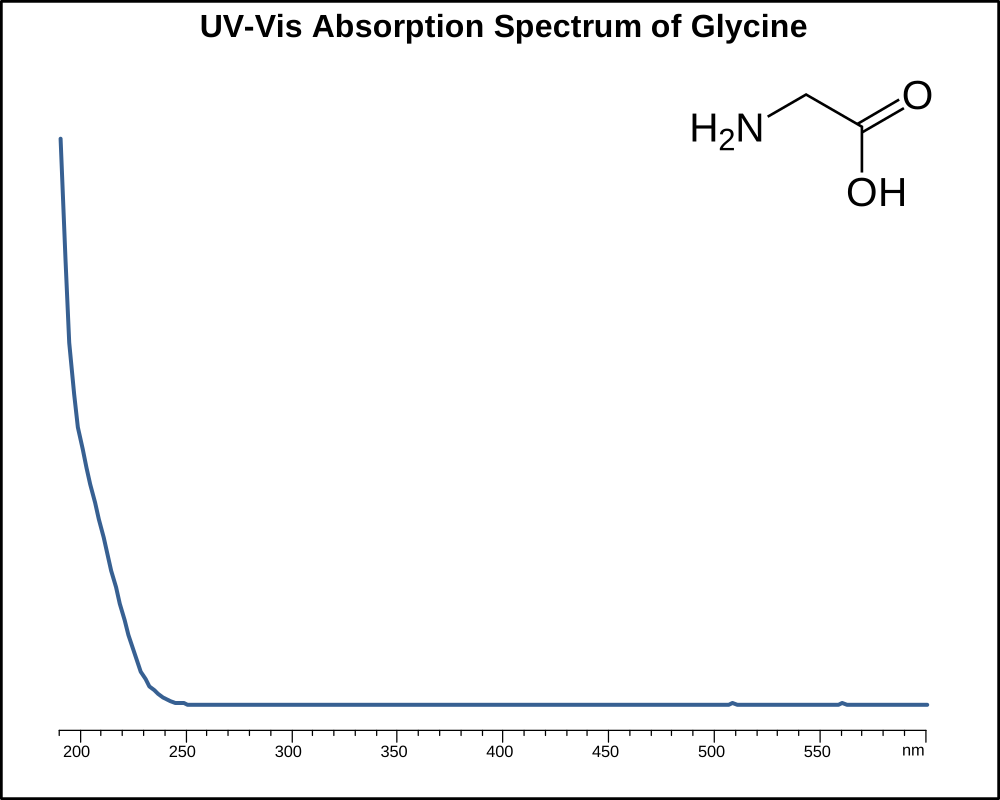
If you are looking for optimized HPLC method to analyze Glycine check our HPLC Applications library
For optimal results in HPLC analysis, it is recommended to measure absorbance at a wavelength that matches the absorption maximum of the compound(s) being analyzed. The UV spectrum shown can assist in selecting an appropriate wavelength for your analysis. Please note that certain mobile phases and buffers may block wavelengths below 230 nm, rendering absorbance measurement at these wavelengths ineffective. If detection below 230 nm is required, it is recommended to use acetonitrile and water as low UV-transparent mobile phases, with phosphoric acid and its salts, sulfuric acid, and TFA as buffers.
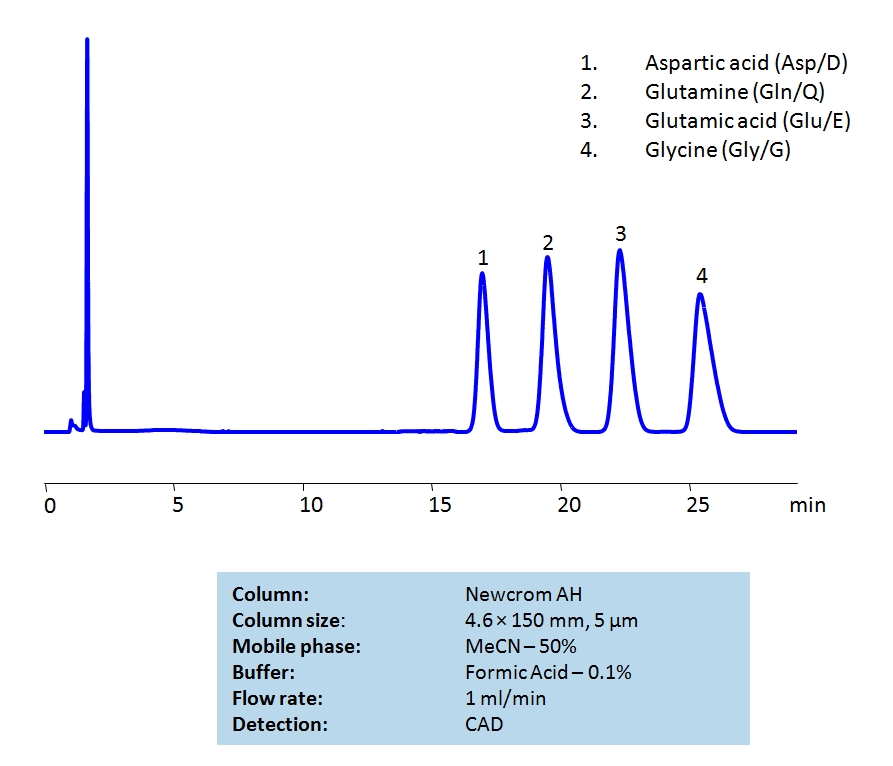
HPLC Separation of Amino Acids on Newcrom AH Column
October 1, 2020
HPLC Method for Aspartic Acid, L-Glutamine, Glutamic Acid, Glycine on Newcrom AH by SIELC Technologies
Amino acids are the building blocks of proteins. Based on their dietary requirement, they are classified into essential and non-essential amino acids. Essential amino acids cannot be synthesized by the human body in sufficient quantities and must be obtained from the diet. Non-essential amino acids, on the other hand, can be synthesized by the body and are not dependent on dietary intake.
It’s worth noting that while these amino acids are considered “non-essential” for adults under normal circumstances because the body can synthesize them, there are situations where some may become “conditionally essential.” This means that under certain conditions like illness, stress, or trauma, the body might not produce them in sufficient quantities, and dietary intake becomes necessary. Arginine, for instance, is considered conditionally essential, especially during periods of rapid growth, illness, or trauma.
You can find detailed UV spectra of Aspartic Acid and information about its various lambda maxima by visiting the following link.
You can find detailed UV spectra of Glutamine and information about its various lambda maxima by visiting the following link.
You can find detailed UV spectra of Glutamine and information about its various lambda maxima by visiting the following link.
You can find detailed UV spectra of Glutamine and information about its various lambda maxima by visiting the following link.
Aspartic Acid, L-Glutamine, Glutamic Acid, Glycine can be retained and analyzed using the Newcrom AH stationary phase column. The analysis utilizes an isocratic method with a simple mobile phase consisting of water and acetonitrile (MeCN) with a Formic Acid buffer. Detection is performed using CAD.
| Column | Newcrom AH, 4.6 x 150 mm, 5 µm, 100 A, dual ended |
| Mobile Phase | MeCN – 50% |
| Buffer | Formic Acid – 0.1% |
| Flow Rate | 1.0 ml/min |
| Detection | CAD |
| Class of Compounds |
Drug, Acid, Hydrophilic, Ionizable, Vitamin, Supplements, Amino acid |
| Analyzing Compounds | Aspartic Acid, L-Glutamine, Glutamic Acid, Glycine |
Application Column
Newcrom AH
Column Diameter: 4.6 mm
Column Length: 150 mm
Particle Size: 5 µm
Pore Size: 100 A
Column options: dual ended
Glutamic Acid
Glycine
L-Glutamine
New HPLC Amino Acids Separation Compatible With Carbon Dating Technique
February 11, 2020
HPLC Method for Proline, Glycine, D-Alanine, Alanine, Hydroxyproline on Newcrom AH by SIELC Technologies

High Performance Liquid Chromatography (HPLC) Method for Analysis of Proline, Glycine, D-Alanine, Alanine, Hydroxyproline.
Hydroxyproline seems to be the most promising amino acid used in carbon dating when isolated from bone collagen. Separation of amino acids is challenging, especially without the use of ions or inorganic buffers that can interfere with Mass spectrometer (MS) or contaminate the sample with modern carbon. Amino acids are also not retained in reverse-phase chromatography. The ideal solution would be using water only to separate the amino acids. This would allow a direct coupling to MS. We were able to separate hydroxyproline from proline and other simple amino acids like glycine and alanine in HPLC on Newcrom AH column using water only as a mobile phase. Using water also allowed UV detection at 205 nm which can’t be done if using a buffer based on acetic or formic acid.
See more information on radiocarbon dating here.
The same method can be modified to get symmetrical peaks and higher efficiency if a mobile phase with ionic modifier such as formic acid is used.
You can find detailed UV spectra of Proline and information about its various lambda maxima by visiting the following link.
You can find detailed UV spectra of Glycine and information about its various lambda maxima by visiting the following link.
| Column | Newcrom AH, 4.6 x 150 mm, 5 µm, 100 A, dual ended |
| Mobile Phase | MeCN/H2O |
| Flow Rate | 1.0 ml/min |
| Detection | UV, 205 nm, CAD |
| Class of Compounds |
Drug, Acid, Hydrophilic, Ionizable, Vitamin, Supplements, Amino acid |
| Analyzing Compounds | Proline, Glycine, D-Alanine, Alanine, Hydroxyproline |
Application Column
Newcrom AH
Column Diameter: 4.6 mm
Column Length: 150 mm
Particle Size: 5 µm
Pore Size: 100 A
Column options: dual ended
D-Alanine
Glycine
Hydroxyproline
Proline
CAD Detection
HPLC Separation of Mixture of Conditionally Essential Amino Acids on Primesep 100 Column
March 11, 2019
HPLC Method for L-Glutamine, Glycine, Cysteine, L-Cysteine, Proline, Tyrosine, Arginine, Amino Acids on Primesep 100 by SIELC Technologies
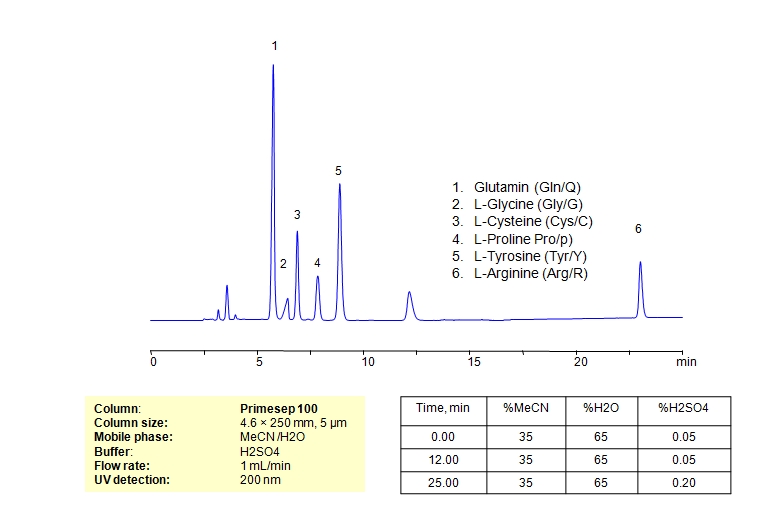
High Performance Liquid Chromatography (HPLC) Method for Analysis of L-Glutamine, Glycine, Cysteine, L-Cysteine, Proline, Tyrosine, Arginine, Amino Acids.
Glutamine is an amino acid with the chemical formula C5H10N2O3. It is a building block for protein, but it also supports the immune system, gut health, and detoxification. It is usually found in meat, fish, eggs, dairy, and whole grains; though some consider it the most abundant amino acid in the body. People also take glutamine as treatment for sickle cell disease, healing of burns, recovery after surgery, and injuries.
L-Glycine is an important amino acid compounds widely used in pharmaceutical, biochemical, and peptide research. It has he chemical formula C₂H₅NO₂. It is water-soluble and plays a critical role in protein synthesis, peptide modification, and metabolic studies. It can be found in meat., eggs. and bones.
L-Cysteine is an amino acid with the chemical formula C5H10N2O3. It is primarily a building block for protein, but it also has antioxidant effects. On occasion, ot os used to support people dealing with cancer, diabetes, and hangover, but there is yet to be substantial evidence that it works. Poultry, egg, beef, and whole grains are rich sources of the amino acid.
L-Proline is an amino acid with the chemical formula C5H9NO2. It is naturally produced in the body, but it is also recommended to be consumed through the diet. It can be found in meat, fish, and dairy. It is used for skin healing and treatment of other skin conditions as it is an essential component of collagen. It is important for upkeep of joints and tendons, as well as heart muscles.
L-Tyrosine is an amino acid with the chemical formula C9H11NO3. It is naturally used in the body to create neurotransmitters like dopamine and norepinephrine. While it is produced in the body naturally, it can also be consumed in beef, pork, fish, dairy products, and beans. As a supplement, it is also used to treat Phenylketonuria (PKU).
L-Arginine is an amino acid with the chemical formula C9H11NO3. It is a precursor for nitric acid, making it crucial for blood flow and general cardiovascular health. It can help lower blood pressure, help with chest pain, and improve symptoms of Peripheral arterial disease (PAD).
L-Glutamine, Glycine, Cysteine, L-Cysteine, Proline, Tyrosine, Arginine, Amino Acids can be retained and analyzed using the Primesep 100 stationary phase column. The analysis utilizes an isocratic method with a simple mobile phase consisting of water and acetonitrile (MeCN) with a sulfuric acid buffer. Detection is performed using UV.
| Column | Primesep 100, 4.6 x 250 mm, 5 µm, 100 A, dual ended |
| Mobile Phase | MeCN/H2O – 35/65% |
| Buffer | H2SO4 0.05% 12 min hold, gradient 0.05-0.20, 13 min |
| Flow Rate | 1.0 ml/min |
| Detection | UV, 200 nm |
| Class of Compounds |
Drug, Acid, Hydrophilic, Ionizable, Vitamin, Supplements, Amino acid |
| Analyzing Compounds | L-Glutamine, Glycine, Cysteine, L-Cysteine, Proline, Tyrosine, Arginine, Amino Acids |
Application Column
Primesep 100
Column Diameter: 4.6 mm
Column Length: 250 mm
Particle Size: 5 µm
Pore Size: 100 A
Column options: dual ended
Arginine
Cysteine
Glycine
L-Cysteine
L-Glutamine
Proline
Tyrosine
HPLC Method for Analysis of Glycine Methyl Ester Hydrochloride
October 26, 2018
HPLC Method for Glycine methyl ester, Glycine on Primesep A by SIELC Technologies
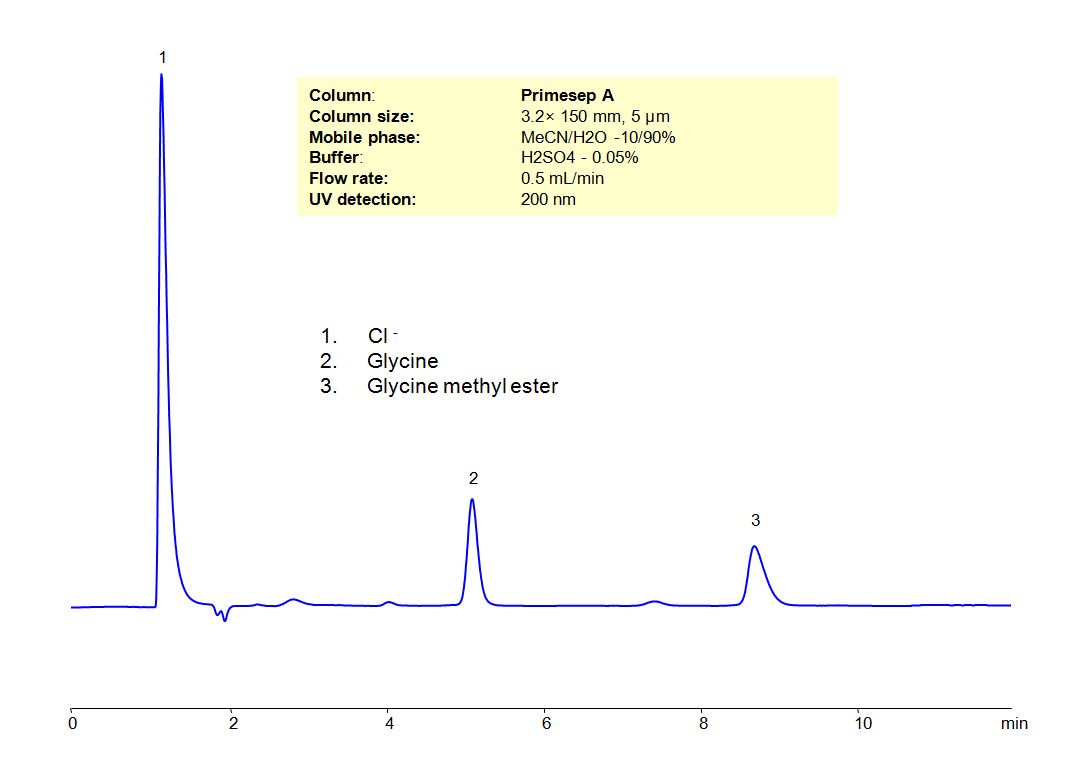
High Performance Liquid Chromatography (HPLC) Method for Analysis of Glycine methyl ester, Glycine
Glycine Methyl Ester Hydrochloride is a water soluble organic compound that is typically used in synthesis of pharmaceuticals and pesticides. Besides that, it is also used as a flavor enhancer and nutritional supplement.
Glycine Methyl Ester Hydrochloride can be retained and analyzed using the Primesep-A stationary phase column. The analysis utilizes an isocratic method with a simple mobile phase consisting of water and acetonitrile (MeCN) with a sulfuric acid buffer. Detection is performed using UV.
| Column | Primesep A, 3.2 x 150 mm, 5 µm, 100 A, dual ended |
| Mobile Phase | MeCN/H2O – 10/90% |
| Buffer | H2SO4 – 0.05% |
| Flow Rate | 0.05 ml/min |
| Detection | UV, 200 nm |
| Class of Compounds |
Amino acid, Drug, Acid, Hydrophilic, Ionizable, Vitamin, Supplements, Zwitterionic |
| Analyzing Compounds | Glycine methyl ester, Glycine |
Application Column
Primesep A
Column Diameter: 3.2 mm
Column Length: 150 mm
Particle Size: 5 µm
Pore Size: 100 A
Column options: dual ended
Glycine methyl ester
HPLC Method for Analysis of Glycine and Glycine Methyl Ester Hydrochloride
October 25, 2018
HPLC Method for Glycine methyl ester, Glycine on Primesep 100 by SIELC Technologies
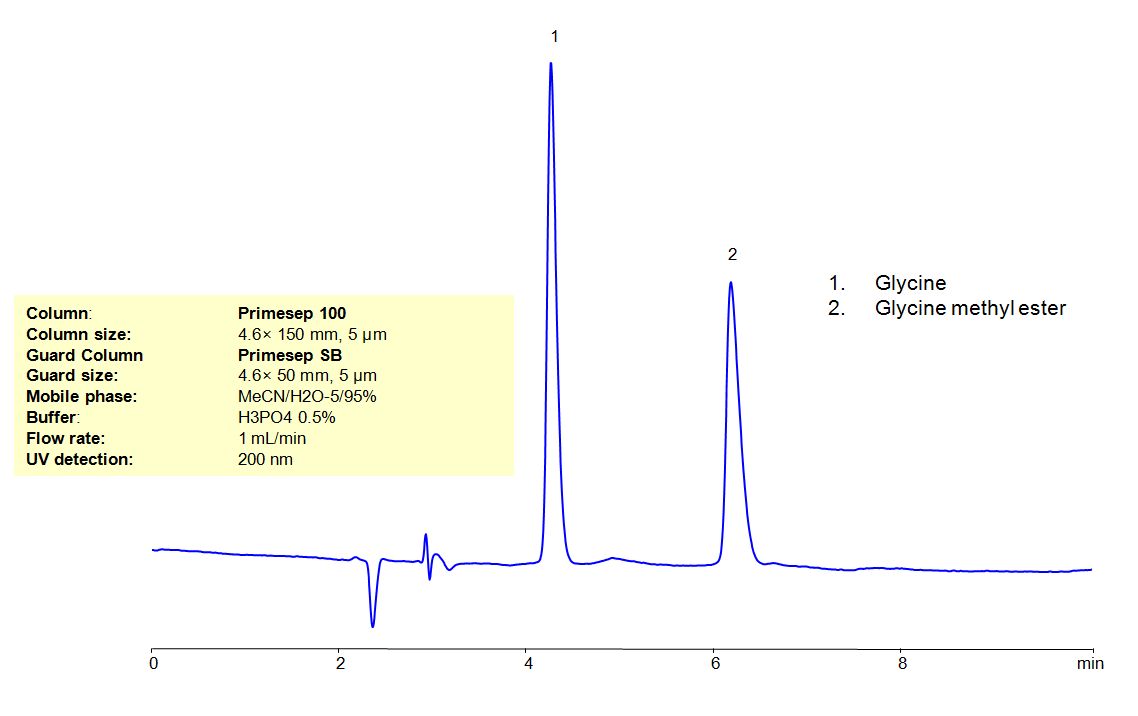
High Performance Liquid Chromatography (HPLC) Method for Analysis of Glycine methyl ester, Glycine
Glycine and glycine methyl ester hydrochloride are important amino acid compounds widely used in pharmaceutical, biochemical, and peptide research. Both compounds are water-soluble and play critical roles in protein synthesis, peptide modification, and metabolic studies. High-performance liquid chromatography (HPLC) offers a precise and reliable method to separate, identify, and quantify glycine and its methyl ester derivative with excellent sensitivity and reproducibility. This analytical approach is essential for quality control, pharmaceutical formulation analysis, and research applications involving amino acid derivatives. Using HPLC for these compounds ensures accurate, consistent results in laboratory and industrial settings.
| Column | Primesep 100, 4.6 x 150 mm, 5 µm, 100 A, dual ended |
| Mobile Phase | MeCN/H2O – 5/95% |
| Buffer | H3PO4 – 0.5% |
| Flow Rate | 1 ml/min |
| Detection | UV, 200 nm |
| Class of Compounds | Amino acid, Drug, Acid, Hydrophilic, Ionizable, Vitamin, Supplements, Zwitterionic |
| Analyzing Compounds | Glycine methyl ester, Glycine |
Application Column
Primesep 100
Column Diameter: 4.6 mm
Column Length: 150 mm
Particle Size: 5 µm
Pore Size: 100 A
Column options: dual ended
Glycine methyl ester
HPLC Separation of Lysine and Arginine from Other Amino Acids
July 10, 2012
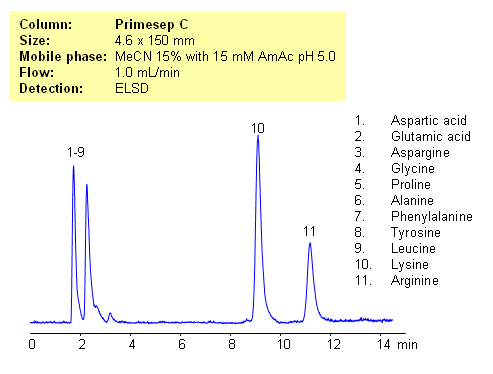
Application Notes: Amino acids are polar ionic compounds which are not retained on reversed-phase column without ion-pairing reagent. In our application, lysine and arginine can be separated from other amino acids. Amino acids with a pH between 3 and 5 and with one basic and one acidic group become very polar. Therefore these amino acids don’t have strong ion-exchange interaction with Primesep C stationary phase. Amino acids with two amino groups still carry positive net charge and can interact with stationary phase by cations-exchange mechanism. pH variation of the mobile phase can be an effective tool to adjust selectivity of separation for zwitter-ionic, basic and acidic compounds. This method can be used for separation of mono-charged compounds from compounds having an extra charge.
Application Columns: Primesep C
Application compounds: Aspartic acid, Glutamic acid, Aspargine, Glycine, Proline, Alanine, Phenylalanine, Tyrosine, Leucine, Lysine, Arginine
Detection technique: UV, LC/MS, ELSD/CAD
| Column | Primesep C, 4.6×150 mm, 5 µm, 100A |
| Mobile Phase | MeCN – 15% |
| Buffer | AmAc pH 5.0- 15 mM |
| Flow Rate | 1.0 ml/min |
| Detection | ELSD |
| Class of Compounds |
Drug, Acid, Hydrophilic, Ionizable, Vitamin, Supplements |
| Analyzing Compounds | Aspartic acid, Glutamic acid, Aspargine, Glycine, Proline, Alanine, Phenylalanine, Tyrosine, Leucine, Lysine, Arginine |
Application Column
Primesep C
The Primesep family of mixed-mode columns offers a wide variety of stationary phases, boasting unprecedented selectivity in the separation of a broad array of chemical compounds across multiple applications. Corresponding Primesep guard columns, available with all stationary phases, do not require holders. SIELC provides a method development service available to all customers. Inquire about our specially-tailored custom LC-phases for specific separations.
Select optionsArginine
Asparagine
Aspartic Acid
Glutamic Acid
Glycine
Leucine
Lysine
Phenylalanine
Proline
Tyrosine
UV Detection
HPLC Analysis of Polysorbate in Mixture with Amino Acids and Sugar
July 16, 2009
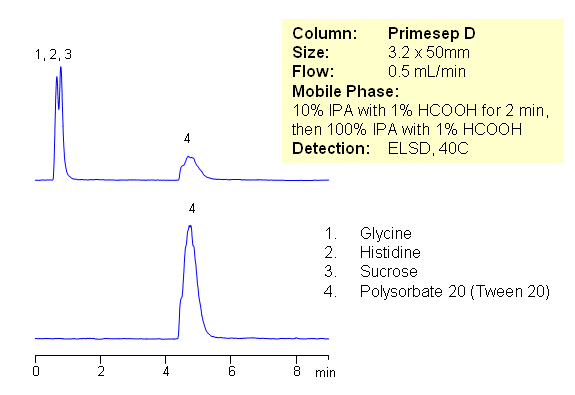
Polysorbates are a class of emulsifiers used in some pharmaceuticals and food preparation. They are often used in cosmetics to solubilize essential oils into water-based products. Polysorbates are oily liquids derived from PEG-ylated sorbitan (a derivative of sorbitol) esterified with fatty acids. Surfactants that are esters of plain (non-PEG-ylated) sorbitan with fatty acids are usually referred to by the name Span. It is often required to quantitate Polysorbate (Polysorbate/Tween 20, Polysorbate/Tween 40, Polysorbate 60/Tween 60 and Polysorbate 80) by HPLC in various formulations. Polysorbates exist in form of oligomers.
| Column | Primesep D, 3.2×50 mm, 5 µm, 100A |
| Mobile Phase | IPA |
| Buffer | Formic Acid |
| Flow Rate | 0.5 ml/min |
| Detection | ELSD |
| Class of Compounds |
Drug, Acid, Hydrophilic, Ionizable, Vitamin, Supplements, Amino acid |
| Analyzing Compounds | Glycine, Histidine, Sucrose, Polysorbate 20 |
Application Column
Primesep D
The Primesep family of mixed-mode columns offers a wide variety of stationary phases, boasting unprecedented selectivity in the separation of a broad array of chemical compounds across multiple applications. Corresponding Primesep guard columns, available with all stationary phases, do not require holders. SIELC provides a method development service available to all customers. Inquire about our specially-tailored custom LC-phases for specific separations.
Select optionsGlycine
Histidine
Polysorbate
Polysorbate 20
Polysorbate 80
Sucrose
Tween 20
Tween 80
HPLC Separation of DMSO and Glycine by Mixed-Mode Chromatography
July 16, 2009
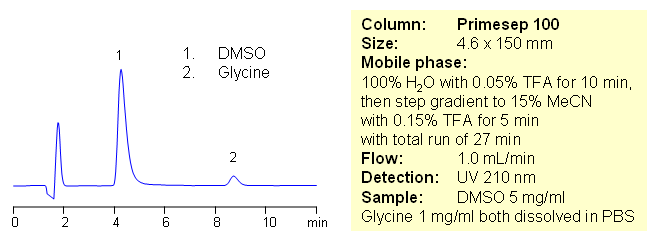
Dimethyl sulfoxide is important polar aprotic solvent, which is frequently used in pharmaceutical drug manufacturing, desolution, etc. DMSO is used as one of the solvents on protein chemistry due to universal ability to dissolve small molecules like amino acids. Amino acids and DMSO are very polar and have no retention on reversed-phase columns. In this HPLC application DMSO and glycine are separated on Primesep 100 mixed-mode column. DMSO is retained by weak reversed-phase mechanism and very low organic concentration is required in order to achieve any retention. Glycine, like any other underivatized amino acid, is retained by weak reversed-phase and moderate cation-exchange mechanism. Method uses acetonitrile/water/TFA gradient and UV detection.
| Column | Primesep 100, 4.6×150 mm, 5 µm, 100A |
| Mobile Phase | MeCN/H2O |
| Buffer | TFA |
| Flow Rate | 1.0 ml/min |
| Detection | UV, 210 nm |
| Class of Compounds |
Drug, Acid, Hydrophilic, Ionizable, Vitamin, Supplements, Amino acid |
| Analyzing Compounds | DMSO, Glycine |
Application Column
Primesep 100
The Primesep family of mixed-mode columns offers a wide variety of stationary phases, boasting unprecedented selectivity in the separation of a broad array of chemical compounds across multiple applications. Corresponding Primesep guard columns, available with all stationary phases, do not require holders. SIELC provides a method development service available to all customers. Inquire about our specially-tailored custom LC-phases for specific separations.
Select optionsDMSO (Dimethyl sulfoxide)
Glycine
