
| CAS Number | 1477-55-0 |
|---|---|
| Molecular Formula | C8H12N2 |
| Molecular Weight | 136.198 |
| InChI Key | FDLQZKYLHJJBHD-UHFFFAOYSA-N |
| LogP | -0.3 |
| Synonyms |
|
Applications:
Uv-Vis Spectrum of m-Xylylenediamine
February 12, 2026
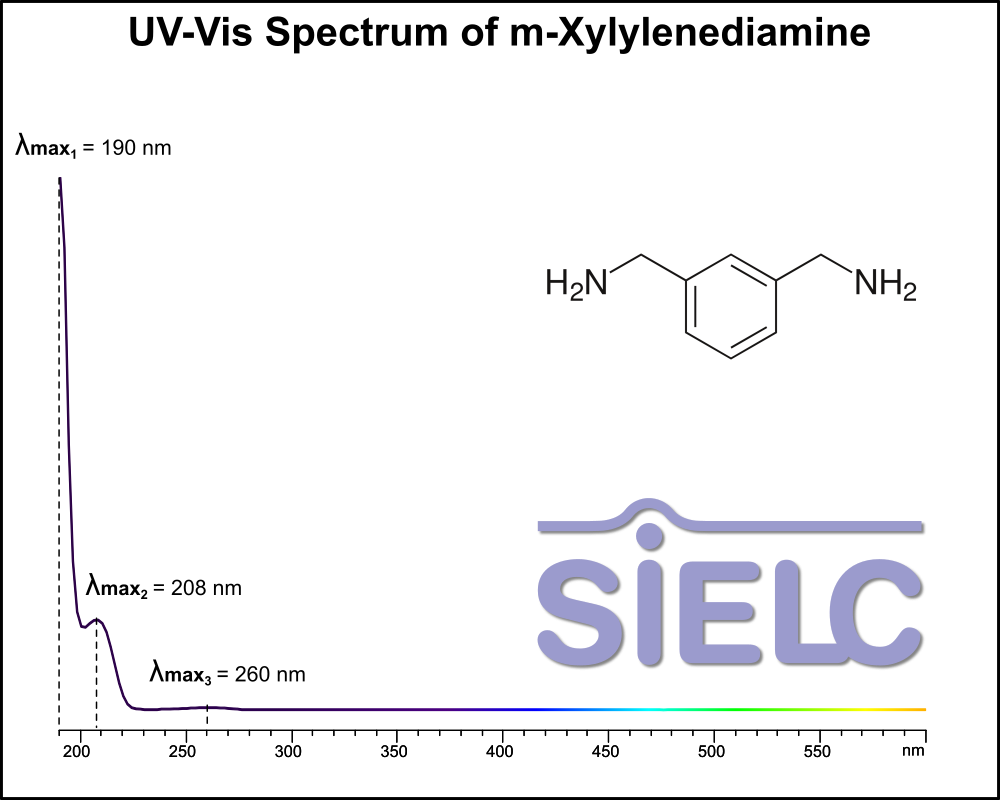
If you are looking for optimized HPLC method to analyze m-Xylylenediamine check our HPLC Applications library
For optimal results in HPLC analysis, it is recommended to measure absorbance at a wavelength that matches the absorption maximum of the compound(s) being analyzed. The UV spectrum shown can assist in selecting an appropriate wavelength for your analysis. Please note that certain mobile phases and buffers may block wavelengths below 230 nm, rendering absorbance measurement at these wavelengths ineffective. If detection below 230 nm is required, it is recommended to use acetonitrile and water as low UV-transparent mobile phases, with phosphoric acid and its salts, sulfuric acid, and TFA as buffers.
For some compounds, the UV-Vis Spectrum is affected by the pH of the mobile phase. The spectra presented here are measured with an acidic mobile phase that has a pH of 3 or lower.

HPLC Method for Separation of Amines on BIST B and BIST B+ Columns
March 23, 2023
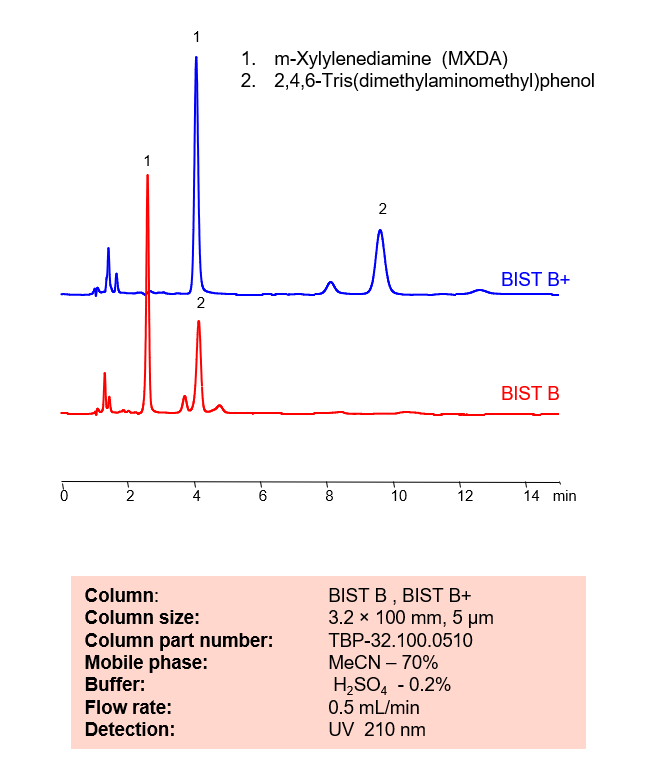
HPLC Method for Separation of m-Xylylenediamine, 2,4,6-Tris(dimethylaminomethyl)phenol on BIST B and BIST B+ Columns by SIELC Technologies
m-Xylylenediamine (MXDA) is a popular curing agent used on epoxy resins with the chemical formula C8H12N2. When MXDA undergoes the Sommelet reaction, it results in a isophthalaldehyde. You can find detailed UV spectra of m-Xylylenediamine and information about its various lambda maxima by visiting the following link.
2,4,6-Tris(dimethylaminomethyl)phenol is an organic compound with the chemical formula C15H27N3O. It is amine-based curing agent used on epoxy resins and as an accelerator for epoxy resin curing agents. It is considered to be one of the most widely used room temperature accelerators for two-component resin systems. Less commonly, it is used in polyurethane chemistry. You can find detailed UV spectra of 2,4,6-Tris(dimethylaminomethyl)phenoland information about its various lambda maxima by visiting the following link.
Using SIELC’s newly introduced BIST™ method, m-Xylylenediamine, 2,4,6-Tris(dimethylaminomethyl)phenol can be retained and separated on a positively charged, anion-exchange BIST B column. The surface chemistry of BIST™ B+ columns are designed to have stronger ionic retention capabilities, resulting in the marked increase in retention compared to BIST™ B columns.
There are two keys to this retention method: 1) a multi-charged, negative buffer, such as Sulfuric acid (H2SO4), which acts as a bridge, linking the positively charged dipeptide to the positively charged column surface and 2) a mobile phase consisting mostly of organic solvent (such as MeCN) to minimize the formation of a solvation layer around the charged analytes. Using this new and unique analysis method, these two amines can be UV detected at 210 nm.
Condition
| Column | BIST B, 3.2 x 100 mm, 5 µm, 100 A, dual ended |
| Mobile Phase | MeCN – 70% |
| Buffer | H2SO4 – 0.2% |
| Flow Rate | 0.5 ml/min |
| Detection | UV 210 nm |
Description
| Class of Compounds | Amines |
| Analyzing Compounds | m-Xylylenediamine, 2,4,6-Tris(dimethylaminomethyl)phenol |
Application Column
BIST B
Column Diameter: 3.2 mm
Column Length: 100 mm
Particle Size: 5 µm
Pore Size: 100 A
Column options: dual ended
BIST B+
Column Diameter: 3.2 mm
Column Length: 100 mm
Particle Size: 5 µm
Pore Size: 100 A
Column options: dual ended
m-Xylylenediamine
HPLC Method for Separation of Amines in Non Aqueous MP on BIST B+ Column
March 1, 2023
HPLC Method for Separation of of Dopamine, m-Xylylenediamine, 2,4,6-Tris(dimethylaminomethyl)phenol in Non Aqueous MP on BIST B+ by SIELC Technologies
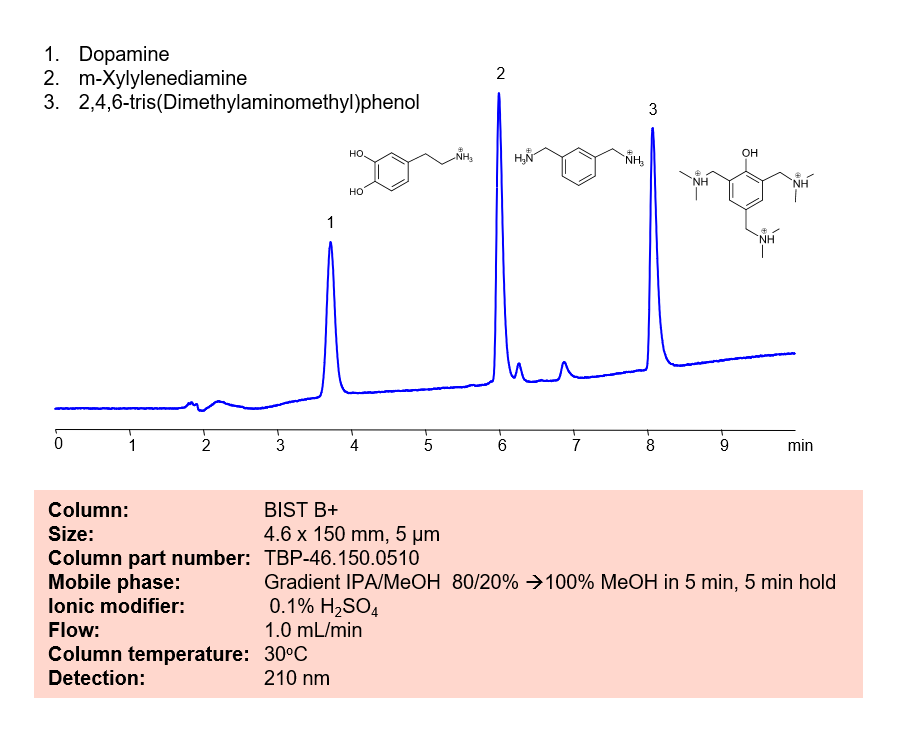
Dopamine is a neurotransmitter with the chemical formula C8H11NO2. It is released during pleasurable activities, reinforcing those behaviors, and motivating people to continue seeking them out. It is often used to treat low blood pressure, low heart rate, and heart attacks Dopamine influences the release of other hormones. A deficiency of it can influence movement and lead to conditions like Parkinson’s disease. You can find detailed UV spectra of Dopamine and information about its various lambda maxima by visiting the following link.
m-Xylylenediamine (MXDA) is a popular curing agent used on epoxy resins with the chemical formula C8H12N2. When MXDA undergoes the Sommelet reaction, it results in a isophthalaldehyde. You can find detailed UV spectra of m-Xylylenediamine and information about its various lambda maxima by visiting the following link.
2,4,6-Tris(dimethylaminomethyl)phenol is an organic compound with the chemical formula C15H27N3O. It is amine-based curing agent used on epoxy resins and as an accelerator for epoxy resin curing agents. It is considered to be one of the most widely used room temperature accelerators for two-component resin systems. Less commonly, it is used in polyurethane chemistry. You can find detailed UV spectra of 2,4,6-Tris(dimethylaminomethyl)phenoland information about its various lambda maxima by visiting the following link.
Using SIELC’s newly introduced BIST method, Dopamine, m-Xylylenediamine, 2,4,6-Tris(dimethylaminomethyl)phenol can be retained on a positively-charged anion-exchange BIST B+ column. There are two keys to this retention method: 1) a multi-charged, negative buffer, such as Sulfuric acid (H2SO4), which acts as a bridge, linking the positively-charged analytes to the positively-charged column surface and 2) a mobile phase consisting mostly of less polar organic solvent (such as IPA) to minimize the formation of a solvation layer around the charged analytes. This method uses an entirely non-aqueous mobile phase to drive BIST retention. The gradient starts with a high concentration of the less polar IPA to generate the initial BIST retention and progresses to the more polar MeOH to elute the longer-retaining amines in a reasonable time. Using this new and unique analysis method, these 3 amines can be retained and UV detected at 210 nm.
Condition
| Column | BIST B+, 4.6 x 150 mm, 5 µm, 100 A, dual ended |
| Mobile Phase | Gradient IPA/MeOH- 80/20% to 100% MeOH, 5 min , 5 min hold |
| Buffer | H2SO4 – 0.2% |
| Flow Rate | 1.0 ml/min |
| Detection | UV 210 nm |
| Peak Retention Time | 3.52 min, 6.12 min, 8.57 min |
Description
| Class of Compounds | Amines |
| Analyzing Compounds | Dopamine, m-Xylylenediamine, 2,4,6-Tris(dimethylaminomethyl)phenol |
Application Column
BIST B+
Column Diameter: 4.6 mm
Column Length: 150 mm
Particle Size: 5 µm
Pore Size: 100 A
Column options: dual ended
Dopamine
m-Xylylenediamine
HPLC Method For Analysis of Xylylenediamine on BIST B+ Column
June 15, 2022
HPLC Method for Xylylenediamine, m-Xylylenediamine on BIST B+ by SIELC Technologies
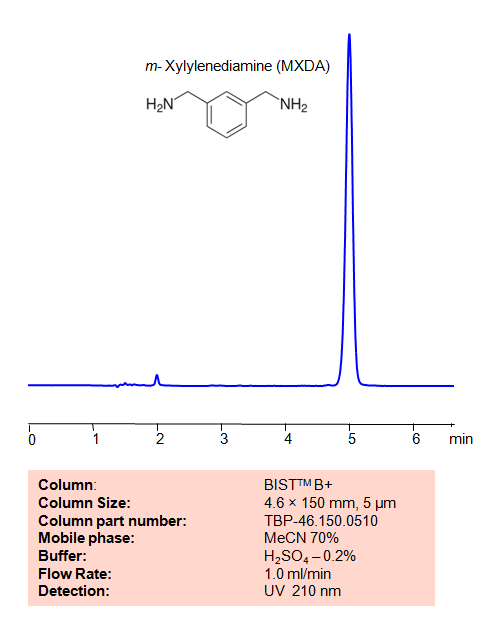
High Performance Liquid Chromatography (HPLC) Method for Analysis of Xylylenediamine, m-Xylylenediamine.
m-Xylylenediamine (MXDA) is a popular curing agent used on epoxy resins with the chemical formula C8H12N2. When MXDA undergoes the Sommelet reaction, it results in a isophthalaldehyde. You can find detailed UV spectra of m-Xylylenediamine and information about its various lambda maxima by visiting the following link.
Using SIELC’s newly introduced BIST method, Xylylenediamine, m-Xylylenediamine, which protonates in water, can be retained on a positively-charged anion-exchange BIST B+ column. There are two keys to this retention method: 1) a multi-charged, negative buffer, such as Sulfuric acid (H2SO4), which acts as a bridge, linking the positively-charged MXDA analytes to the positively-charged column surface and 2) a mobile phase consisting mostly of organic solvent (such as MeCN) to minimize the formation of a solvation layer around the charged analytes. Using this new and unique analysis method, MXDA can be retained and UV detected at 210 nm.
| Column | BIST B+, 4.6 x 150 mm, 5 µm, 100 A, dual ended |
| Mobile Phase | MeCN/H2O – 70/30% |
| Buffer | H2SO4 – 0.2 % |
| Flow Rate | 1.0 ml/min |
| Detection | UV, 210 nm |
| Class of Compounds |
Drug, Basic, Hydrophobic, Ionizable, Zwitterionic |
| Analyzing Compounds | Xylylenediamine, m-Xylylenediamine |
Application Column
BIST B+
Column Diameter: 4.6 mm
Column Length: 150 mm
Particle Size: 5 µm
Pore Size: 100 A
Column options: dual ended
m-Xylylenediamine
HPLC Method for Analysis of m-Xylylenediamine (MXDA) on BIST™ B+ Column
June 15, 2022
HPLC Method for m-Xylylenediamine on BIST B+ by SIELC Technologies

High Performance Liquid Chromatography (HPLC) Method for Analysis of m-Xylylenediamine.
m-Xylylenediamine (MXDA) is a popular curing agent used on epoxy resins with the chemical formula C8H12N2. When MXDA undergoes the Sommelet reaction, it results in a isophthalaldehyde. You can find detailed UV spectra of m-Xylylenediamine and information about its various lambda maxima by visiting the following link.
Using SIELC’s newly introduced BIST™ method, m-Xylylenediamine, which protonates in water, can be retained on a positively-charged anion-exchange BIST B+ column. There are two keys to this retention method: 1) a multi-charged, negative buffer, such as Sulfuric acid (H2SO4), which acts as a bridge, linking the positively-charged MXDA analytes to the positively-charged column surface and 2) a mobile phase consisting mostly of organic solvent (such as MeCN) to minimize the formation of a solvation layer around the charged analytes. Using this new and unique analysis method, MXDA can be retained and UV detected at 210 nm.
| Column | BIST B+, 4.6 x 150 mm, 5 µm, 100 A, dual ended |
| Mobile Phase | MeCN – 80% |
| Buffer | H2SO4 – 0.2% |
| Flow Rate | 1.0 ml/min |
| Detection | UV 210nm |
| Class of Compounds | Amine, Aliphatic amine |
| Analyzing Compounds | m-Xylylenediamine |
Application Column
BIST B+
Column Diameter: 4.6 mm
Column Length: 150 mm
Particle Size: 5 µm
Pore Size: 100 A
Column options: dual ended
Analysis of m-Xylylenediamine (MXDA)
February 15, 2012
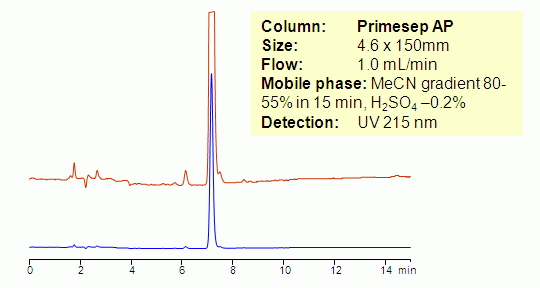
| Column | Primesep AP, 4.6×150 mm, 5 µm, 100A |
| Mobile Phase | MeCN/H2O |
| Buffer | H2SO4 – 0.2 % |
| Flow Rate | 1.0 ml/min |
| Detection | UV, 215 nm |
| Class of Compounds |
Drug, Basic, Hydrophobic, Ionizable, Zwitterionic |
| Analyzing Compounds | m-Xylylenediamine (MXDA) |
Application Column
Primesep AP
The Primesep family of mixed-mode columns offers a wide variety of stationary phases, boasting unprecedented selectivity in the separation of a broad array of chemical compounds across multiple applications. Corresponding Primesep guard columns, available with all stationary phases, do not require holders. SIELC provides a method development service available to all customers. Inquire about our specially-tailored custom LC-phases for specific separations.
Select optionsXylylenediamine
m-Xylylenediamine
