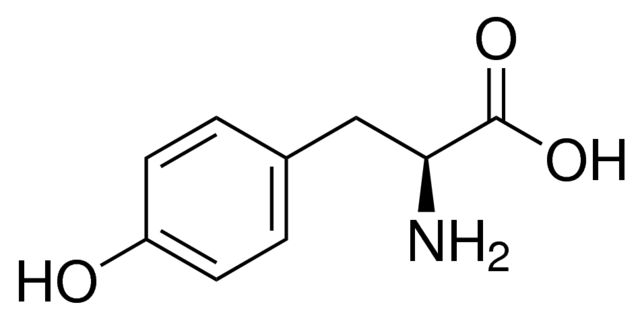
| CAS Number | 60-18-4 |
|---|---|
| Molecular Formula | C9H11NO3 |
| Molecular Weight | 181.191 |
| InChI Key | OUYCCCASQSFEME-QMMMGPOBSA-N |
| LogP | -2.3 |
| Synonyms |
|
Applications:
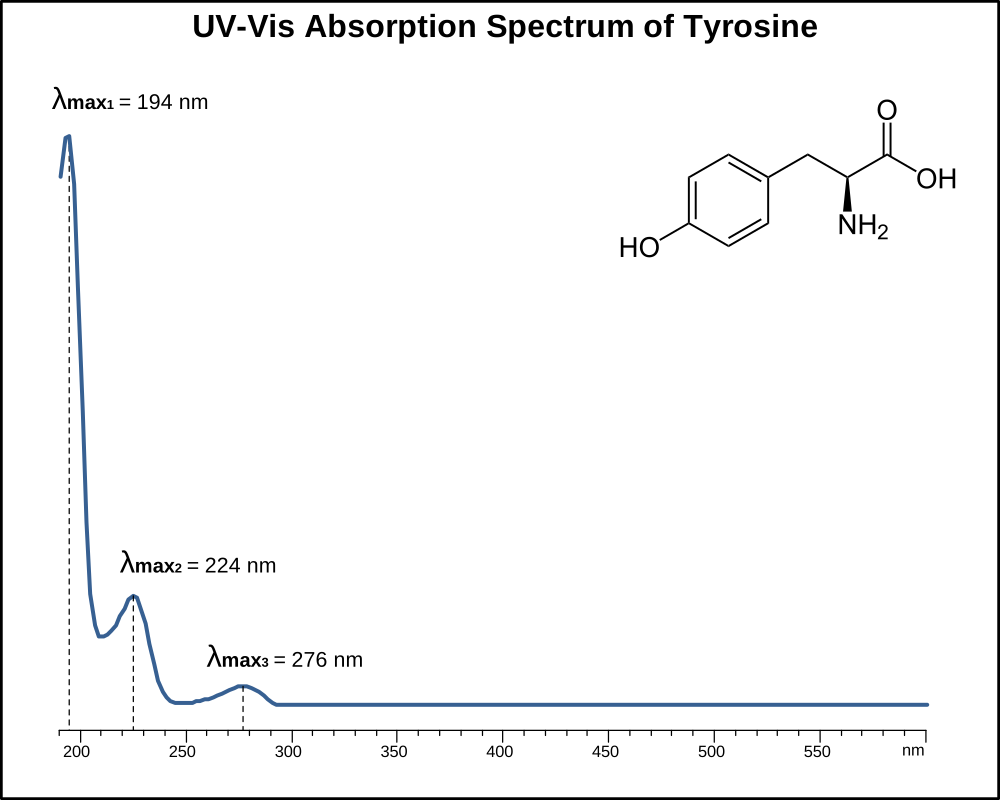
UV-Vis Spectrum of Tyrosine
July 8, 2024
Access the UV-Vis Spectrum SIELC Library
If you are looking for optimized HPLC method to analyze Tyrosine check our HPLC Applications library
For optimal results in HPLC analysis, it is recommended to measure absorbance at a wavelength that matches the absorption maximum of the compound(s) being analyzed. The UV spectrum shown can assist in selecting an appropriate wavelength for your analysis. Please note that certain mobile phases and buffers may block wavelengths below 230 nm, rendering absorbance measurement at these wavelengths ineffective. If detection below 230 nm is required, it is recommended to use acetonitrile and water as low UV-transparent mobile phases, with phosphoric acid and its salts, sulfuric acid, and TFA as buffers.

HPLC Separation of Mixture of Conditionally Essential Amino Acids on Primesep 100 Column
March 11, 2019
HPLC Method for L-Glutamine, Glycine, Cysteine, L-Cysteine, Proline, Tyrosine, Arginine, Amino Acids on Primesep 100 by SIELC Technologies
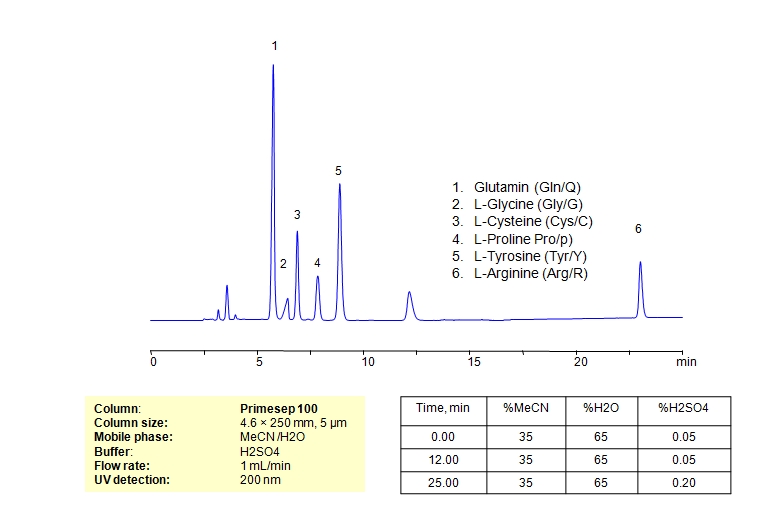
High Performance Liquid Chromatography (HPLC) Method for Analysis of L-Glutamine, Glycine, Cysteine, L-Cysteine, Proline, Tyrosine, Arginine, Amino Acids.
Glutamine is an amino acid with the chemical formula C5H10N2O3. It is a building block for protein, but it also supports the immune system, gut health, and detoxification. It is usually found in meat, fish, eggs, dairy, and whole grains; though some consider it the most abundant amino acid in the body. People also take glutamine as treatment for sickle cell disease, healing of burns, recovery after surgery, and injuries.
L-Glycine is an important amino acid compounds widely used in pharmaceutical, biochemical, and peptide research. It has he chemical formula C₂H₅NO₂. It is water-soluble and plays a critical role in protein synthesis, peptide modification, and metabolic studies. It can be found in meat., eggs. and bones.
L-Cysteine is an amino acid with the chemical formula C5H10N2O3. It is primarily a building block for protein, but it also has antioxidant effects. On occasion, ot os used to support people dealing with cancer, diabetes, and hangover, but there is yet to be substantial evidence that it works. Poultry, egg, beef, and whole grains are rich sources of the amino acid.
L-Proline is an amino acid with the chemical formula C5H9NO2. It is naturally produced in the body, but it is also recommended to be consumed through the diet. It can be found in meat, fish, and dairy. It is used for skin healing and treatment of other skin conditions as it is an essential component of collagen. It is important for upkeep of joints and tendons, as well as heart muscles.
L-Tyrosine is an amino acid with the chemical formula C9H11NO3. It is naturally used in the body to create neurotransmitters like dopamine and norepinephrine. While it is produced in the body naturally, it can also be consumed in beef, pork, fish, dairy products, and beans. As a supplement, it is also used to treat Phenylketonuria (PKU).
L-Arginine is an amino acid with the chemical formula C9H11NO3. It is a precursor for nitric acid, making it crucial for blood flow and general cardiovascular health. It can help lower blood pressure, help with chest pain, and improve symptoms of Peripheral arterial disease (PAD).
L-Glutamine, Glycine, Cysteine, L-Cysteine, Proline, Tyrosine, Arginine, Amino Acids can be retained and analyzed using the Primesep 100 stationary phase column. The analysis utilizes an isocratic method with a simple mobile phase consisting of water and acetonitrile (MeCN) with a sulfuric acid buffer. Detection is performed using UV.
| Column | Primesep 100, 4.6 x 250 mm, 5 µm, 100 A, dual ended |
| Mobile Phase | MeCN/H2O – 35/65% |
| Buffer | H2SO4 0.05% 12 min hold, gradient 0.05-0.20, 13 min |
| Flow Rate | 1.0 ml/min |
| Detection | UV, 200 nm |
| Class of Compounds |
Drug, Acid, Hydrophilic, Ionizable, Vitamin, Supplements, Amino acid |
| Analyzing Compounds | L-Glutamine, Glycine, Cysteine, L-Cysteine, Proline, Tyrosine, Arginine, Amino Acids |
Application Column
Primesep 100
Column Diameter: 4.6 mm
Column Length: 250 mm
Particle Size: 5 µm
Pore Size: 100 A
Column options: dual ended
Arginine
Cysteine
Glycine
L-Cysteine
L-Glutamine
Proline
Tyrosine
HPLC Separation of Lysine and Arginine from Other Amino Acids
July 10, 2012
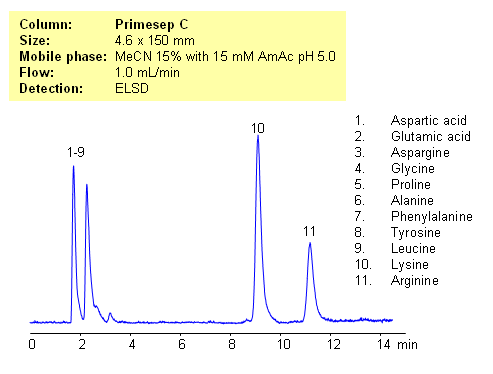
Application Notes: Amino acids are polar ionic compounds which are not retained on reversed-phase column without ion-pairing reagent. In our application, lysine and arginine can be separated from other amino acids. Amino acids with a pH between 3 and 5 and with one basic and one acidic group become very polar. Therefore these amino acids don’t have strong ion-exchange interaction with Primesep C stationary phase. Amino acids with two amino groups still carry positive net charge and can interact with stationary phase by cations-exchange mechanism. pH variation of the mobile phase can be an effective tool to adjust selectivity of separation for zwitter-ionic, basic and acidic compounds. This method can be used for separation of mono-charged compounds from compounds having an extra charge.
Application Columns: Primesep C
Application compounds: Aspartic acid, Glutamic acid, Aspargine, Glycine, Proline, Alanine, Phenylalanine, Tyrosine, Leucine, Lysine, Arginine
Detection technique: UV, LC/MS, ELSD/CAD
| Column | Primesep C, 4.6×150 mm, 5 µm, 100A |
| Mobile Phase | MeCN – 15% |
| Buffer | AmAc pH 5.0- 15 mM |
| Flow Rate | 1.0 ml/min |
| Detection | ELSD |
| Class of Compounds |
Drug, Acid, Hydrophilic, Ionizable, Vitamin, Supplements |
| Analyzing Compounds | Aspartic acid, Glutamic acid, Aspargine, Glycine, Proline, Alanine, Phenylalanine, Tyrosine, Leucine, Lysine, Arginine |
Application Column
Primesep C
The Primesep family of mixed-mode columns offers a wide variety of stationary phases, boasting unprecedented selectivity in the separation of a broad array of chemical compounds across multiple applications. Corresponding Primesep guard columns, available with all stationary phases, do not require holders. SIELC provides a method development service available to all customers. Inquire about our specially-tailored custom LC-phases for specific separations.
Select optionsArginine
Asparagine
Aspartic Acid
Glutamic Acid
Glycine
Leucine
Lysine
Phenylalanine
Proline
Tyrosine
UV Detection
HPLC Separation of Amino Acids in HILIC and Cation-Exchange Modes
July 14, 2011
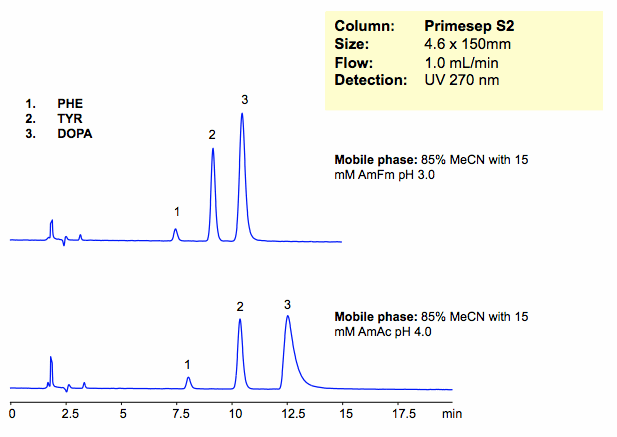
Amino acids can be retained and separated on a Primesep S2 column in HILIC/cation-exchange mode.
| Column | Primesep S2, 4.6×150 mm, 5 µm, 100A |
| Mobile Phase | MeCN/H2O |
| Buffer | AmFm |
| Flow Rate | 1.0 ml/min |
| Detection | UV, 270 nm |
| Class of Compounds |
Drug, Acid, Monocarboxylic acid, Hydrophilic, Ionizable, Hormone |
| Analyzing Compounds | Dopa, Tyrosine, Phenylalanine |
Application Column
Primesep S2
The Primesep family of mixed-mode columns offers a wide variety of stationary phases, boasting unprecedented selectivity in the separation of a broad array of chemical compounds across multiple applications. Corresponding Primesep guard columns, available with all stationary phases, do not require holders. SIELC provides a method development service available to all customers. Inquire about our specially-tailored custom LC-phases for specific separations.
Select optionsPhenylalanine
Tyrosine
HPLC Separation of Catecholamines on Primesep 100 Column with Phosphate Buffers
July 8, 2011
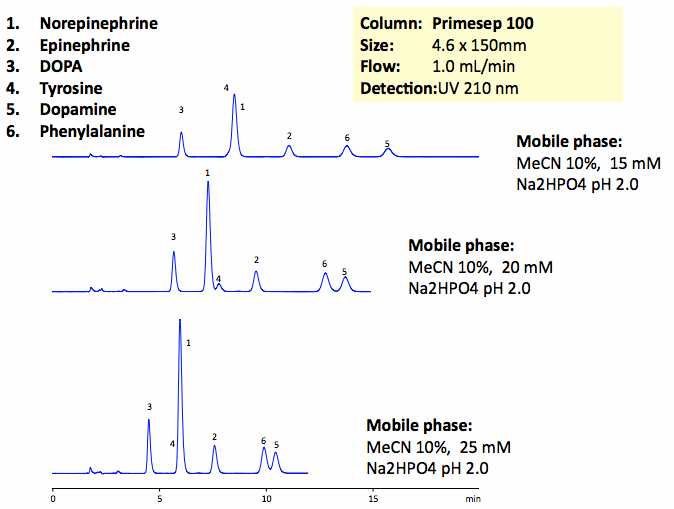
The catecholamine neurotransmitters are amino-acid derivatives of tyrosine. DOPA, tyrosine, phenylalanine, norepinephrine, epinephrine, and dopamine and baseline are resolved on a Primesep 100 column with UV-transparent phosphate buffer. This method can be used for analysis of catecholamines and related impurities in various matrices. Peak order and retention time can be changed by changing the amount of ACN, buffer concentration and buffer pH. Various buffers can be used to accommodate desired detection technique. Primesep 100 is a reversed-phase cation-exchange mixed-mode column that can be used for analysis of polar neutral, polar ionizable, polar zwitter-ionic, hydrophobic neutral, and hydrophobic ionic compounds in the same run. Column can be operated in reverse-phase, cation-exchange, anion-exclusion, HILIC and mixed-modes depending on the mobile phase selection and nature of analytes. Column is compatible with LC/MS and does not require use of ion-pairing reagents.
| Column | Primesep 100, 4.6×150 mm, 5 µm, 100A |
| Mobile Phase | MeCN/H2O |
| Buffer | Na2HPO4 |
| Flow Rate | 1.0 ml/min |
| Detection | UV, 210 nm |
| Class of Compounds |
Drug, Acid, Hydrophilic, Ionizable, Hormone |
| Analyzing Compounds | Tyrosine, DOPA, Phenylalanine, Norepinephrine, Epinephrine, Dopamine |
Application Column
Primesep 100
The Primesep family of mixed-mode columns offers a wide variety of stationary phases, boasting unprecedented selectivity in the separation of a broad array of chemical compounds across multiple applications. Corresponding Primesep guard columns, available with all stationary phases, do not require holders. SIELC provides a method development service available to all customers. Inquire about our specially-tailored custom LC-phases for specific separations.
Select optionsDopamine
Epinephrine
Norepinephrine
Phenylalanine
Tyrosine
HPLC Separation of Amino Acids in Zero Organic Mode on Primesep 200 column
July 8, 2011
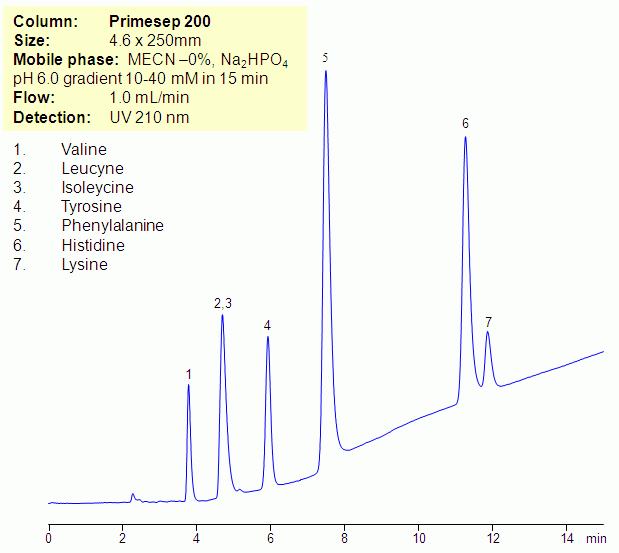
Essential and non-essential amino acids can be retained and separated in zero-organic mode on Primesep mixed-mode HPLC columns. Zero-organic mode is required to monitor isotopes of carbon. Amino acids are retained by combination of reversed-phase and cation-exchange mechanisms. At lower pH, some of the amino acids are more hydrophobic. Buffer pH will affect ionization state of amino acids, and at higher pH (above 2.5), the amino acids will be less hydrophobic and retentive in zero-organic mode. Amino acids can be monitored by low UV. Method can be used in archeological research for analysis of various molecules where presence of organic component of the mobile phase interferes with analysis.
| Column | Primesep 200, 4.6×250 mm, 5 µm, 100A |
| Mobile Phase | MeCN/H2O |
| Buffer | Na2HPO4 |
| Flow Rate | 1.0 ml/min |
| Detection | UV 210 nm |
| Class of Compounds |
Drug, Acid, Hydrophilic, Ionizable, Vitamin, Supplements |
| Analyzing Compounds | Valine, Leucyne, Isoleycine, Tyrosine, Phenylalanine, Histidine, Lysine |
Application Column
Primesep 200
The Primesep family of mixed-mode columns offers a wide variety of stationary phases, boasting unprecedented selectivity in the separation of a broad array of chemical compounds across multiple applications. Corresponding Primesep guard columns, available with all stationary phases, do not require holders. SIELC provides a method development service available to all customers. Inquire about our specially-tailored custom LC-phases for specific separations.
Select optionsIsoleucine
Leucine
Lysine
Phenylalanine
Tyrosine
Valine
HPLC Analysis of Polar Basic and Acetic Compounds on Primesep AB Column
May 6, 2010
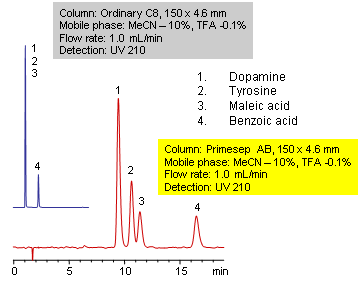
Mixture of polar acidic and basic compounds is separated on a Primesep AB mixed-mode HPLC column. Dopamine and tyrosine are retained by combination of reversed-phase and cation-exchange mechanisms. Maleic acid is retained by anion-exchange mechanism, and benzoic acid is retained by reversed-phase mechanism. Primesep AB is a trimodal column with a C12 hydrophobic chain and cation-exchange and anion exchange groups on the surface. Method utilizes UV detection but can be used with other detection techniques (ELSD, LC/MS, Corona).
| Column | Primesep AB, 4.6×150 mm, 5 µm, 100A |
| Mobile Phase | MeCN/H2O |
| Buffer | TFA – 0.1% |
| Flow Rate | 1.0 ml/min |
| Detection | UV, 210 nm |
| Class of Compounds |
Drug, Acid, Monocarboxylic acid, Hydrophilic, Ionizable, Hormone |
| Analyzing Compounds | Tyrosine, Dopamine, Maleic Acid, Benzoic Acid |
Application Column
Primesep AB
The Primesep family of mixed-mode columns offers a wide variety of stationary phases, boasting unprecedented selectivity in the separation of a broad array of chemical compounds across multiple applications. Corresponding Primesep guard columns, available with all stationary phases, do not require holders. SIELC provides a method development service available to all customers. Inquire about our specially-tailored custom LC-phases for specific separations.
Select optionsDopamine
Maleic Acid
Tyrosine
Complex Mixture of Acids, Bases, Amino Acids, and Neutral Compounds
October 14, 2006
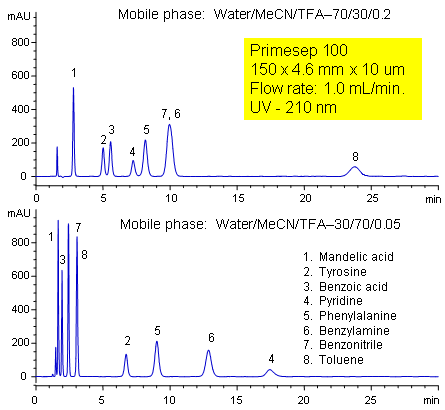
Primesep 100 separates a mixture of amino acids (tyrosine, phenylalanine), organic acids (benzoic acid, mandelic acid), amines (benzylamine, pyridine), and neutrals (benzonitrile, toluene) in one HPLC run by combining reversed-phase, cation-exchange, and polar interactions. The method is tunable and peak order can be changed significantly by adjusting acetonitrile and trifluoroacetic acid concentrations. The separation method uses a mobile phase mixture of water, acetonitrile (MeCN, ACN) and trifluoracetic acid (TFA) and compatible with UV, mass spec (LC/MS) and evaporative light scattering (ELSD) detection.
| Column | Primesep 100, 4.6×250 mm, 5 µm, 100A |
| Mobile Phase | MeCN/H2O – 30/70% |
| Buffer | TFA – 0.2 |
| Flow Rate | 1.0 ml/min |
| Detection | UV, 210 nm |
| Class of Compounds |
Drug, Acid, Hydrophilic, Ionizable, Vitamin, Supplements, Amino acid |
| Analyzing Compounds | Tyrosine, phenylalanine, Benzoic acid, mandelic acid, Benzylamine, Pyridine, Benzonitrile, Toluene |
Application Column
Primesep 100
The Primesep family of mixed-mode columns offers a wide variety of stationary phases, boasting unprecedented selectivity in the separation of a broad array of chemical compounds across multiple applications. Corresponding Primesep guard columns, available with all stationary phases, do not require holders. SIELC provides a method development service available to all customers. Inquire about our specially-tailored custom LC-phases for specific separations.
Select optionsBenzoic Acid
Benzonitrile
Benzylamine
Mandelic Acid
Organic Acids
Phenylalanine
Pyridine
Toluene
Tyrosine
HPLC Separation of Compounds of Catecholamine Pathway
March 3, 2006
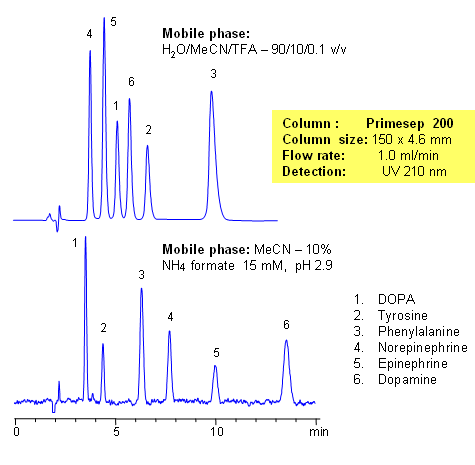
The catecholamine neurotransmitters are amino-acid derivatives of tyrosine. DOPA, tyrosine, phenylalanine, norepinephrine, epinephrine, and dopamine and baseline are resolved on a
Primesep 200 column with UV-transparent phosphate buffer. This method can be used for the analysis of catecholamines and related impurities in various matrices. The peak order and retention time can be changed by changing the amount of ACN, buffer concentration and buffer pH. Various buffers can be used to accommodate the desired detection technique. Primesep 200 is a reversed-phase cation-exchange mixed-mode column that can be used for analysis of polar neutral, polar ionizable, polar zwitterionic, hydrophobic neutral, and hydrophobic ionic compounds in the same run. Column can be operated in reverse-phase, cation-exchange, anion-exclusion, HILIC and mixed-modes depending on the mobile phase selection and the nature of the analytes. The column is compatible with LC/MS and does not require the use of ion-pairing reagents.
| Column | Primesep 200, 4.6×150 mm, 5 µm, 100A |
| Mobile Phase | MeCN/H2O |
| Buffer | TFA, AmFm |
| Flow Rate | 1.0 ml/min |
| Detection | UV, 210 nm |
| Class of Compounds |
Drug, Acid, Hydrophilic, Ionizable, Hormone |
| Analyzing Compounds | Tyrosine, DOPA, Phenylalanine, Norepinephrine, Epinephrine, Dopamine |
Application Column
Primesep 200
The Primesep family of mixed-mode columns offers a wide variety of stationary phases, boasting unprecedented selectivity in the separation of a broad array of chemical compounds across multiple applications. Corresponding Primesep guard columns, available with all stationary phases, do not require holders. SIELC provides a method development service available to all customers. Inquire about our specially-tailored custom LC-phases for specific separations.
Select optionsDopamine
Epinephrine
Phenylalanine
Tyrosine
UV Detection
Bufferless Ion Separation (BLIS™) Chromatography of Amino Acids (1)
January 13, 2005
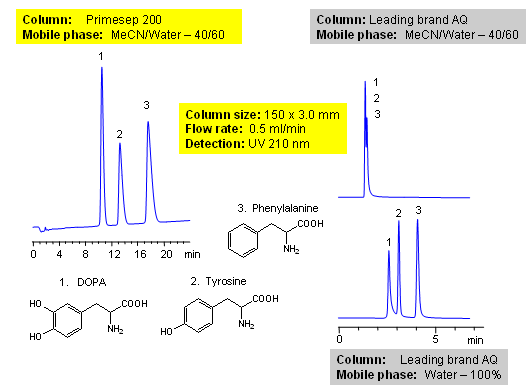
Amino acids are the building blocks of proteins and are widely used as supplements. Amino acids can exist in acidic, basic or zwitterionic form depending on the pH of their environment (mobile phase in this case). Primesep 200 is a reverse-phase column with embedded weak acidic ion-pairing groups which allows for retention and separation of amino acids without requiring a buffer making it ideal for use with UV detection, mass spectrometry (MS), evaporative light scattering detection (ELSD).
| Column | Primesep 200, 3.0×150 mm, 5 µm, 100A |
| Mobile Phase | MeCN/H2O – 40/60% |
| Buffer | No |
| Flow Rate | 0.5 ml/min |
| Detection | UV, 210 nm |
| Class of Compounds |
Drug, Acid, Hydrophilic, Ionizable, Vitamin, Supplements, Amino acid |
| Analyzing Compounds | Dopa, Phenylalanine, Tyrosine |
Application Column
Primesep 200
The Primesep family of mixed-mode columns offers a wide variety of stationary phases, boasting unprecedented selectivity in the separation of a broad array of chemical compounds across multiple applications. Corresponding Primesep guard columns, available with all stationary phases, do not require holders. SIELC provides a method development service available to all customers. Inquire about our specially-tailored custom LC-phases for specific separations.
Select optionsPhenylalanine
Tyrosine
HPLC Analysis of the Catecholamine Pathway
January 17, 2004
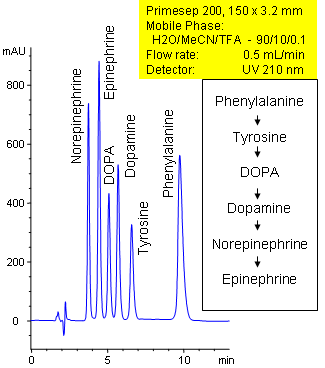
Primesep 200 separates catecholamines in the catecholamine pathway in 10 minutes. Phenylalanine, tyrosine, DOPA, dopamine, norepinephrine, and epinephrine are baseline resolved by a combination of reversed-phase, ion-exchange, and ion-exclusion mechanisms. Excellent peak shape results with a mass spec compatible mobile phase of water, acetonitrile (MeCN, ACN) and trifluoracetic acid (TFA) with UV detection at 210 nm.
| Column | Primesep 200, 3.2×150 mm, 5 µm, 100A |
| Mobile Phase | MeCN/H2O – 10/90% |
| Buffer | TFA – 0.1% |
| Flow Rate | 0.5 ml/min |
| Detection | UV, 210 nm |
| Class of Compounds |
Drug, Acid, Hydrophilic, Ionizable, Hormone |
| Analyzing Compounds | Tyrosine, DOPA, Phenylalanine, Norepinephrine, Epinephrine, Dopamine |
Application Column
Primesep 200
The Primesep family of mixed-mode columns offers a wide variety of stationary phases, boasting unprecedented selectivity in the separation of a broad array of chemical compounds across multiple applications. Corresponding Primesep guard columns, available with all stationary phases, do not require holders. SIELC provides a method development service available to all customers. Inquire about our specially-tailored custom LC-phases for specific separations.
Select optionsDopamine
Epinephrine
Phenylalanine
Tyrosine
