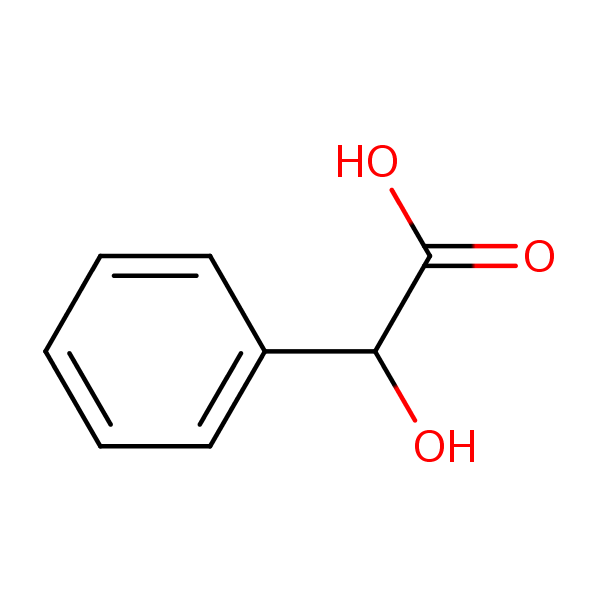
| CAS Number | 90-64-2 |
|---|---|
| Molecular Formula | C8H8O3 |
| Molecular Weight | 152.149 |
| InChI Key | IWYDHOAUDWTVEP-UHFFFAOYSA-N |
| LogP | 0.62 |
| Synonyms |
|
Applications:
HPLC Chiral Separation of Mandelic Acid Enantiomers on Cyralis CM Column
June 18, 2026
HPLC Chiral Method for Analysis of Mandelic Acid Enantiomers on Cyralis CM Column by SIELC Technologies
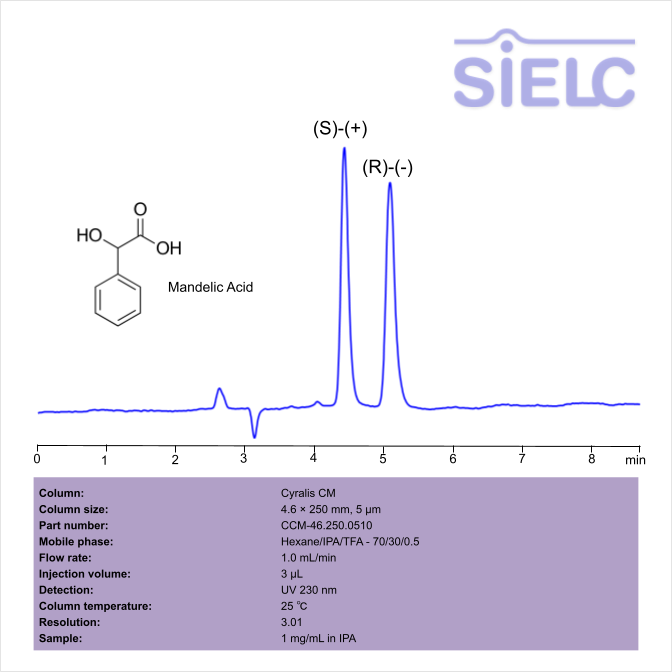
High Performance Liquid Chromatography (HPLC) Method for Analysis of Mandelic Acid.
Mandelic Acid is a an aromatic alpha hydroxy acid with the chemical formula C8H8O3. It is used primarily as a precursor in organic synthesis of various drugs. While it is also a common component of chemical face peels, it is not recommended as treatment for acne. You can find detailed UV spectra of Mandelic Acid and information about its various lambda maxima by visiting the following link.
This application describes a normal-phase chiral HPLC method for the separation of Mandelic Acid enantiomers using SIELC’s Cyralis CM chiral column. Cyralis CM is a cellulose-based chiral stationary phase (CSP) designed for enantiomeric separations, optical purity testing, chiral impurity analysis, and stereoisomer characterization in pharmaceutical, chemical, agrochemical, and fine chemical applications.
Mandelic Acid can be retained and analyzed using the Cyralis CM stationary phase column. The analysis utilizes an isocratic method with a mobile phase consisting of Hexane, IPA, and TFA. Detection is performed using UV.
Condition
| Column | Cyralis CM, 4.6 x 250 mm, 5 µm, 100 A, normal phase |
| Mobile Phase | Hexane/IPA/TFA – 70/30/0.5% |
| Flow Rate | 1.0 mL/min |
| Detection | UV 230 nm |
| Resolution | 3.01 |
Description
| Class of Compounds | Acid |
| Analyzing Compounds | Mandelic Acid |
Application Column
Cyralis CM
Column Diameter: 4.6 mm
Column Length: 250 mm
Particle Size: 5 µm
Pore Size: 100 A
Column options: normal phase

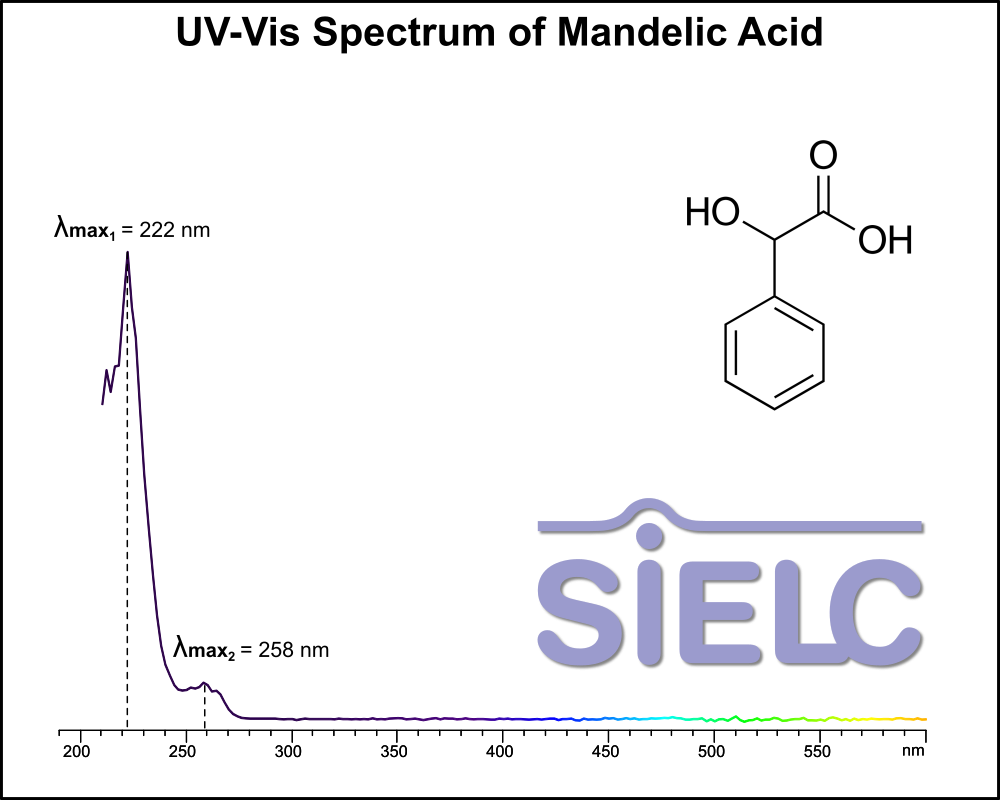
UV-Vis Spectrum of Mandelic Acid
December 18, 2025
If you are looking for optimized HPLC method to analyze Mandelic Acid check our HPLC Applications library
UV/Vis.: λmax: 222, 258.
For optimal results in HPLC analysis, it is recommended to measure absorbance at a wavelength that matches the absorption maximum of the compound(s) being analyzed. The UV spectrum shown can assist in selecting an appropriate wavelength for your analysis. Please note that certain mobile phases and buffers may block wavelengths below 230 nm, rendering absorbance measurement at these wavelengths ineffective. If detection below 230 nm is required, it is recommended to use acetonitrile and water as low UV-transparent mobile phases, with phosphoric acid and its salts, sulfuric acid, and TFA as buffers.
For some compounds, the UV-Vis Spectrum is affected by the pH of the mobile phase. The compound was dissolved in IPA. This analysis was done with the mobile phase of hexane, IPA, and TFA.
HILIC Separation of Carboxylic Acids
August 22, 2008
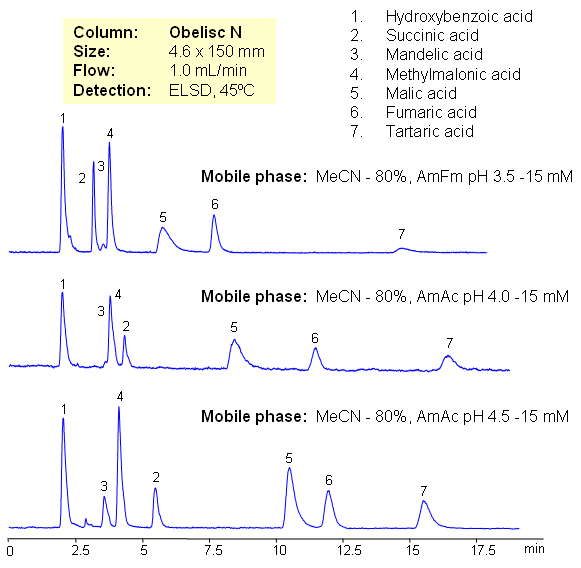
Hydrophilic acids are separated on Obelisc N mixed-mode HILIC column. Seven carboxylic acids are separated based on their polarity and pKa values. Changes in ionization states of acids and stationary phase can be used to control elution order of organic and inorganic acids.
Application Column
Obelisc N
SIELC has developed the Obelisc™ columns, which are mixed-mode and utilize Liquid Separation Cell technology (LiSC™). These cost-effective columns are the first of their kind to be commercially available and can replace multiple HPLC columns, including reversed-phase (RP), AQ-type reversed-phase, polar-embedded group RP columns, normal-phase, cation-exchange, anion-exchange, ion-exclusion, and HILIC (Hydrophilic Interaction Liquid Chromatography) columns. By controlling just three orthogonal method parameters - buffer concentration, buffer pH, and organic modifier concentration - users can adjust the column properties with pinpoint precision to separate complex mixtures.
Select optionsHydroxybenzoic Acid
Malic Acid
Mandelic Acid
Methylmalonic Acid
Organic Acids
Succinic Acid
Tartaric Acid
Complex Mixture of Acids, Bases, Amino Acids, and Neutral Compounds
October 14, 2006
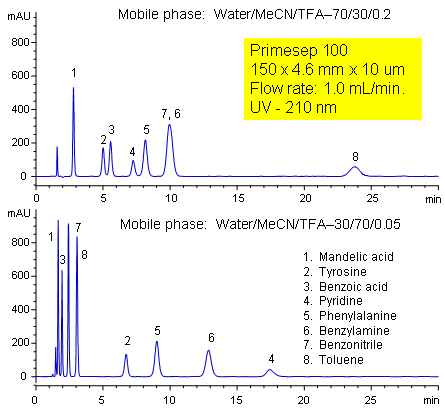
Primesep 100 separates a mixture of amino acids (tyrosine, phenylalanine), organic acids (benzoic acid, mandelic acid), amines (benzylamine, pyridine), and neutrals (benzonitrile, toluene) in one HPLC run by combining reversed-phase, cation-exchange, and polar interactions. The method is tunable and peak order can be changed significantly by adjusting acetonitrile and trifluoroacetic acid concentrations. The separation method uses a mobile phase mixture of water, acetonitrile (MeCN, ACN) and trifluoracetic acid (TFA) and compatible with UV, mass spec (LC/MS) and evaporative light scattering (ELSD) detection.
| Column | Primesep 100, 4.6×250 mm, 5 µm, 100A |
| Mobile Phase | MeCN/H2O – 30/70% |
| Buffer | TFA – 0.2 |
| Flow Rate | 1.0 ml/min |
| Detection | UV, 210 nm |
| Class of Compounds |
Drug, Acid, Hydrophilic, Ionizable, Vitamin, Supplements, Amino acid |
| Analyzing Compounds | Tyrosine, phenylalanine, Benzoic acid, mandelic acid, Benzylamine, Pyridine, Benzonitrile, Toluene |
Application Column
Primesep 100
The Primesep family of mixed-mode columns offers a wide variety of stationary phases, boasting unprecedented selectivity in the separation of a broad array of chemical compounds across multiple applications. Corresponding Primesep guard columns, available with all stationary phases, do not require holders. SIELC provides a method development service available to all customers. Inquire about our specially-tailored custom LC-phases for specific separations.
Select optionsBenzoic Acid
Benzonitrile
Benzylamine
Mandelic Acid
Organic Acids
Phenylalanine
Pyridine
Toluene
Tyrosine
