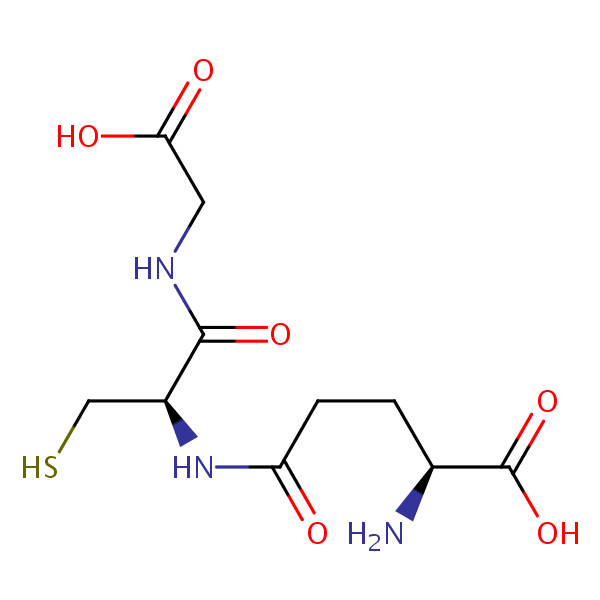
| CAS Number | 70-18-8 |
|---|---|
| Molecular Formula | C10H17N3O6S |
| Molecular Weight | 307.321 |
| InChI Key | RWSXRVCMGQZWBV-WDSKDSINSA-N |
| LogP | -2.58 |
| Synonyms |
|
Applications:
HPLC Method for Separation of Glutathione (GSH) and Oxidized Glutathione (GSSG) on Chromni Column
September 1, 2026
HPLC Method for Analysis of Glutathione, Glutathione oxidized (GSSG) on Chromni Column by SIELC Technologies
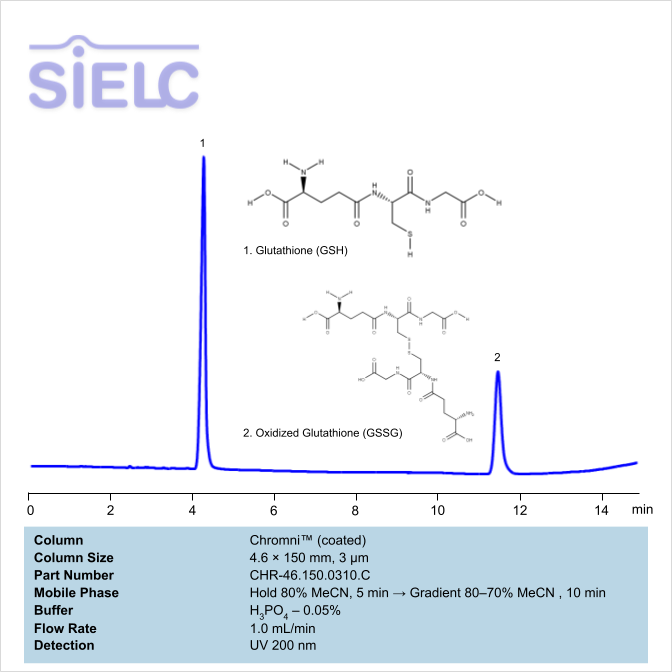
High Performance Liquid Chromatography (HPLC) Method for Analysis of Glutathione, Glutathione oxidized (GSSG).
following link.
Glutathione, reduced (GSH) is a tripeptide (small protein) consisting of the amino acids glutamic acid, cysteine, and glycine. It has the chemical formula C10H17N3O6S. GSH serves as an antioxidant, helping to prevent damage to cellular components caused by reactive oxygen species such as free radicals and peroxides. In fact, it is the most prevalent endogenous antioxidant, protecting cells from damage by neutralizing harmful free radicals and reactive oxygen species. It also regenerates other antioxidants, like vitamins C and E, from their oxidized forms. It contributes to the neutralization of many different types of harmful substances, such as pollutants, heavy metals, and some drugs, thereby aiding in the detoxification process. Not only that, it plays a crucial role in the proper function of white blood cells, including T cell lymphocytes—the foundation of adaptive immunity. Low levels of glutathione have been linked to several diseases, including cancer, neurodegenerative disorders such as Parkinson’s disease, cardiovascular diseases, and HIV/AIDS. Additionally, glutathione levels typically decrease with age, which can contribute to the aging process. Glutathione is primarily synthesized in the liver and then distributed to other tissues in the body. It can also be obtained from some foods, especially fruits, vegetables, and meats. You can find detailed UV spectra of Glutathione and information about its various lambda maxima by visiting the following link.
Oxidized glutathione, or glutathione disulfide (GSSG), is a form of the antioxidant molecule glutathione with the chemical formula C20H32N6O12S2. Glutathione exists in two forms: the reduced form (GSH), which is the active antioxidant, and the oxidized form (GSSG). When glutathione neutralizes a free radical or a reactive oxygen species, it becomes oxidized and forms GSSG. The ratio of GSH to GSSG within cells is often used as a measure of cellular oxidative stress. The body can convert GSSG back into the active GSH form using an enzyme called glutathione reductase, provided there are adequate levels of NADPH, a compound integral to many cellular processes, including the antioxidant response.
Glutathione, Glutathione oxidized (GSSG) can be retained and analyzed using the Chromni stationary phase column. The analysis utilizes a gradient method with a simple mobile phase consisting of water and acetonitrile (MeCN) and phosphoric acid. Detection is performed using UV.
Condition
| Column | Chromni, 4.6 x 150 mm, 3 µm, 100 A, surface coated |
| Mobile Phase | MeCN/H2O |
| Buffer | H3PO4 – 0.05% |
| Flow Rate | 1.0 ml/min |
| Detection | UV 200 nm |
Description
| Class of Compounds | Amino Acids |
| Analyzing Compounds | Glutathione, Glutathione oxidized (GSSG) |
Application Column
Chromni
Column Diameter: 4.6 mm
Column Length: 150 mm
Particle Size: 3 µm
Pore Size: 100 A
Column options: surface coated
Glutathione oxidized (GSSG)

UV-Vis Spectrum of Glutathione Reduced
July 11, 2024
Access the UV-Vis Spectrum SIELC Library
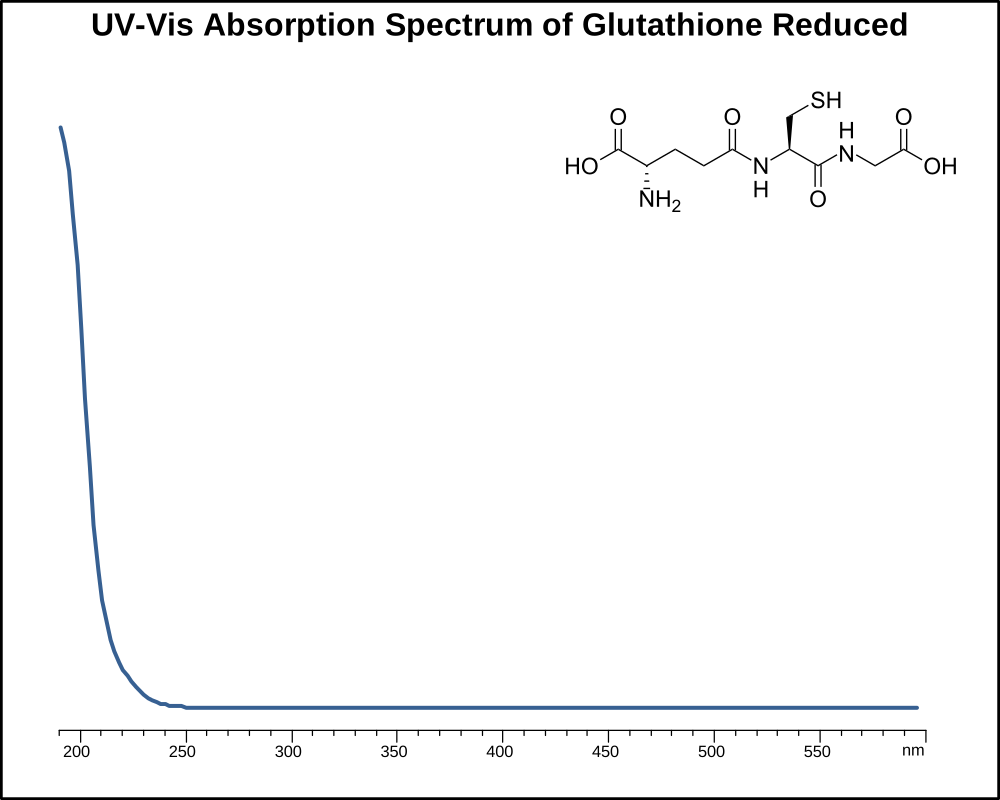
UV-Vis Spectrum of Glutathione. Absorption starts high at 190 nm but quickly falls off and bottoms out around 245 nm.
If you are looking for optimized HPLC method to analyze Glutathione check our HPLC Applications library
For optimal results in HPLC analysis, it is recommended to measure absorbance at a wavelength that matches the absorption maximum of the compound(s) being analyzed. The UV spectrum shown can assist in selecting an appropriate wavelength for your analysis. Please note that certain mobile phases and buffers may block wavelengths below 230 nm, rendering absorbance measurement at these wavelengths ineffective. If detection below 230 nm is required, it is recommended to use acetonitrile and water as low UV-transparent mobile phases, with phosphoric acid and its salts, sulfuric acid, and TFA as buffers.
HPLC Method for Analysis of Glutathione reduced (GSH) on Primesep 100 Column
June 14, 2023
HPLC Method for Analysis of Glutathione on Primesep 100 by SIELC Technologies
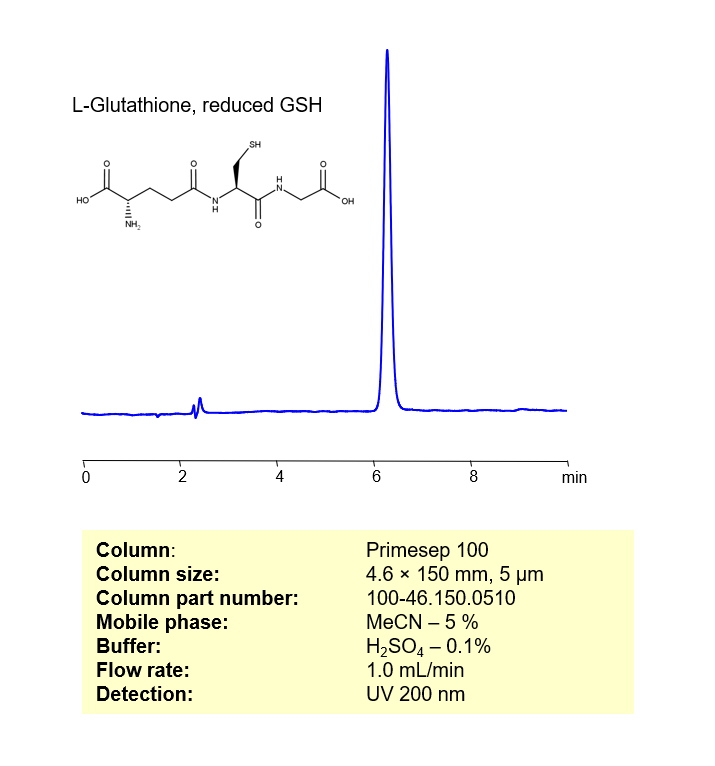
L-Glutathione, also known as reduced glutathione or simply GSH, is a tripeptide made up of three amino acids: L-glutamic acid, L-cysteine, and glycine. It has the chemical formula C10H17N3O6S.
Glutathione is found in nearly all cells, and in its reduced form (GSH), it is a powerful antioxidant. It plays a crucial role in protecting cells against oxidative stress by neutralizing reactive oxygen species such as free radicals and peroxides.
The unique aspect of glutathione is the cysteine thiol group (SH) which acts as a reducing agent and can be reversibly oxidized and reduced. In cells, glutathione is maintained in the reduced form by the enzyme glutathione reductase, which reduces the disulfide form of the molecule (GSSG, glutathione disulfide) back to GSH.
Apart from being an antioxidant, glutathione also plays other important roles including detoxification, immune system support, protein function regulation, and as a cofactor for various enzymes. Its deficiency can lead to cellular stress and dysfunction, underscoring its vital role in maintaining cellular health.
In supplement form, L-Glutathione is often used with the intent to support antioxidant activity in the body. However, it is important to consult with a healthcare provider before starting any new supplement regimen.
Glutathione can be retained and analyzed using a reverse-phase Primesep 100 column. The mobile phase for this method consists of water, acetonitrile (MeCN), and sulfuric acid, which serves as a buffer. This analytical method can be monitored using UV detection at 200 nm.
LOD was determined for this combination of instrument, method, and analyte, and it can vary from one laboratory to another even when the same general type of analysis is being performed.
Condition
| Column | Primesep 100, 4.6 x 150 mm, 5 µm, 100 A, dual ended |
| Mobile Phase | MeCN/H2O -5/95% |
| Buffer | H2SO4 – 0.1% |
| Flow Rate | 1.0 ml/min |
| Detection | UV 200 nm |
| Peak Retention Time | 6,12 min |
| Sample concentration | 0.5 mg/ml |
| Injection volume | 1 µl |
| Sample diluent | H2O + NaOH |
| LOD | 50 ppb |
Description
| Class of Compounds | Thiol, Amino acid |
| Analyzing Compounds | Glutathione |
Application Column
Primesep 100
Column Diameter: 4.6 mm
Column Length: 150 mm
Particle Size: 5 µm
Pore Size: 100 A
Column options: dual ended
HPLC Method for Separation of Sulfur-containing Biomolecules on Primesep 100 Column
June 13, 2023
HPLC Method for Separation of Cysteine, Glutathione, reduced, Cystine, Cysteine-glutathione disulfide, Glutathione oxidized on Primesep 100 by SIELC Technologies
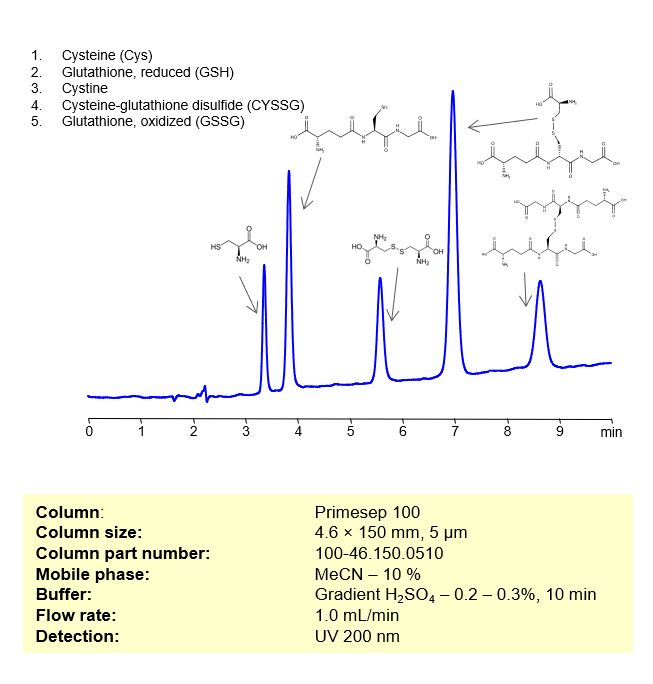
These compounds are all involved in redox reactions and cellular defenses against oxidative stress in biological systems. Here’s a bit more about each of them:
Cysteine is an amino acid with the chemical formula C5H10N2O3. It is primarily a building block for protein, but it also has antioxidant effects. On occasion, it is used to support people dealing with cancer, diabetes, and hangover, but there is yet to be substantial evidence that it works. Poultry, egg, beef, and whole grains are rich sources of the amino acid. This is a sulfur-containing amino acid that’s used in the biosynthesis of proteins. Its thiol side chain often participates in enzymatic reactions, and contributes to the stability of proteins by forming disulfide bonds. You can find detailed UV spectra of Cysteine and information about its various lambda maxima by visiting the following link.
Glutathione, reduced (GSH) is a tripeptide (small protein) consisting of the amino acids glutamic acid, cysteine, and glycine. It has the chemical formula C10H17N3O6S. GSH serves as an antioxidant, helping to prevent damage to cellular components caused by reactive oxygen species such as free radicals and peroxides. In fact, it is the most prevalent endogenous antioxidant, protecting cells from damage by neutralizing harmful free radicals and reactive oxygen species. It also regenerates other antioxidants, like vitamins C and E, from their oxidized forms. It contributes to the neutralization of many different types of harmful substances, such as pollutants, heavy metals, and some drugs, thereby aiding in the detoxification process. Not only that, it plays a crucial role in the proper function of white blood cells, including T cell lymphocytes—the foundation of adaptive immunity. Low levels of glutathione have been linked to several diseases, including cancer, neurodegenerative disorders such as Parkinson’s disease, cardiovascular diseases, and HIV/AIDS. Additionally, glutathione levels typically decrease with age, which can contribute to the aging process. Glutathione is primarily synthesized in the liver and then distributed to other tissues in the body. It can also be obtained from some foods, especially fruits, vegetables, and meats. You can find detailed UV spectra of Glutathione and information about its various lambda maxima by visiting the following link.
Cystine is an amino acid with the molecular formula C6H12N2O4S2. It plays a crucial role in various biological processes due to its ability to stabilize protein three-dimensional structures. It is a covalently bonded dimer molecule of two cysteine molecules, connected through a disulfide bond. Disulfide bonds between cysteine residues in peptide chains contribute to the 3D structure of proteins. In dietary supplements and food labeling, this compound is often referred to as a conditionally essential amino acid. It serves as a major precursor for the synthesis of glutathione. UV spectra of Cystine and information about its various lambda maxima by visiting the following link.
Cysteine-glutathione disulfide (CySSG) is a mixed disulfide with the chemical formula C13H22N4O8S2. It is formed by the reaction of glutathione with the oxidized form of cysteine (cystine). It is one of the forms in which cysteine is stored and transported in plasma. UV spectra of Cysteine-glutathione disulfide and information about its various lambda maxima by visiting the following link.
Oxidized glutathione, or glutathione disulfide (GSSG), is a form of the antioxidant molecule glutathione with the chemical formula C20H32N6O12S2. Glutathione exists in two forms: the reduced form (GSH), which is the active antioxidant, and the oxidized form (GSSG). When glutathione neutralizes a free radical or a reactive oxygen species, it becomes oxidized and forms GSSG. The ratio of GSH to GSSG within cells is often used as a measure of cellular oxidative stress. The body can convert GSSG back into the active GSH form using an enzyme called glutathione reductase, provided there are adequate levels of NADPH, a compound integral to many cellular processes, including the antioxidant response.
Overall, these molecules play vital roles in the body’s antioxidant defenses, detoxification of xenobiotics, modulation of redox-controlled signaling pathways, and regulation of cellular proliferation and apoptosis.
Cysteine, Cystine, Cysteine-glutathione disulfide, Glutathione, Glutathione oxidized (GSSG) can be retained, separated, and analyzed using a reverse-phase Primesep 100 column. The mobile phase for this method consists of water, acetonitrile (MeCN), and Sulfuric acid, which serves as a buffer.
Condition
| Column | Primesep 100, 4.6 x 150 mm, 5 µm, 100 A, dual ended |
| Mobile Phase | MeCN -10% |
| Buffer | Gradient H2SO4 0.1-0.3%, 10 min |
| Flow Rate | 1.0 ml/min |
| Detection | UV 200 nm |
Description
| Class of Compounds | Thiol, Amino acid |
| Analyzing Compounds | Cysteine, Glutathione, reduced, Cystine, Cysteine-glutathione disulfide, Glutathione oxidized |
Application Column
Primesep 100
Column Diameter: 4.6 mm
Column Length: 150 mm
Particle Size: 5 µm
Pore Size: 100 A
Column options: dual ended
Cysteine-glutathione disulfide
Cystine
Glutathione
Glutathione oxidized (GSSG)
HPLC Method for Analysis off Glutathione on Primesep 100 Column
March 6, 2020
HPLC Method for Separation of Glutathione on Primesep 100 by SIELC Technologies
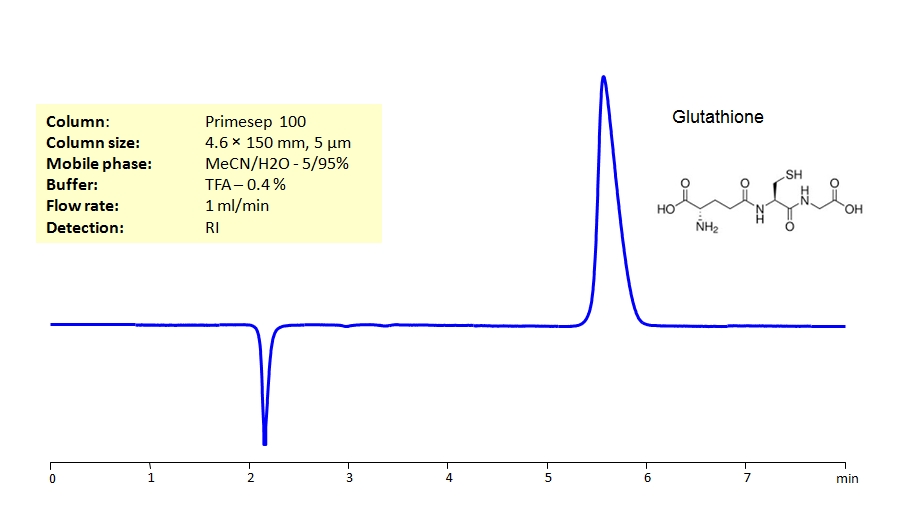
High Performance Liquid Chromatography (HPLC) Method for Analysis of Glutathione.
Glutathione is a tripeptide composed of three amino acids: glutamate, cysteine, and glycine. It’s often referred to as the body’s “master antioxidant” because of its vital role in maintaining cellular health and preventing oxidative stress.
Here are some key functions and characteristics of glutathione:
- Antioxidant Function: Glutathione is the most prevalent endogenous antioxidant, protecting cells from damage by neutralizing harmful free radicals and reactive oxygen species. It also regenerates other antioxidants, like vitamins C and E, from their oxidized forms.
- Detoxification: Glutathione contributes to the neutralization of many different types of harmful substances, such as pollutants, heavy metals, and some drugs, thereby aiding in the detoxification process.
- Immune System Support: It plays a crucial role in the proper function of white blood cells, including T cell lymphocytes—the foundation of adaptive immunity.
- Health and Disease: Low levels of glutathione have been linked to several diseases, including cancer, neurodegenerative disorders such as Parkinson’s disease, cardiovascular diseases, and HIV/AIDS. Additionally, glutathione levels typically decrease with age, which can contribute to the aging process.
Glutathione is primarily synthesized in the liver and then distributed to other tissues in the body. It can also be obtained from some foods, especially fruits, vegetables, and meats.
Glutathione can be retained on Primesep 100 mixed-mode column using a mobile phase of Acetonitrile (ACN), water and Trifluoroacetic acid (TFA) buffer. This analysis method can be detected via Refraction Index (RI) Detection, mass spectrometry (MS), evaporative light scattering detection (ELSD) and Charged aerosol detection (CAD).
High Performance Liquid Chromatography (HPLC) Method for Analysis of Glutathione
| Column | Primesep 100, 4.6 x 150 mm, 5 µm, 100 A, dual ended |
| Mobile Phase | MeCN/H2O – 5/95% |
| Buffer | TFA – 0.4% |
| Flow Rate | 1.0 ml/min |
| Detection | RI |
| Class of Compounds | Drug, Acid, Hydrophilic, Ionizable, Vitamin, Supplements, Amino acid |
| Analyzing Compounds | Glutathione |
Application Column
Primesep 100
Column Diameter: 4.6 mm
Column Length: 150 mm
Particle Size: 5 µm
Pore Size: 100 A
Column options: dual ended
Separation of Glutathione on Newcrom R1 HPLC column
February 16, 2018
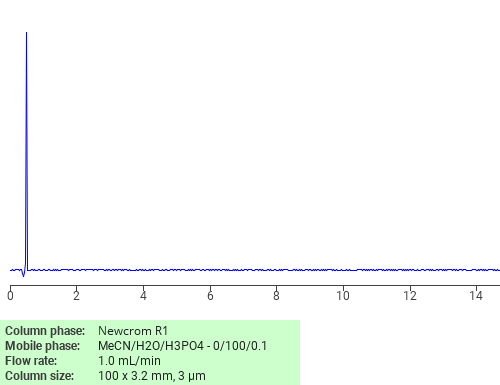
Glutathione can be analyzed by this reverse phase (RP) HPLC method with simple conditions. The mobile phase contains an acetonitrile (MeCN), water, and phosphoric acid. For Mass-Spec (MS) compatible applications the phosphoric acid needs to be replaced with formic acid. Smaller 3 µm particles columns available for fast UPLC applications. This liquid chromatography method is scalable and can be used for isolation impurities in preparative separation. It also suitable for pharmacokinetics.
Application Column
Newcrom R1
The Newcrom columns are a family of reverse-phase-based columns. Newcrom A, AH, B, and BH are all mixed-mode columns with either positive or negative ion-pairing groups attached to either short (25 Å) or long (100 Å) ligand chains. Newcrom R1 is a special reverse-phase column with low silanol activity.
Select options
