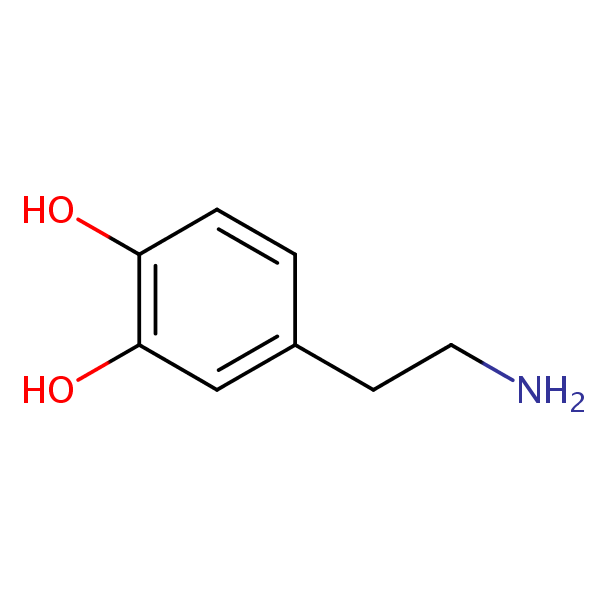
| CAS Number | 51-61-6 |
|---|---|
| Molecular Formula | C8H11NO2 |
| Molecular Weight | 153.181 |
| InChI Key | VYFYYTLLBUKUHU-UHFFFAOYSA-N |
| LogP | -0.980 |
| Synonyms |
|
Applications:
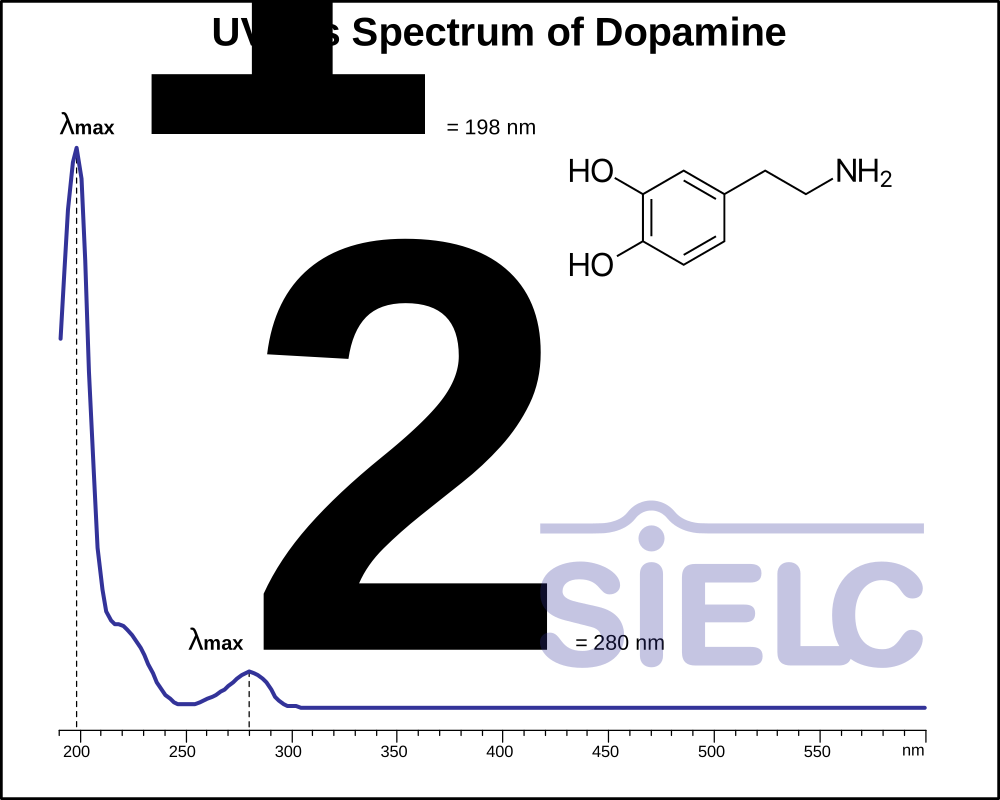
UV-Vis Spectrum of Dopamine
July 19, 2024
Access the UV-Vis Spectrum SIELC Library
If you are looking for optimized HPLC method to analyze Dopamine check our HPLC Applications library
For optimal results in HPLC analysis, it is recommended to measure absorbance at a wavelength that matches the absorption maximum of the compound(s) being analyzed. The UV spectrum shown can assist in selecting an appropriate wavelength for your analysis. Please note that certain mobile phases and buffers may block wavelengths below 230 nm, rendering absorbance measurement at these wavelengths ineffective. If detection below 230 nm is required, it is recommended to use acetonitrile and water as low UV-transparent mobile phases, with phosphoric acid and its salts, sulfuric acid, and TFA as buffers.
For some compounds, the UV-Vis Spectrum is affected by the pH of the mobile phase. The spectra presented here are measured with an acidic mobile phase that has a pH of 3 or lower.

HPLC Method for Separation of Amines in Non Aqueous MP on BIST B+ Column
March 1, 2023
HPLC Method for Separation of of Amines in Non Aqueous MP on BIST B+ by SIELC Technologies
Separation type: Bridge Ion Separation Technology, or BIST™ by SIELC Technologies
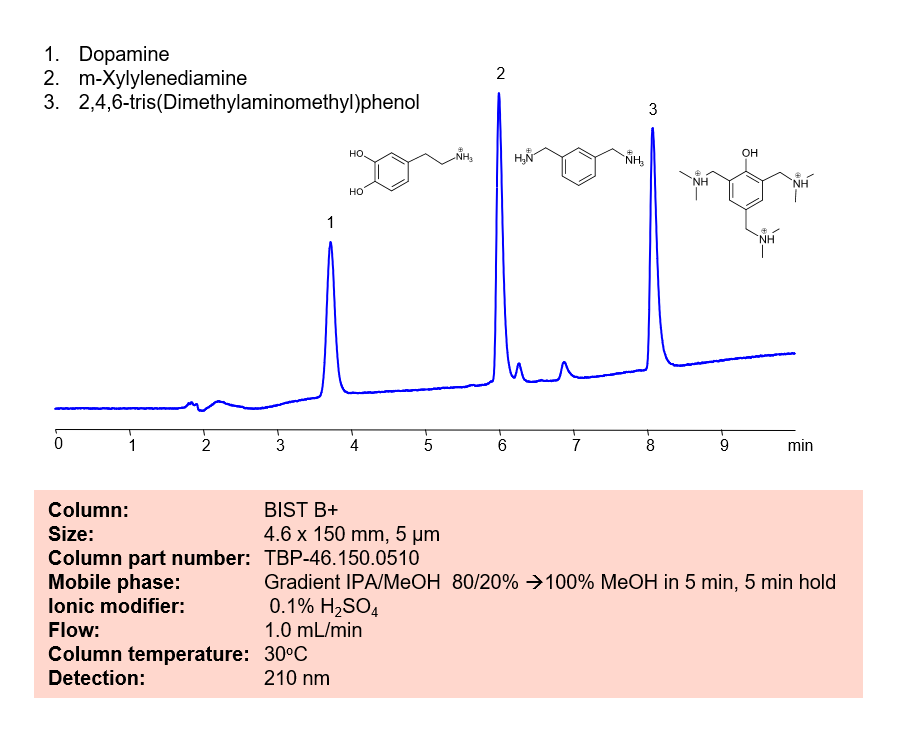
Dopamine is a key neurotransmitter and medical stimulant used to treat low blood pressure, low heart rate, and heart attacks. m-Xylylenediamine (MXDA) is a popular curing agent used on epoxy resins. 2,4,6-Tris(dimethylaminomethyl)phenol is another amine-based curing agent used on epoxy resins. Using SIELC’s newly introduced BIST method, these 3 amines can be retained on a positively-charged anion-exchange BIST B+ column. There are two keys to this retention method: 1) a multi-charged, negative buffer, such as Sulfuric acid (H2SO4), which acts as a bridge, linking the positively-charged analytes to the positively-charged column surface and 2) a mobile phase consisting mostly of less polar organic solvent (such as IPA) to minimize the formation of a solvation layer around the charged analytes. This method uses an entirely non-aqueous mobile phase to drive BIST retention. The gradient starts with a high concentration of the less polar IPA to generate the initial BIST retention and progresses to the more polar MeOH to elute the longer-retaining amines in a reasonable time. Using this new and unique analysis method, these 3 amines can be retained and UV detected at 210 nm.
High Performance Liquid Chromatography (HPLC) Method for Analysis of of Amines in Non Aqueous MP
Condition
| Column | BIST B+, 4.6 x 150 mm, 5 µm, 100 A, dual ended |
| Mobile Phase | Gradient IPA/MeOH- 80/20% to 100% MeOH, 5 min , 5 min hold |
| Buffer | H2SO4 – 0.2% |
| Flow Rate | 1.0 ml/min |
| Detection | UV 210 nm |
| Peak Retention Time | 3.52 min, 6.12 min, 8.57 min |
Description
| Class of Compounds | Amines |
| Analyzing Compounds | Dopamine, m-Xylylenediamine, 2,4,6-Tris(dimethylaminomethyl)phenol |
Application Column
BIST B+
Column Diameter: 4.6 mm
Column Length: 150 mm
Particle Size: 5 µm
Pore Size: 100 A
Column options: dual ended
Dopamine
m-Xylylenediamine
HPLC Method For Analysis Of Dopamine and Serotonin on Primesep 200 Column
March 25, 2022
HPLC Method for Dopamine, Serotonin on Primesep 200 by SIELC Technologies
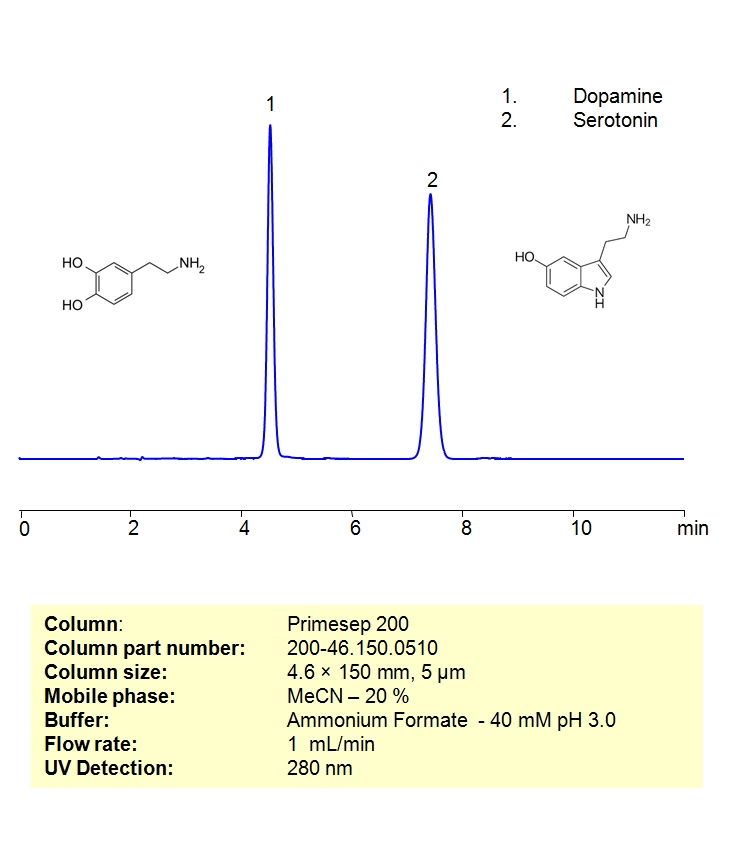
High Performance Liquid Chromatography (HPLC) Method for Analysis of Dopamine, Serotonin.
Dopamine is a neurotransmitter with the chemical formula C8H11NO2. It is released during pleasurable activities, reinforcing those behaviors, and motivating people to continue seeking them out. Dopamine influences the release of other hormones. A deficiency of it can influence movement and lead to conditions like Parkinson’s disease. You can find detailed UV spectra of Dopamine and information about its various lambda maxima by visiting the following link.
Serotonin is a neurotransmitter derived from tryptophan with the chemical formula C₁₀H₁₂N₂O. Serotonin is a chemical messenger that is crucial for bodily functions. It helps regulate mood and reduce anxiety, digestion, blood clotting, and contributes to the sleep-wake cycle. Low serotonin levels are often associated with a variety of mental illnesses including but not limited to Obsessive Compulsive Disorder (OCD), Post-Traumatic Stress Disorder (PTSD), Depression, and Anxiety. You can find detailed UV spectra of Serotonin and information about its various lambda maxima by visiting the following link.
Dopamine, Serotonin can be retained and analyzed using the Primesep 200 stationary phase column. The analysis utilizes an isocratic method with a simple mobile phase consisting of water and acetonitrile (MeCN) with an ammonium formate buffer. Detection is performed using UV.
| Column | Primesep 200, 4.6×150 mm, 5 µm, 100A |
| Mobile Phase | MeCN/H2O – 20/80% |
| Buffer | Ammonium Formate pH 3.0 – 40 mM |
| Flow Rate | 1.0 ml/min |
| Detection | UV, 280 nm, |
| Class of Compounds |
Neurotransmitters |
| Analyzing Compounds | Dopamine, Serotonin |
Application Column
Primesep 200
Column Diameter: 4.6 mm
Column Length: 150 mm
Particle Size: 5 µm
Pore Size: 100 A
Column options: dual ended
Serotonin
HPLC Separation of Catecholamines on Newcrom AH Column
May 20, 2021
HPLC Method for Dopamine, Epinephrine, Norepinephrine on Newcrom AH by SIELC Technologies
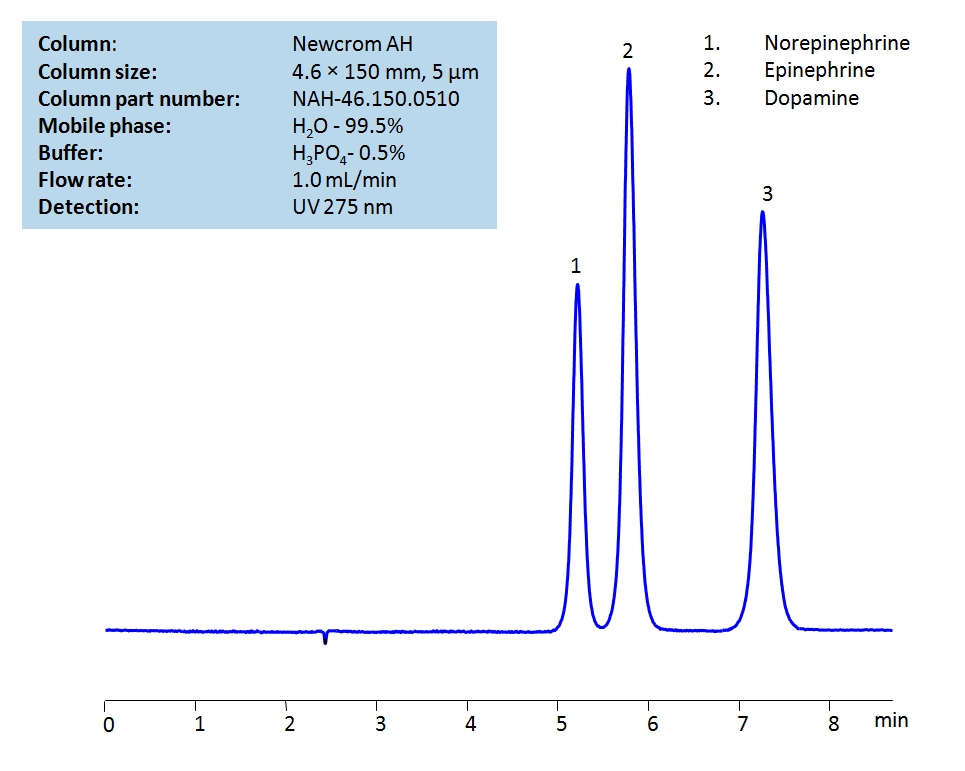

High Performance Liquid Chromatography (HPLC) Method for Analysis of Dopamine, Epinephrine, Norepinephrine.
Catecholamines are neurotransmitters that generate the ‘fight-or-flight’ responsein the body. The 3 main catecholamines are epinephrine (also known as adrenaline), norepinephrine, and dopamine, and they are produced by the adrenal glands.
Norepinephrine, also known as noradrenaline and noradrenalin, is a catecholamine with the chemical formula C8H11NO3. It functions as a hormone, neurotransmitter, and neuromodulator responsible for improving alertness, focus, memory, and regulating mood. You can find detailed UV spectra of Norepinephrine and information about its various lambda maxima by visiting the following link.
Epinephrine, also known as adrenaline or adrenalin, is a a hormone and medication with the chemical formula C9H13NO3. As a hormone, it is involved in regulating involuntary operations of nearly all internal organs. As a medication, it is used to treat allergic reaction anaphylaxis and cardiac arrest. When other treatments are not effective, it is occasionally used to treat asthma. You can find detailed UV spectra of Epinephrine and information about its various lambda maxima by visiting the following link.
Dopamine is a neurotransmitter with the chemical formula C8H11NO2. It is released during pleasurable activities, reinforcing those behaviors, and motivating people to continue seeking them out. Dopamine influences the release of other hormones. A deficiency of it can influence movement and lead to conditions like Parkinson’s disease. You can find detailed UV spectra of Dopamine and information about its various lambda maxima by visiting the following link.
Dopamine, Epinephrine, Norepinephrine can be detected in the low UV regime. Using a Newcrom AH mixed-mode column and a mobile phase consisting of almost entirely water with either a phosphoric (H3PO4) acid or ammonium formate (AmFm) buffer, the catecholamines can be retained, separated, and measured. This analysis method can be UV detected at 275 nm with high resolution. The latter mobile phase (utilizing AmFm) is compatible with Mass Spectrometry.
| Column | Newcrom AH, 4.6 x 150 mm, 5 µm, 100 A, dual ended |
| Mobile Phase | H2O |
| Buffer | H3PO4 or AmFm pH 3.0 |
| Flow Rate | 1.0 ml/min |
| Detection | UV, 275 nm |
| Class of Compounds |
Drug, Acid, Hydrophilic, Ionizable, Hormone |
| Analyzing Compounds | Dopamine, Epinephrine, Norepinephrine |
Application Column
Newcrom AH
Column Diameter: 4.6 mm
Column Length: 150 mm
Particle Size: 5 µm
Pore Size: 100 A
Column options: dual ended
Epinephrine
Norepinephrine
HPLC Determination of Dopamine in Human Plasma Sample
May 10, 2019
HPLC Method for Dopamine on Primesep 200 by SIELC Technologies
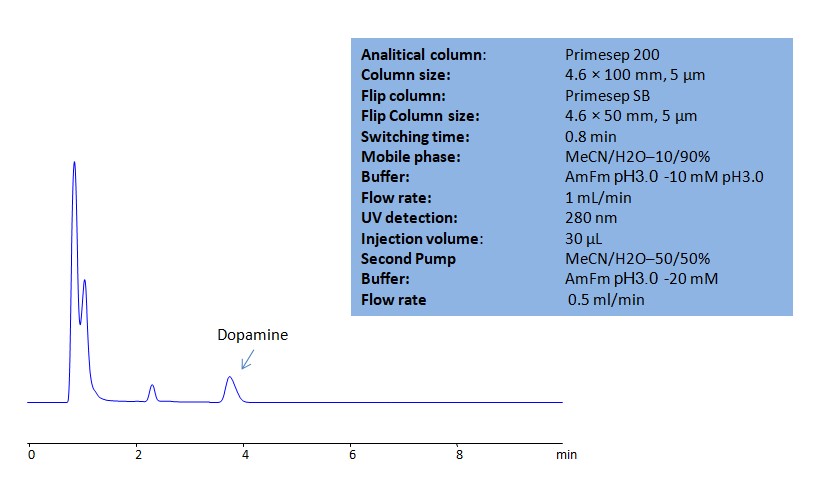
High Performance Liquid Chromatography (HPLC) Method for Analysis of Dopamine.
Dopamine is a neurotransmitter with the chemical formula C8H11NO2. It is released during pleasurable activities, reinforcing those behaviors, and motivating people to continue seeking them out. Dopamine influences the release of other hormones. A deficiency of it can influence movement and lead to conditions like Parkinson’s disease.
FlipLC™ is an alternative method to avoid the interference of most of the contaminants by the use of an isolation column and a high pressure switching valve before the separation column. This method allows sample cleaning and analyte separation in one automated process. The isolation column and the separation column should have orthogonal retention characteristics to operate efficiently in this setup. Mixed-mode columns with reverse phase and ion-exchange characteristics were used in this analysis.
Application Column
Primesep 200
The Primesep family of mixed-mode columns offers a wide variety of stationary phases, boasting unprecedented selectivity in the separation of a broad array of chemical compounds across multiple applications. Corresponding Primesep guard columns, available with all stationary phases, do not require holders. SIELC provides a method development service available to all customers. Inquire about our specially-tailored custom LC-phases for specific separations.
Select options
Primesep SB
The Primesep family of mixed-mode columns offers a wide variety of stationary phases, boasting unprecedented selectivity in the separation of a broad array of chemical compounds across multiple applications. Corresponding Primesep guard columns, available with all stationary phases, do not require holders. SIELC provides a method development service available to all customers. Inquire about our specially-tailored custom LC-phases for specific separations.
Select options
HPLC Determination of Dopamine in Serum
May 6, 2019
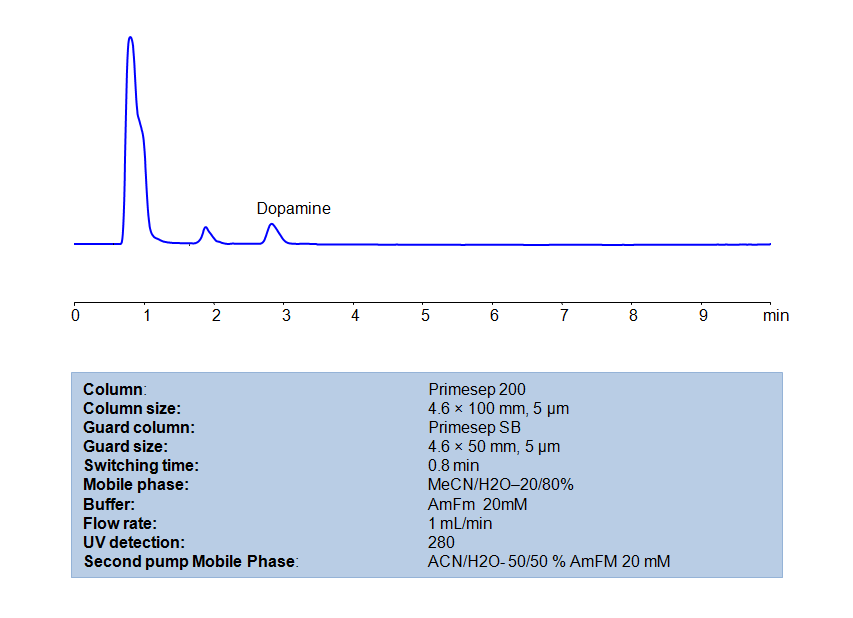
High Performance Liquid Chromatography (HPLC) Method for Analysis of Dopamine.
Dopamine is a neurotransmitter with the chemical formula C8H11NO2. It is released during pleasurable activities, reinforcing those behaviors, and motivating people to continue seeking them out. Dopamine influences the release of other hormones. A deficiency of it can influence movement and lead to conditions like Parkinson’s disease.
FlipLC™ is an alternative method to avoid the interference of most of the contaminants by the use of an isolation column and a high pressure switching valve before the separation column. This method allows sample cleaning and analyte separation in one automated process. The isolation column and the separation column should have orthogonal retention characteristics to operate efficiently in this setup. Mixed-mode columns with reverse phase and ion-exchange characteristics were used in this analysis.
| Column | Primesep 200, 4.6×150 mm, 5 µm, 100A
Primesep SB, 4.6*50 mm, 5 µm, 100A |
| Mobile Phase | MeCN/H2O |
| Buffer | AmFm pH 3.0 |
| Flow Rate | 1.0 ml/min |
| Detection | UV, 280 nm |
| Class of Compounds |
Drug, Hydrophilic, Ionizable, Hormone |
| Analyzing Compounds | Dopamine |
Application Column
Primesep 200
The Primesep family of mixed-mode columns offers a wide variety of stationary phases, boasting unprecedented selectivity in the separation of a broad array of chemical compounds across multiple applications. Corresponding Primesep guard columns, available with all stationary phases, do not require holders. SIELC provides a method development service available to all customers. Inquire about our specially-tailored custom LC-phases for specific separations.
Select options
Primesep SB
The Primesep family of mixed-mode columns offers a wide variety of stationary phases, boasting unprecedented selectivity in the separation of a broad array of chemical compounds across multiple applications. Corresponding Primesep guard columns, available with all stationary phases, do not require holders. SIELC provides a method development service available to all customers. Inquire about our specially-tailored custom LC-phases for specific separations.
Select options
HPLC Separation of DOPAC, Homovanillic Acid and Dopamine on the Primesep 100 Column
July 10, 2012
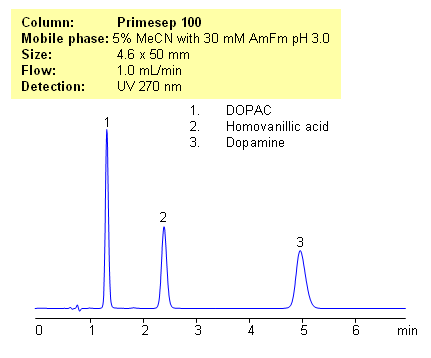
Application Notes: Neurotransmitters DOPAC, homovanillic acid and dopamine were separated by mixed-mode chromatography on Primesep 100 and Primesep 200 HPLC columns. The method can be used for quantification of neurotransmitters with LC/MS compatible conditions. The compounds are retained by combination of reversed-phase, ion-exchange or ion-exclusion mechanisms. The retention time and selectivity of separation can be adjusted by variation of amount of acetonitrile, buffer pH and buffer concentration.
Application Columns: Primesep 100
Application compounds: Dopac, Homovanillic Acid, Dopamine
Detection technique: UV, LC/MS, ELSD/CAD
| Column | Primesep 100, 4.6×50 mm, 5 µm, 100A |
| Mobile Phase | MeCN/H2O – 5/95% |
| Buffer | AmFm pH 3.0- 30 mM |
| Flow Rate | 1.0 ml/min |
| Detection | UV, 270 nm |
| Class of Compounds |
Drug, Acid, Monocarboxylic acid, Hydrophilic, Ionizable, Hormone |
| Analyzing Compounds | DOPAC, Homovanillic Acid, Dopamine |
Application Column
Primesep 100
The Primesep family of mixed-mode columns offers a wide variety of stationary phases, boasting unprecedented selectivity in the separation of a broad array of chemical compounds across multiple applications. Corresponding Primesep guard columns, available with all stationary phases, do not require holders. SIELC provides a method development service available to all customers. Inquire about our specially-tailored custom LC-phases for specific separations.
Select options
Primesep 200
The Primesep family of mixed-mode columns offers a wide variety of stationary phases, boasting unprecedented selectivity in the separation of a broad array of chemical compounds across multiple applications. Corresponding Primesep guard columns, available with all stationary phases, do not require holders. SIELC provides a method development service available to all customers. Inquire about our specially-tailored custom LC-phases for specific separations.
Select optionsDopamine
Homovanillic Acid
HPLC Separation of DOPAC, Homovanillic Acid in Dopamine on the Primesep 200 Column
July 10, 2012
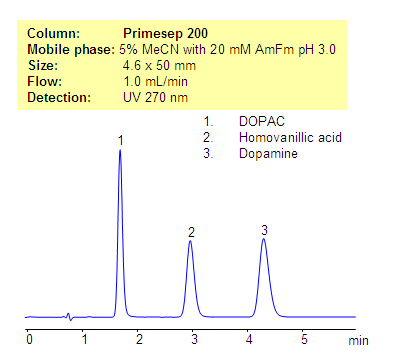
Application Notes: Neurotransmitters DOPAC, homovanillic acid and dopamine were separated by mixed-mode chromatography on Primesep 100 and Primesep 200 HPLC columns. The method can be used for quantification of neurotransmitters with LC/MS compatible conditions. The compounds are retained by combination of reversed-phase, ion-exchange or ion-exclusion mechanisms. The retention time and selectivity of separation can be adjusted by variation of amount of acetonitrile, buffer pH and buffer concentration.
Application Columns: Primesep 100, Primesep 200
Application compounds: Dopac, Homovanillic Acid, Dopamine
Detection technique: UV, LC/MS, ELSD/CAD
| Column | Primesep 200, 4.6×50 mm, 5 µm, 100A |
| Mobile Phase | MeCN/H2O – 5/95% |
| Buffer | AmFm pH 3.0- 30 mM |
| Flow Rate | 1.0 ml/min |
| Detection | UV, 270 nm |
| Class of Compounds |
Drug, Acid, Monocarboxylic acid, Hydrophilic, Ionizable, Hormone |
| Analyzing Compounds | DOPAC, Homovanillic Acid, Dopamine |
Application Column
Primesep 200
Column Diameter: 4.6 mm
Column Length: 50 mm
Particle Size: 5 µm
Pore Size: 100 A
Column options: dual ended
Dopamine
Homovanillic Acid
USP Analysis of Dopamine Using a Legacy L1 column
June 21, 2012
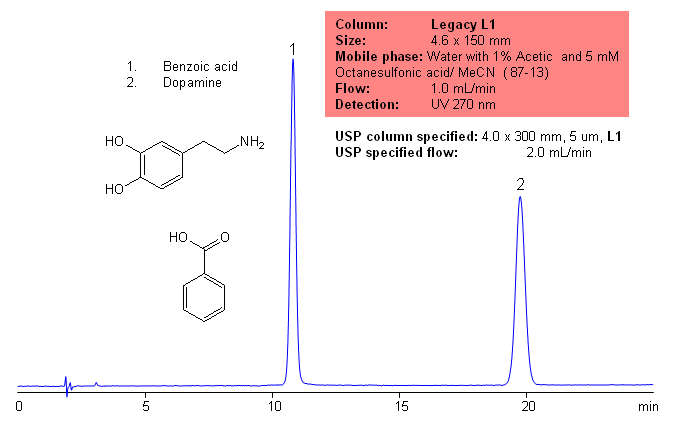
Application Notes: Dopamine is a naturally occurring neurotransmitter found in the brain. Dopamine is a well studied compound because dopamine is an important neurotransmitter known to regulate many functions from pain response to behavior disorders. According to USP methods, dopamine hydrochloride contains not less than 98% and not more than 102% dopamine hydrochloride calculated on the dried basis. The USP HPLC method for the separation of hydrocortisone was developed on Legacy L1 column according to the US Pharmacopeia methodology. L1 classification is assigned to reversed-phase HPLC column containing C18 ligand. Support for the material is spherical silica gel with particles size 3-10 um and pore size of 100-120A. Resolution between critical pairs corresponds to rules and specifications of USP.
Application Columns: Legacy L1 C18 HPLC column
Application compounds: Dopamine hydrochloride
Mobile phase: Water with 1% acetic and 5mM octanesulfonic acid/MeCN
Detection technique: UV
Reference: USP35: NF30
| Column | Legacy L1, 4.6×150 mm, 5 µm, 100A |
| Mobile Phase | Water with 1% Acetic and 5 mM Octanesulfonic acid/ MeCN ( 87-13) |
| Flow Rate | 1.0 ml/min |
| Detection | UV, 270 nm |
| Class of Compounds |
Drug, Hydrophilic, Ionizable, Hormone, Acid |
| Analyzing Compounds | Dopamine |
Application Column
Legacy L1
SIELC's family of Legacy columns is based on the United States Pharmacopeia's (USP) published chromatographic methods and procedures. Numerous brands have columns used in USP reference standards and methods. USP has created various designations to group together columns with similar types of packing and properties in the solid phase. SIELC's Legacy columns adhere to these strict requirements and properties, allowing you to easily replace older columns that are no longer available without needing to significantly modify your method or SOPs.
Select optionsDopamine
HPLC Separation of Homovanillic Acid, Dopamine, and DOPAC using Hydrogen Bonding
June 18, 2012
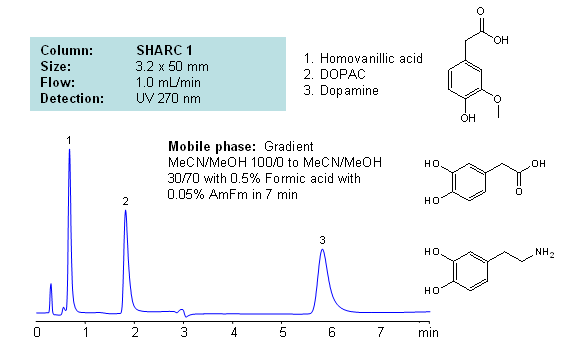
| Column | Sharc 1, 3.2×50 mm, 5 µm, 100A |
| Mobile Phase | Gradient MeCN/MeOH – 100/0 – 30/70% |
| Buffer | Formic Acid – 0.5% AmFm 0.05% 7 min |
| Flow Rate | 1.0 ml/min |
| Detection | UV, 270 nm |
| Class of Compounds |
Drug, Acid, Monocarboxylic acid, Hydrophilic, Ionizable, Hormone |
| Analyzing Compounds | DOPAC, Homovanillic Acid, Dopamine |
Application Column
SHARC 1
The SHARC™ family of innovative columns represents the first commercially available columns primarily utilizing separation based on hydrogen bonding. SHARC stands for Specific Hydrogen-bond Adsorption Resolution Column. Hydrogen bonding involves an interaction or attraction between a bound hydrogen atom and molecules containing electronegative atoms, such as oxygen, nitrogen, and fluorine.
Select optionsDopamine
Homovanillic Acid
HPLC Separation of Dopamine and Epinephrine in HILIC and Cation-Exchange Modes
July 14, 2011
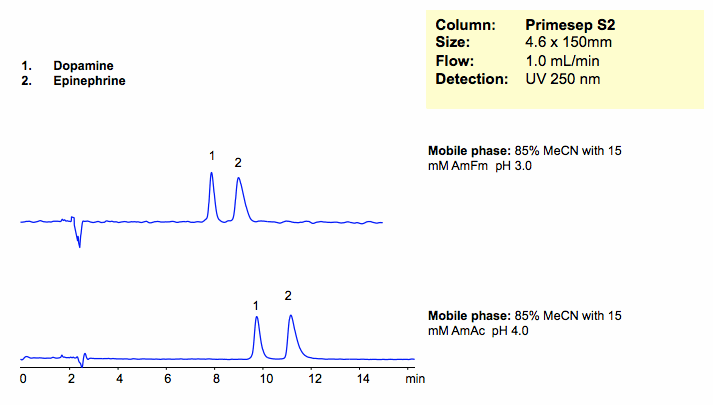
Dopamine and epinephrine were separated on a Primesep S2 HILIC mixed-mode column. Dopamine and epinephrine are retained by HILIC and cation-exchange mechanisms. Retention time is controlled by the amount of ACN, buffer and buffer pH. Method is compatible with LC/MS and can be used for analysis of polar metabolites in biofluids.
| Column | Primesep S2, 4.6×150 mm, 5 µm, 100A |
| Mobile Phase | MeCN/H2O |
| Buffer | AmFm |
| Flow Rate | 1.0 ml/min |
| Detection | UV, 250 nm |
| Class of Compounds |
Drug, Acid, Monocarboxylic acid, Hydrophilic, Ionizable, Hormone |
| Analyzing Compounds | Dopamine, Epinephrine |
Application Column
Primesep S2
The Primesep family of mixed-mode columns offers a wide variety of stationary phases, boasting unprecedented selectivity in the separation of a broad array of chemical compounds across multiple applications. Corresponding Primesep guard columns, available with all stationary phases, do not require holders. SIELC provides a method development service available to all customers. Inquire about our specially-tailored custom LC-phases for specific separations.
Select optionsEpinephrine
HPLC Separation of Catecholamines on Primesep 100 Column with Phosphate Buffers
July 8, 2011
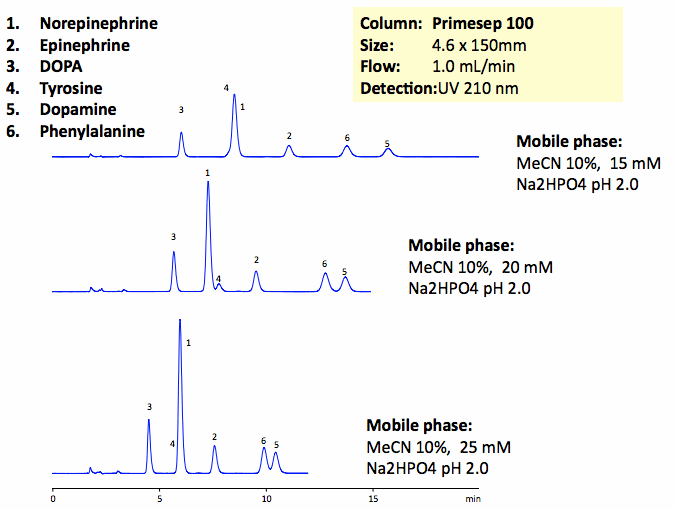
The catecholamine neurotransmitters are amino-acid derivatives of tyrosine. DOPA, tyrosine, phenylalanine, norepinephrine, epinephrine, and dopamine and baseline are resolved on a Primesep 100 column with UV-transparent phosphate buffer. This method can be used for analysis of catecholamines and related impurities in various matrices. Peak order and retention time can be changed by changing the amount of ACN, buffer concentration and buffer pH. Various buffers can be used to accommodate desired detection technique. Primesep 100 is a reversed-phase cation-exchange mixed-mode column that can be used for analysis of polar neutral, polar ionizable, polar zwitter-ionic, hydrophobic neutral, and hydrophobic ionic compounds in the same run. Column can be operated in reverse-phase, cation-exchange, anion-exclusion, HILIC and mixed-modes depending on the mobile phase selection and nature of analytes. Column is compatible with LC/MS and does not require use of ion-pairing reagents.
| Column | Primesep 100, 4.6×150 mm, 5 µm, 100A |
| Mobile Phase | MeCN/H2O |
| Buffer | Na2HPO4 |
| Flow Rate | 1.0 ml/min |
| Detection | UV, 210 nm |
| Class of Compounds |
Drug, Acid, Hydrophilic, Ionizable, Hormone |
| Analyzing Compounds | Tyrosine, DOPA, Phenylalanine, Norepinephrine, Epinephrine, Dopamine |
Application Column
Primesep 100
The Primesep family of mixed-mode columns offers a wide variety of stationary phases, boasting unprecedented selectivity in the separation of a broad array of chemical compounds across multiple applications. Corresponding Primesep guard columns, available with all stationary phases, do not require holders. SIELC provides a method development service available to all customers. Inquire about our specially-tailored custom LC-phases for specific separations.
Select optionsDopamine
Epinephrine
Norepinephrine
Phenylalanine
Tyrosine
HPLC Analysis of Polar Basic and Acetic Compounds on Primesep AB Column
May 6, 2010
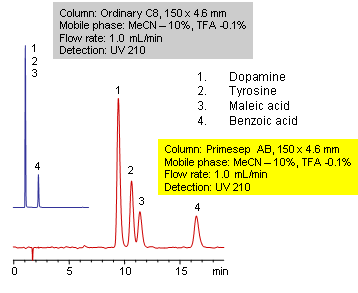
Mixture of polar acidic and basic compounds is separated on a Primesep AB mixed-mode HPLC column. Dopamine and tyrosine are retained by combination of reversed-phase and cation-exchange mechanisms. Maleic acid is retained by anion-exchange mechanism, and benzoic acid is retained by reversed-phase mechanism. Primesep AB is a trimodal column with a C12 hydrophobic chain and cation-exchange and anion exchange groups on the surface. Method utilizes UV detection but can be used with other detection techniques (ELSD, LC/MS, Corona).
| Column | Primesep AB, 4.6×150 mm, 5 µm, 100A |
| Mobile Phase | MeCN/H2O |
| Buffer | TFA – 0.1% |
| Flow Rate | 1.0 ml/min |
| Detection | UV, 210 nm |
| Class of Compounds |
Drug, Acid, Monocarboxylic acid, Hydrophilic, Ionizable, Hormone |
| Analyzing Compounds | Tyrosine, Dopamine, Maleic Acid, Benzoic Acid |
Application Column
Primesep AB
The Primesep family of mixed-mode columns offers a wide variety of stationary phases, boasting unprecedented selectivity in the separation of a broad array of chemical compounds across multiple applications. Corresponding Primesep guard columns, available with all stationary phases, do not require holders. SIELC provides a method development service available to all customers. Inquire about our specially-tailored custom LC-phases for specific separations.
Select optionsDopamine
Maleic Acid
Tyrosine
HPLC Separation of Polar Compounds
January 13, 2010
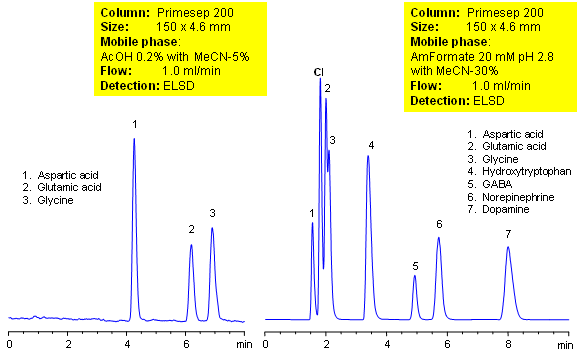
The separation of amino acids, the building blocks of proteins, can be challenging to separate on a reverse-phase column due to their high polarity. Using a mixed-mode HPLC column, allows the separation of amino acids by cation-exchange and ion-exclusion mechanisms as well as hydrophobicity. Fine tuning of separation can be achieved with changes in organic concentration of the mobile phase as well as choice of buffer and pH.
| Column | Primesep 200, 4.6×150 mm, 5 µm, 100A |
| Mobile Phase | MeCN/H2O |
| Buffer | AcOH, AmFm |
| Flow Rate | 1.0 ml/min |
| Detection | ELSD |
| Class of Compounds |
Drug, Acid, Hydrophilic, Ionizable, Hormone |
| Analyzing Compounds | Aspartic acid, Glutaric acid, Glycine, Hydroxytriptophan, GABA, Norepinephrine, Dopamine |
Application Column
Primesep 200
The Primesep family of mixed-mode columns offers a wide variety of stationary phases, boasting unprecedented selectivity in the separation of a broad array of chemical compounds across multiple applications. Corresponding Primesep guard columns, available with all stationary phases, do not require holders. SIELC provides a method development service available to all customers. Inquire about our specially-tailored custom LC-phases for specific separations.
Select optionsAspartic Acid
Dopamine
Glutamic Acid
Norepinephrine
gamma-Aminobutyric Acid (GABA)
Separation of Serotonin, Dopamine, and Related Compounds
August 22, 2008
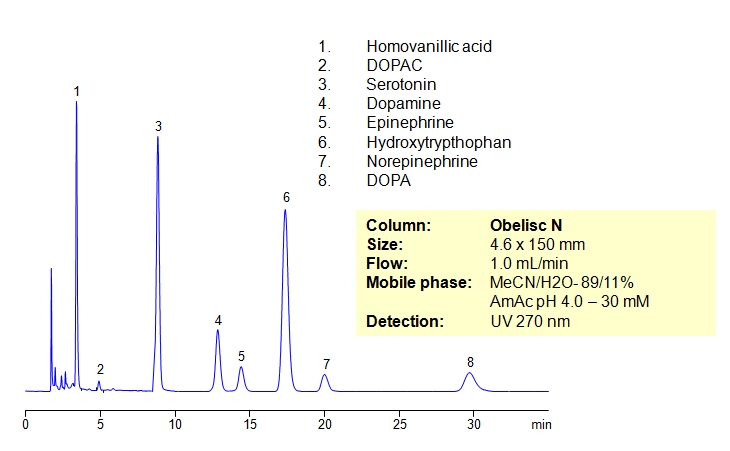
Catecholamines are chemical compounds derived from the amino acid tyrosine containing catechol and amine groups. Some of them are biogenic amines. Retention of compounds of the catecholamine pathway is achieved on Obelisc N column. All polar compounds are well retained by combination of HILIC and ion-exchange mechanisms. Obelisc N columns produce very good peak shapes for all analytes. The method is very sensitive to amount of ACN, buffer and buffer pH. The retention time changes with variation of the main parameters. This method can be used for quantitation of biogenic amines and related compounds (homovanillic acid, dihydroxyphenyl acetic acid, serotonin, dopamine, epinephrine, hydroxytryptophan, epinephrine and DOPA) in urine, blood and other biological fluids. Further optimization of this HPLC method can be used during screening and validation. Amines and acids can be analyzed in the same run and retained by a combination of polar organic mode, cation-exchange and anion-exchange modes. Various buffers within specified pH can be employed (ammonium formate, ammonium acetate, sodium phosphate, etc.).
| Column | Obelisc N, 4.6×150 mm, 5 µm, 100A |
| Mobile Phase | MeCN/H2O |
| Buffer | AmAc pH 4.0- 30 mM |
| Flow Rate | 1.0 ml/min |
| Detection | UV, 270 nm |
| Class of Compounds |
Drug, Acid, Monocarboxylic acid, Hydrophilic, Ionizable, Hormone |
| Analyzing Compounds | Homovanillic acid, Dihydroxyphenyl acetic acid, Serotonin, Dopamine, Epinephrine, Hydroxytryptophan, DOPA |
Application Column
Obelisc N
SIELC has developed the Obelisc™ columns, which are mixed-mode and utilize Liquid Separation Cell technology (LiSC™). These cost-effective columns are the first of their kind to be commercially available and can replace multiple HPLC columns, including reversed-phase (RP), AQ-type reversed-phase, polar-embedded group RP columns, normal-phase, cation-exchange, anion-exchange, ion-exclusion, and HILIC (Hydrophilic Interaction Liquid Chromatography) columns. By controlling just three orthogonal method parameters - buffer concentration, buffer pH, and organic modifier concentration - users can adjust the column properties with pinpoint precision to separate complex mixtures.
Select optionsDOPAC (Dihydroxyphenylacetic Acid)
Dopamine
Epinephrine
Homovanillic Acid
Hydroxytryptophan
Norepinephrine
Serotonin
HPLC Separation of Polar and Hydrophobic Drugs on Obelisc R
March 3, 2007
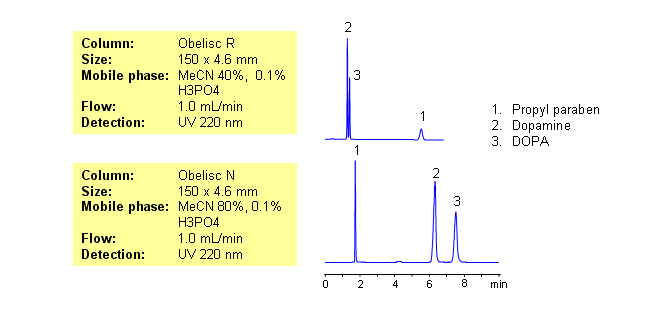
| Column | Obelisc R, 4.6 x 150 mm, 5 µm, 100 A, dual ended |
| Mobile Phase | MeCN/H2O – 40/60% |
| Buffer | H3PO4 – 0.1% |
| Flow Rate | 1.0 ml/min |
| Detection | UV, 220 nm |
| Class of Compounds |
Drug, Acid, Preservative, Hydrophilic, Ionizable, Hormone |
| Analyzing Compounds | Propyl paraben, Dopamine, DOPA |
Application Column
Obelisc R
Column Diameter: 4.6 mm
Column Length: 150 mm
Particle Size: 5 µm
Pore Size: 100 A
Column options: dual ended
Dopamine
Propylparaben
HPLC Separation of Compounds of Catecholamine Pathway
March 3, 2006
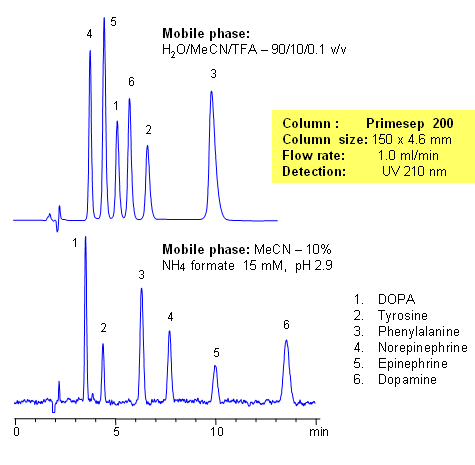
The catecholamine neurotransmitters are amino-acid derivatives of tyrosine. DOPA, tyrosine, phenylalanine, norepinephrine, epinephrine, and dopamine and baseline are resolved on a
Primesep 200 column with UV-transparent phosphate buffer. This method can be used for the analysis of catecholamines and related impurities in various matrices. The peak order and retention time can be changed by changing the amount of ACN, buffer concentration and buffer pH. Various buffers can be used to accommodate the desired detection technique. Primesep 200 is a reversed-phase cation-exchange mixed-mode column that can be used for analysis of polar neutral, polar ionizable, polar zwitterionic, hydrophobic neutral, and hydrophobic ionic compounds in the same run. Column can be operated in reverse-phase, cation-exchange, anion-exclusion, HILIC and mixed-modes depending on the mobile phase selection and the nature of the analytes. The column is compatible with LC/MS and does not require the use of ion-pairing reagents.
| Column | Primesep 200, 4.6×150 mm, 5 µm, 100A |
| Mobile Phase | MeCN/H2O |
| Buffer | TFA, AmFm |
| Flow Rate | 1.0 ml/min |
| Detection | UV, 210 nm |
| Class of Compounds |
Drug, Acid, Hydrophilic, Ionizable, Hormone |
| Analyzing Compounds | Tyrosine, DOPA, Phenylalanine, Norepinephrine, Epinephrine, Dopamine |
Application Column
Primesep 200
The Primesep family of mixed-mode columns offers a wide variety of stationary phases, boasting unprecedented selectivity in the separation of a broad array of chemical compounds across multiple applications. Corresponding Primesep guard columns, available with all stationary phases, do not require holders. SIELC provides a method development service available to all customers. Inquire about our specially-tailored custom LC-phases for specific separations.
Select optionsDopamine
Epinephrine
Phenylalanine
Tyrosine
UV Detection
HPLC Separation of Polar and Hydrophobic Drugs on Obelisc N Cloumn
June 11, 2004
| Column | Obelisc N, 4.6 x 150 mm, 5 µm, 100 A, dual ended |
| Mobile Phase | MeCN/H2O – 80/20% |
| Buffer | H3PO4 – 0.1% |
| Flow Rate | 1.0 ml/min |
| Detection | UV, 220 nm |
| Class of Compounds |
Drug, Acid, Preservative, Hydrophilic, Ionizable, Hormone |
| Analyzing Compounds | Propyl paraben, Dopamine, DOPA |
Application Column
Obelisc N
Column Diameter: 4.6 mm
Column Length: 150 mm
Particle Size: 5 µm
Pore Size: 100 A
Column options: dual ended
Dopamine
Propylparaben
HPLC Separation of Neurotransmitters on Primesep P
June 5, 2004
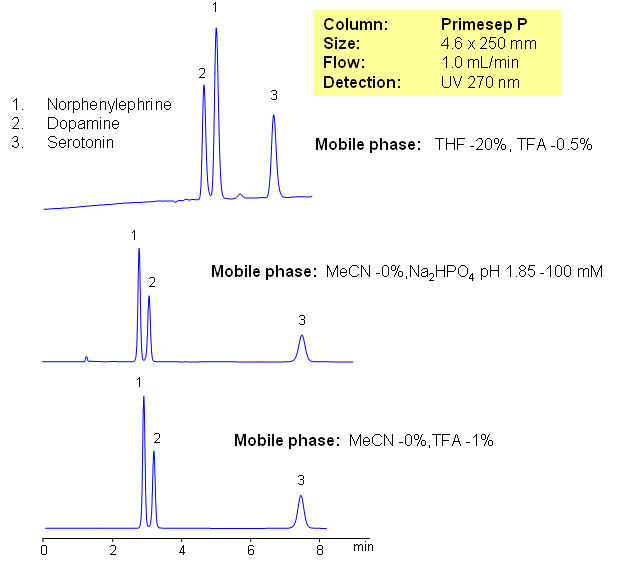
Dopamine, norphenylephrine and serotonin are separated on Primesep P HPLC column. Base line separation of these neurotransmitters can be achieved using mix-mode approach. Primesep P provides retention by reverse phase, pi-pi and cation-exchange mechanisms. Method can be used for fast quantitation of these compounds in various sample matrices. Detection technique ranges from UV to ELSD, LC/MS, RI and CAD. Primesep P column can be used with tetrahydrofuran or with 100% aqueous mobile phase to enhance pi-pi interaction.
Application Column
Primesep P
Column Diameter: 4.6 mm
Column Length: 250 mm
Particle Size: 5 µm
Pore Size: 100 A
Column options: dual ended
Norphenylephrine
Serotonin
HPLC Analysis of the Catecholamine Pathway
January 17, 2004
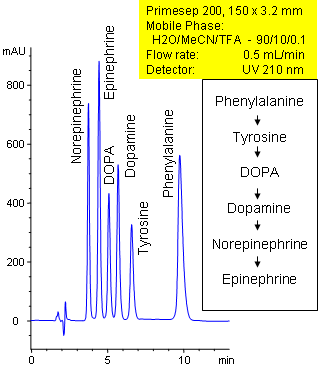
Primesep 200 separates catecholamines in the catecholamine pathway in 10 minutes. Phenylalanine, tyrosine, DOPA, dopamine, norepinephrine, and epinephrine are baseline resolved by a combination of reversed-phase, ion-exchange, and ion-exclusion mechanisms. Excellent peak shape results with a mass spec compatible mobile phase of water, acetonitrile (MeCN, ACN) and trifluoracetic acid (TFA) with UV detection at 210 nm.
| Column | Primesep 200, 3.2×150 mm, 5 µm, 100A |
| Mobile Phase | MeCN/H2O – 10/90% |
| Buffer | TFA – 0.1% |
| Flow Rate | 0.5 ml/min |
| Detection | UV, 210 nm |
| Class of Compounds |
Drug, Acid, Hydrophilic, Ionizable, Hormone |
| Analyzing Compounds | Tyrosine, DOPA, Phenylalanine, Norepinephrine, Epinephrine, Dopamine |
Application Column
Primesep 200
The Primesep family of mixed-mode columns offers a wide variety of stationary phases, boasting unprecedented selectivity in the separation of a broad array of chemical compounds across multiple applications. Corresponding Primesep guard columns, available with all stationary phases, do not require holders. SIELC provides a method development service available to all customers. Inquire about our specially-tailored custom LC-phases for specific separations.
Select optionsDopamine
Epinephrine
Phenylalanine
Tyrosine
HPLC Separation of Catecholamines
January 8, 2004
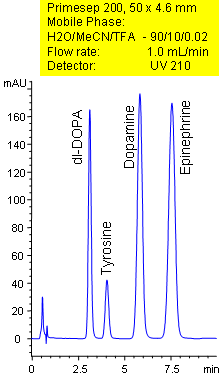
Primesep 200 separates catecholamines in less than 8 minutes. Tyrosine, dl-DOPA, dopamine, epinephrine are baseline resolved by a combination of reversed-phase, ion-exchange, and ion-exclusion mechanisms. Excellent peak shape results with a mass spec compatible mobile phase of water, acetonitrile (MeCN, ACN) and trifluoracetic acid (TFA) with UV detection at 210 nm.
| Column | Primesep 200,4.6×50 mm, 5 µm, 100A |
| Mobile Phase | MeCN/H2O |
| Buffer | TFA |
| Flow Rate | 1.0 ml/min |
| Detection | UV, 210 nm |
| Class of Compounds |
Drug, Acid, Hydrophilic, Ionizable, Hormone |
| Analyzing Compounds | Tyrosine, DOPA, Epinephrine, Dopamine |
Application Column
Primesep 200
The Primesep family of mixed-mode columns offers a wide variety of stationary phases, boasting unprecedented selectivity in the separation of a broad array of chemical compounds across multiple applications. Corresponding Primesep guard columns, available with all stationary phases, do not require holders. SIELC provides a method development service available to all customers. Inquire about our specially-tailored custom LC-phases for specific separations.
Select optionsEpinephrine
